


Why the latest Jones Lang LaSalle earnings matter for shareholders
Jones Lang LaSalle (JLL) just released third quarter and nine month earnings on 28 October 2026, highlighting higher sales, net income and earnings per share compared with the same periods a year earlier.
Investors have responded quickly to the Jones Lang LaSalle update, with a 1 day share price return of 5.42% and a 7 day share price return of 26.17%. That recent momentum sits on top of a 1 year total shareholder return of 26.40% and a very large 3 year total shareholder return that points to a stock where enthusiasm has been building rather than fading.
Scan how Jones Lang LaSalle’s earnings surge compares with 19 high quality undiscovered gems that have been quietly posting strong fundamentals away from the headlines.
After a 26% move in a week and Jones Lang LaSalle now at $379.29 against analyst targets near $411 and a larger implied intrinsic value gap, where does a fair price really sit in that spread?
Most Popular Narrative: 9% Undervalued
Against the $379.29 close, the most followed narrative tags Jones Lang LaSalle with a fair value of about $416.70, which highlights a valuation gap built on recurring fees, capital markets recovery and heavy use of data tools rather than just a hot share price chart.
Continued investment in artificial intelligence, data technology and unified global operating platforms, now reflected in daily AI usage by about 25,000 employees and productivity gains that allow revenue growth without adding brokers, is improving cost discipline and operating leverage, which can support net margin and adjusted EPS.
See why 10 investors see Jones Lang LaSalle as 9% undervalued.
Result: Fair Value of $416.70 (UNDERVALUED)
Still, the Jones Lang LaSalle story can look fragile if office related revenue stays pressured or if capital markets transactions slow again and squeeze fee income.
Find out about the key risks to this Jones Lang LaSalle narrative.
Another View: What Jones Lang LaSalle’s P/E Is Really Telling You
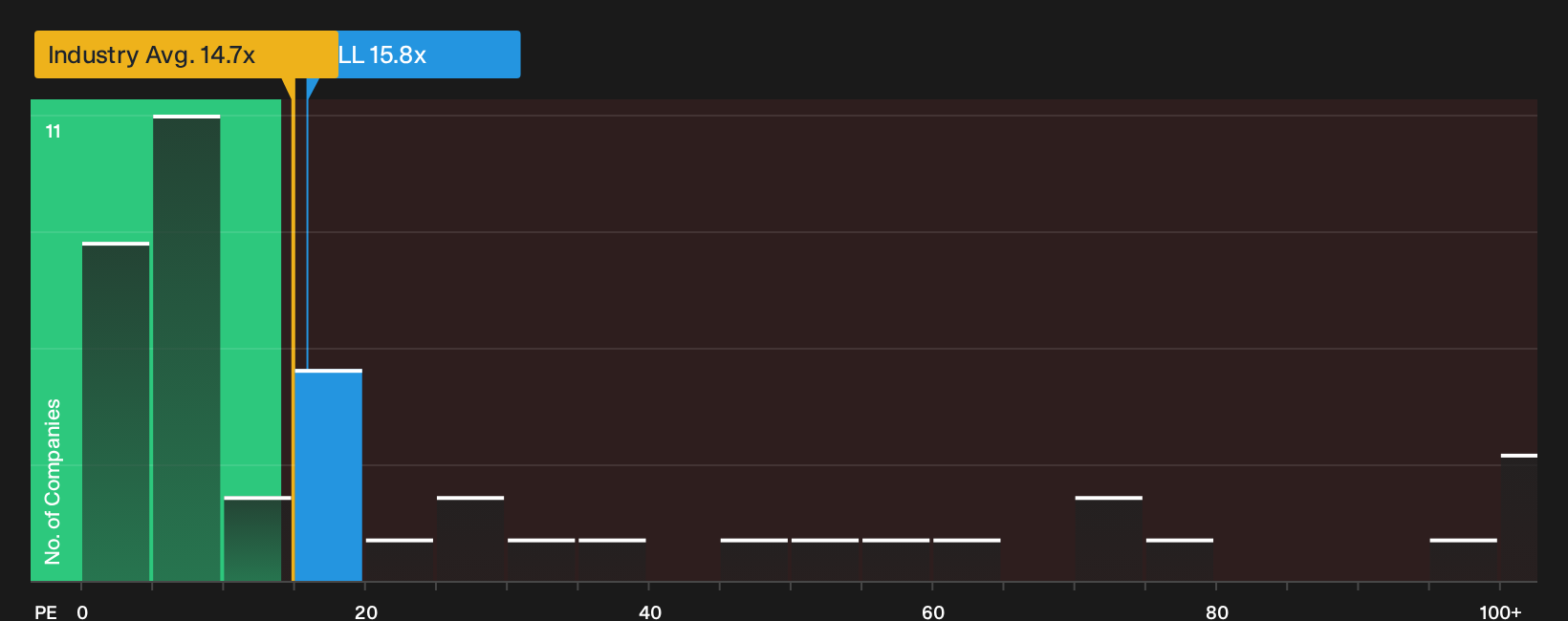
The DCF workup points to Jones Lang LaSalle trading at a discount to estimated future cash flows, yet the P/E picture is more cautious. At 15.8x earnings versus 14.7x for the US real estate group, the stock trades richer than the sector but below a fair ratio of 21.6x that regression suggests the market could move toward. That mix hints at some valuation upside if sentiment stays constructive, but it also raises the question of how much earnings progress is already reflected in today’s premium over the industry.
Before relying on one framework, it helps to see how this earnings based view aligns with the fuller valuation breakdown in our numbers, and what that implies for risk versus reward at $379.29 compared with analyst targets and DCF outputs. See what the numbers say about this price — find out in our valuation breakdown.
For a clearer visual on how Jones Lang LaSalle’s earnings multiple compares with sector norms and the fair ratio anchor implied by the data, take a look at the valuation comparison chart here.
Next Steps
If the Jones Lang LaSalle story so far sounds constructive, use that as a springboard to double check the numbers yourself and stress test every assumption. To see what optimism is already flagged in the data, review the 3 key rewards
Looking for more investment ideas beyond Jones Lang LaSalle?
You have seen how one earnings story can move a stock. Do not stop there when a broader watchlist could sharpen every decision you make.
- Target potential mispricings by scanning a curated set of quality candidates through the 34 high quality undervalued stocks.
- Prioritise resilience by reviewing a list of solid balance sheet and fundamentals (24 results) that can help you focus on financially steady businesses.
- Lower your volatility exposure by checking a 29 resilient stocks with low risk scores that filters for companies with more measured risk profiles.
Have feedback on this article? Concerned about the content? Get in touch with us directly. Alternatively, email editorial-team@simplywallst.com