


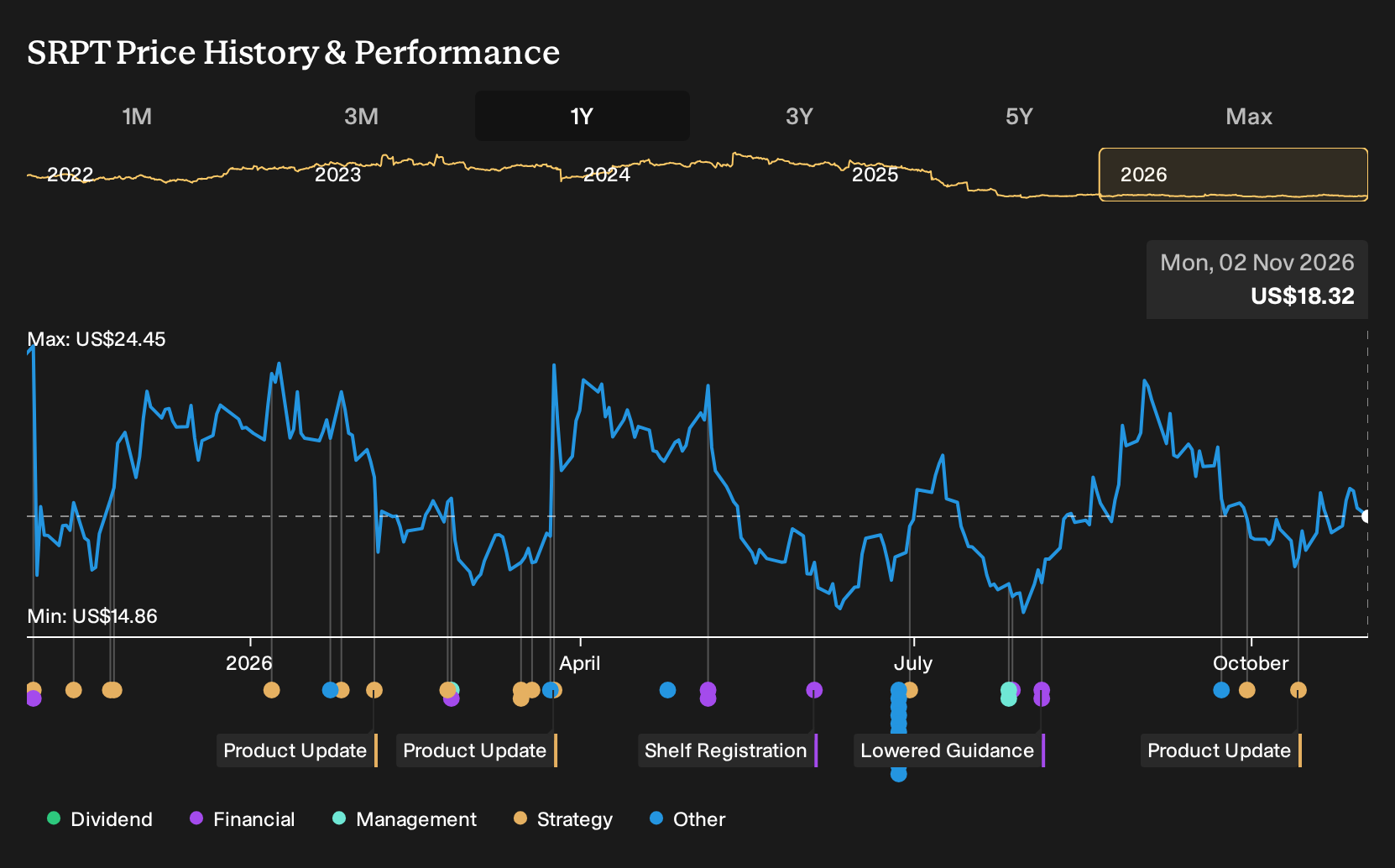
Fresh off a Q1 2026 report where Sarepta Therapeutics surprised the market with US$730.8 million in revenue and US$331 million in net income, it is natural to ask what all that noise has meant for an actual shareholder. Holding Sarepta Therapeutics over the past year would have meant a 25.1% loss, including dividends. If you had chosen to buy on 2 November 2025, was that outcome already hinted at by the early Elevidys safety concerns and regulatory questions, or do the recent earnings beats and pipeline updates now point to something different worth rethinking?
Sarepta Therapeutics is not the only name tied to this theme. Zero in on 33 healthcare AI stocks and compare how each one is priced.
The Argument Sarepta Investors Were Really Having
The shares cost US$24.01 at the start of the period, and anyone looking at Sarepta Therapeutics then had to choose between two very different stories about what that price already implied.
On the upbeat side, the bullish narrative said a Fair Value of US$80, effectively an implied long term price, made sense if broader genetic testing and precision medicine kept expanding the pool of patients for ELEVIDYS and future gene therapies. This view also assumed that payer acceptance and infusion capacity would support that reach.
The cautious view argued for a Fair Value of US$5. This was based on the risk that safety scrutiny after an ELEVIDYS related patient death, plus delays and bottlenecks in the infusion process, could keep administrative costs high and restrain revenue despite a growing rare disease market.
What The Results Changed For Sarepta Therapeutics
The clearest datapoint came later. In Q2 2026 Sarepta Therapeutics reported revenue of US$401.3 million and a loss of US$4.9 million, with net margin moving from 32.2% in Q2 2025 to 1.2% below zero. That challenged the bullish focus on sustained profitability, even as Elevidys and the broader Duchenne portfolio continued to receive regulatory and clinical attention.
The hinge was the profitability assumption. Anyone applying this to another biotech can test it in the same way by tracking whether net income and margin actually move toward the level the upbeat story requires, even when top line trends look reassuring.
What Sarepta Investors Are Being Asked To Believe Now
Today Sarepta Therapeutics trades at US$18.32, after the share price declined about 25.1% over the past year. The selected Narrative sees Fair Value above that level and leans on Sarepta using its Duchenne portfolio and existing profitability to fund new programs without fresh equity.
For that higher figure to hold, a buyer today would be assuming that ELEVIDYS risk mitigation and siRNA neuromuscular data support durable demand strong enough to sustain cash generation and pipeline funding.
"Sarepta Therapeutics is using a cash flow positive Duchenne muscular dystrophy portfolio, with Q2 2026 product gross margins of 75% and non GAAP operating income of US$86 million, to self fund pipeline work and potentially support future earnings and cash generation without relying on new equity."
One Narrative disagrees with today's price. → See where this Narrative says Sarepta Therapeutics should trade
Looking One Step Beyond Sarepta
Sarepta keeps pulling attention toward rare disease genetics. Your eye does not have to stop there.
Chronic obesity and diabetes create a different kind of long haul demand. Those patients often need treatments that fit daily routines, not infusions.
Another large drug maker is leaning into that need, especially around incretin therapies. It is pushing both injectable and pill formats so treatment can feel more flexible.
At the same time, it is adding cancer, immunology and neurology drugs beside that weight and glucose portfolio. That mix could matter if incretin enthusiasm ever cools.
One Narrative has already put a figure on it. → Uncover the company trading 14% below one Narrative's Fair Value
Have feedback on this article? Concerned about the content? Get in touch with us directly. Alternatively, email editorial-team@simplywallst.com