


IonQ (IONQ) has secured a US$7.5 million Phase 2 contract from the Air Force Research Laboratory to extend its quantum network work in Rome, New York into a more operational platform.
IonQ’s share price has come under pressure despite this contract win, with the stock down 6.22% over the past day and 35.64% over the last month, and the 1 year total shareholder return declining 51.76% even as the 3 year total shareholder return remains strongly positive at 151.29%. This points to longer term gains but fading recent momentum as investors reassess both growth potential and funding risks ahead of the November 5 earnings update.
Spot potential rebounds and under-the-radar peers to IonQ by scanning a curated group of 25 quantum computing stocks.IonQ’s slide has arrived just as it secures fresh government work and folds in new acquisitions. This raises a simple question: Are you seeing a business problem take shape, or a sharp reset in sentiment that valuation now has to sort out?
Most Popular Narrative: 41% Undervalued
IonQ’s most followed narrative pegs fair value at $48 per share, which sits well below the last close at $28.17. This frames the recent drawdown as a gap between story and price rather than a clean verdict on the business.
The business is getting better. The stock is getting more expensive. Those two statements can both be true.
IonQ has become even more convincing as the leading public quantum platform. It has the strongest balance sheet, the best revenue scale, the clearest contracted visibility, and the broadest strategic ambition in the sector.
See why 93 investors see IonQ as 41% undervalued.
According to HedgeY, who wrote the most widely followed IonQ narrative, the tension is simple. The platform story is built on Q1 2026 revenue of $64.7 million, full year 2026 guidance of $260 million to $270 million, and Remaining Performance Obligations of $470 million. The equity has been treated as a premium ticket on that future for some time.
HedgeY’s work also flags the balance sheet as a central part of the thesis. With $3.3b of cash, cash equivalents, and investments at the end of 2025, the company has room to fund acquisitions such as Oxford Ionics, Lightsynq, Vector Atomic, Capella, and SkyWater while still pursuing a broader platform across computing, networking, sensing, and manufacturing.
The same narrative does not ignore the other side of the ledger. IonQ remains unprofitable, is forecast to stay loss making over the next three years, and has a P/S ratio that is described in the data as expensive relative to both peers and an estimated fair ratio. This means a lot of future execution is already reflected in earlier prices.
Framed through that lens, the current share pullback, the user fair value of $48, and the 41.3% discount to that number sketch out a story where the underlying quantum platform and the stock chart are no longer in sync. Readers have to judge whether the narrative or the recent price action is doing a better job of weighing the risks listed in the data.
Result: Fair Value of $48 (UNDERVALUED)
Still, IonQ’s story can break if the valuation stays rich while losses persist, or if trapped ion technology and acquisition integrations disappoint expectations.
Find out about the key risks to this IonQ narrative.
Another View: IonQ Looks Expensive On Sales
The first user narrative leans on a $48 fair value for IonQ based on future cash generation and platform potential. A more plain-vanilla check using today’s P/S ratio tells a tougher story for the current share price.
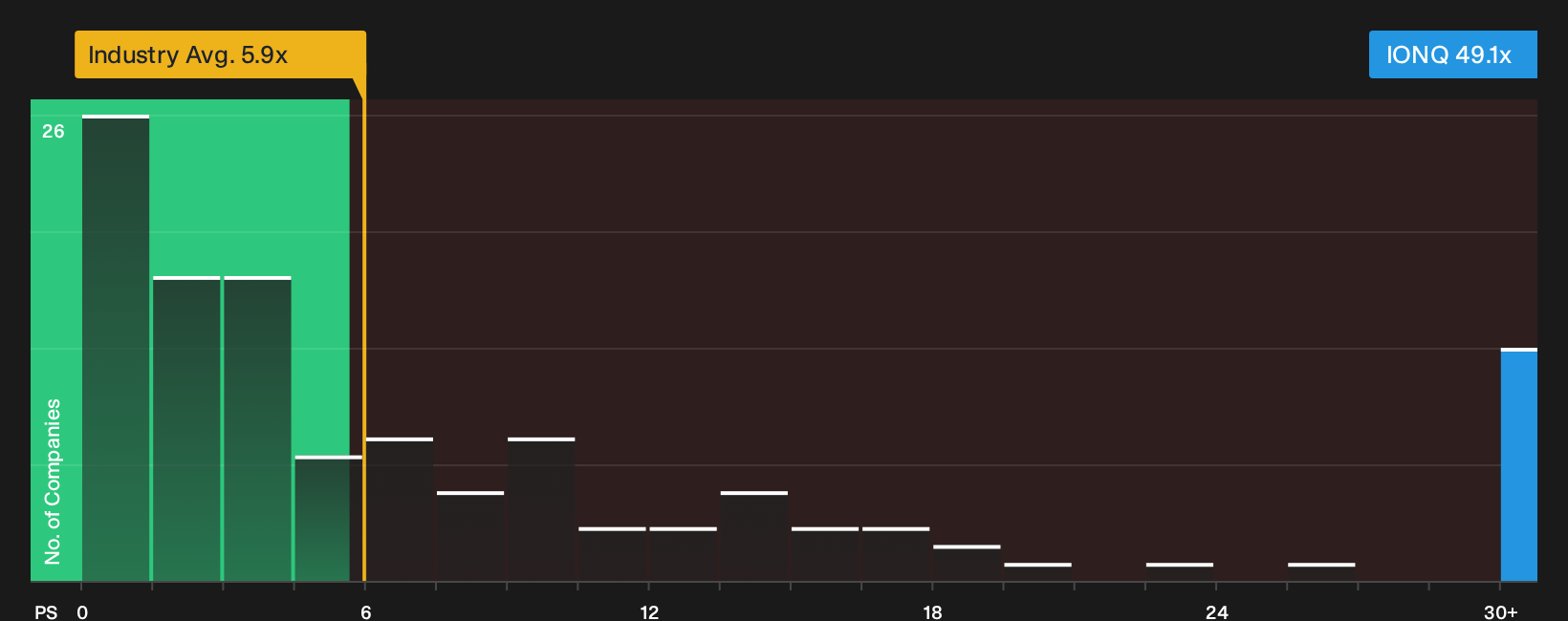
IonQ trades on a P/S of 49.1x, while the fair ratio from the data sits at 6.9x. The broader US semiconductor group is on 5.9x and peer companies average 16.9x. That gap points to a stock where a lot of future success is already priced in. The question is whether you see that as room for disappointment or a premium you are willing to pay.
For a closer look at how this pricing compares with sector norms and what that might mean for risk, See what the numbers say about this price — find out in our valuation breakdown..
Next Steps
Sentiment around IonQ is pulled in two directions, with concern about losses on one side and optimism about the platform build on the other. If you want to move quickly and form your own judgment based on both risks and potential upside, start by weighing the 1 key reward and 3 important warning signs.
Looking for more IonQ sized investment ideas?
If IonQ has sharpened your focus on where risk and return can meet, do not stop here. Use the broader market to pressure test your thinking and uncover alternatives before the crowd does.
- Target resilient balance sheets by scanning a curated list of solid balance sheet and fundamentals (24 results) that can help you stress test your portfolio against tougher conditions.
- Hunt for mispriced opportunities with a focused 34 high quality undervalued stocks that highlights companies combining stronger fundamentals with prices that still look reasonable.
- Stack potential income streams by reviewing a hand picked 4 dividend fortresses that can add cash flow alongside any higher risk growth ideas.
Have feedback on this article? Concerned about the content? Get in touch with us directly. Alternatively, email editorial-team@simplywallst.com