


I look at securities not based on what they are, but on how they function in a portfolio and how much I allocate to them. In my portfolio today, almost everything is a rental because the stock market is in the midst of a transition. The price of ignoring that is growing by the day.
The transition underway is from a market with a clear identity (tech stocks rule!) to one without obvious leaders.
What makes this confusing to many investors is that they have been taught that the key to successful investing is WHAT they own. ETFs are treated like consumer products – some even have their own TV commercials!
Right now, a major focus of my research is what I call an “existential” question for self-directed investors. With more than 4,000 ETFs trading on U.S. exchanges, how many do you actually need to consider? The answer is far fewer than Wall Street wants you to believe.
Let’s take that Vanguard Morningstar Total Stock Market ETF (VTI) for a moment. It seems like a “well-diversified ETF.”
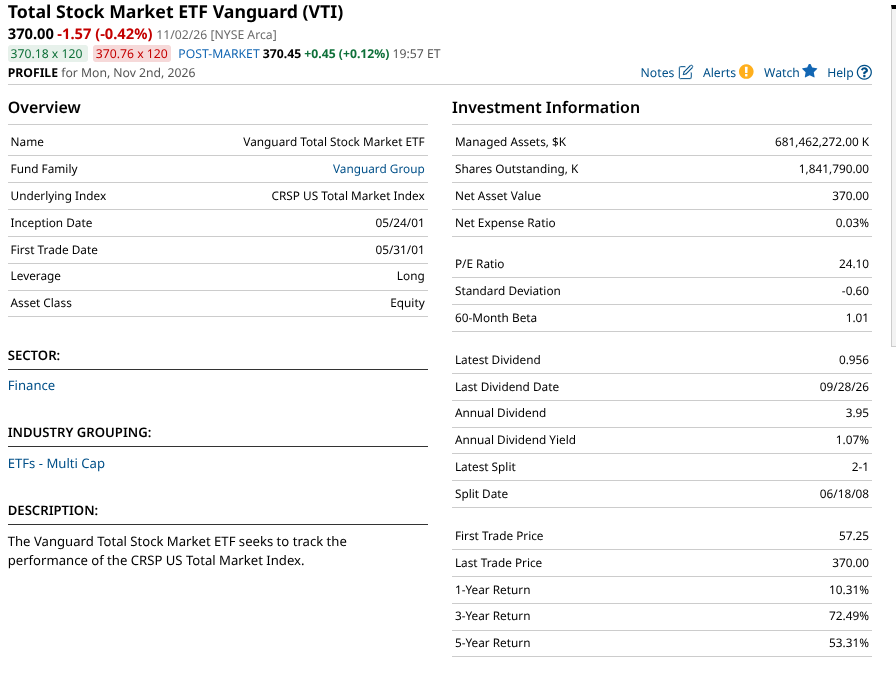
If we look closer, however, we find that VTI is merely a doppelgänger. It performs just like the SPDR S&P ETF (SPY)... and about 500 other ETFs that sound different but are driven by the same huge U.S. tech stocks.
The key stat in this picture below is that VTI holds more than 3,500 U.S. stocks, yet only 10 of those stocks account for nearly 35% of assets. That’s just 0.285% of the stocks in VTI!
Taking it a step further, 1% of the stocks in VTI (35 names) account for 52% of the total assets. So what we have here is a case of the stock market imitating the “K-Shaped economy.” The favored few, and the proletariat.
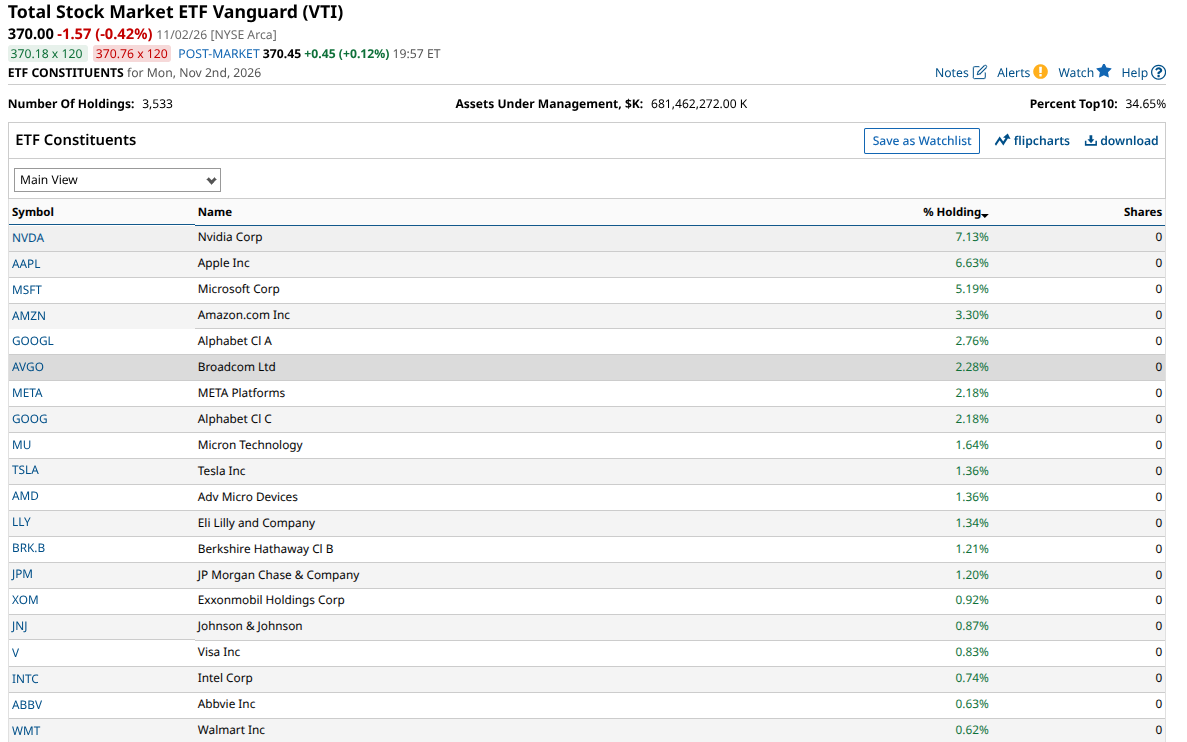
I think this poses great danger to investors right now. So many ETFs move in near-perfect lockstep, differing only by fee structure or a slight nudge in beta.
The single biggest mistake I see self-directed investors making today is accidental overdiversification. They own multiple funds that are nothing more than doppelgängers of each other.
Diversification is great. But only if it really is diversified.
Over the past 20 years, on a 3-year rolling return basis, VTI and SPY have traded within 1% of each other roughly 95% of the time.
There is nothing inherently “wrong” with VTI. If you want to use it as your core equity vehicle, fine. But if you own SPY and then buy VTI thinking you have diversified, you have simply bought a doppelgänger. It is six of one, half a dozen of the other.
Breaking Up With Your Doppelgängers
If you want to build a truly resilient, risk-managed portfolio, stop shopping by fund names and marketing brochures.
- Audit Your Overlap: Look at your equity holdings. If you own an S&P 500 index fund, a total market ETF, a large-cap growth fund, and a tech ETF, you don’t have a diversified portfolio. You have four tickets to the exact same ride.
- Focus on How, Not What: Stop asking whether an ETF is “good” or “bad.” Ask what tactical job it performs. Does it provide a non-correlated return? Does it hedge some wicked outcome in the markets, like a crashing stock market or rising rates? If it just moves with the market, you only need one of them.
The financial industry makes money by launching new wrappers that repackage the same underlying stocks under clever new acronyms. In the same way that I can buy 11 different types of toothpaste, but the basic objective is very similar.
Don’t pay for the packaging. Identify the doppelgängers in your portfolio, strip out the redundancy, and focus your energy on managing risk rather than collecting tickers.
Rob Isbitts is a semi-retired CIO, former fiduciary investment advisor, Barchart columnist, and straight-talker. Download his new free e-book on hedged bond investing for retirement at ETFYourself.com. His research and model portfolios are at ROAR.PiTrade.com.
On the date of publication, Rob Isbitts did not directly have a position in any of the securities mentioned in this article. All information and data in this article is solely for informational purposes. For more information please view the Barchart Disclosure Policy here.