



Residential swimming pool manufacturer Latham (NASDAQ:SWIM) reported Q3 2026 results beating Wall Street’s revenue expectations, with revenue up 12.5% year on year to $182.2 million. The company expects the full year’s revenue to be around $610 million, close to analysts’ consensus estimates. Its GAAP profit of $0.10 per share was 28.1% below analysts’ consensus estimates.
For more on Latham, read our free full research report.
Latham (SWIM) Q3 2026 highlights:
- Revenue $182.2 million vs S&P analysts’ consensus estimates of $181.1 million (12.5% year-on-year growth, 0.6% beat)
- EPS (GAAP) $0.10 vs analysts’ consensus estimates of $0.14 (28.1% miss)
- Adjusted EBITDA $45.25 million vs analysts’ consensus estimates of $45.6 million (24.8% margin, 0.7% miss)
- Revenue guidance The company reconfirmed its revenue guidance for the full year of $610 million at the midpoint
- EBITDA guidance $115 million at the midpoint for the full year, above analysts’ consensus estimates of $114 million
- Operating margin 13%, in line with the same quarter last year
- Free cash flow margin 14.6%, down from 27.9% in the same quarter last year
- Market capitalization $877.6 million
“With much of the pool building season now behind us, and based on our current visibility through year-end, we are narrowing our net sales guidance range to $605-615 million and our adjusted EBITDA guidance range to $112-118 million. This represents 11.7% net sales growth and 15.2% adjusted EBITDA growth at the midpoints,” Mr. Gadd concluded.
Revenue growth
A company’s long-term performance is an indicator of its overall quality. Any business can have short-term success, but a top-tier one grows for years. Latham struggled to consistently increase demand as its $596.9 million in revenue for the trailing 12 months was close to its revenue five years ago. That underwhelming result suggests poor business quality.
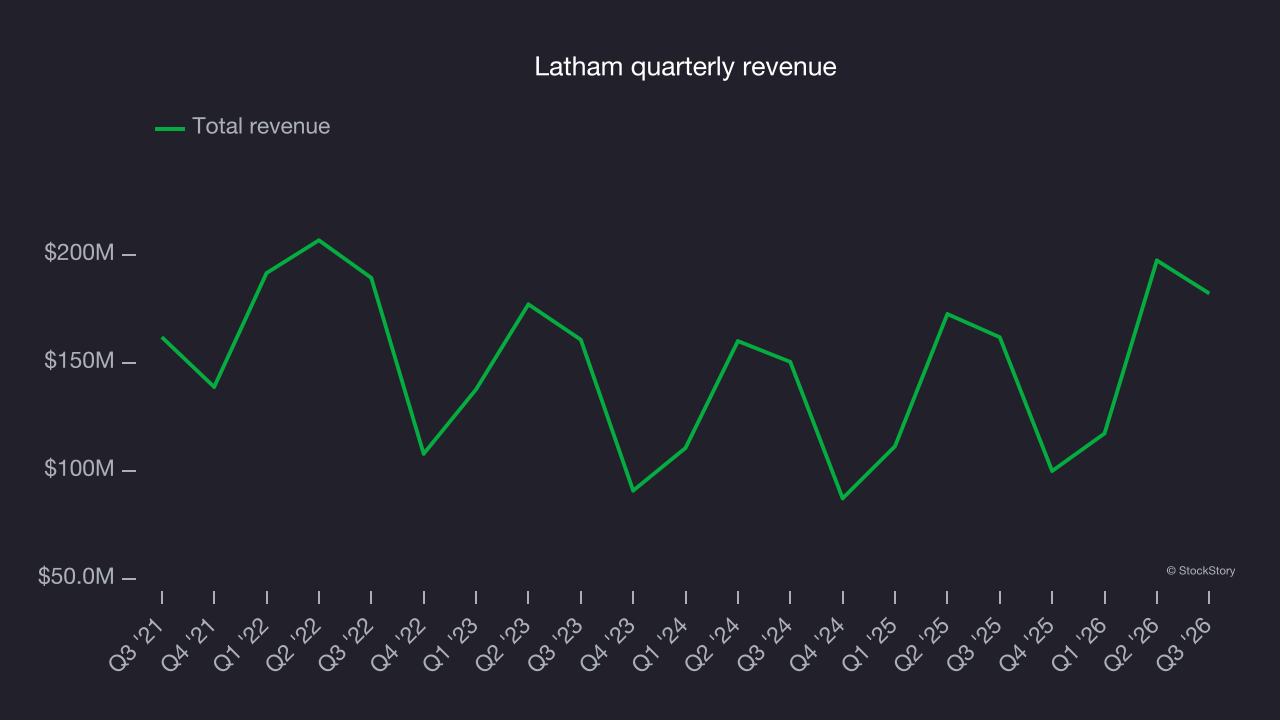
Long-term growth is the most important, but within consumer discretionary, product cycles are short and revenue can be hit-driven due to rapidly changing trends and consumer preferences. Latham’s annualized revenue growth of 8% over the last two years is above its five-year trend, a positive sign. 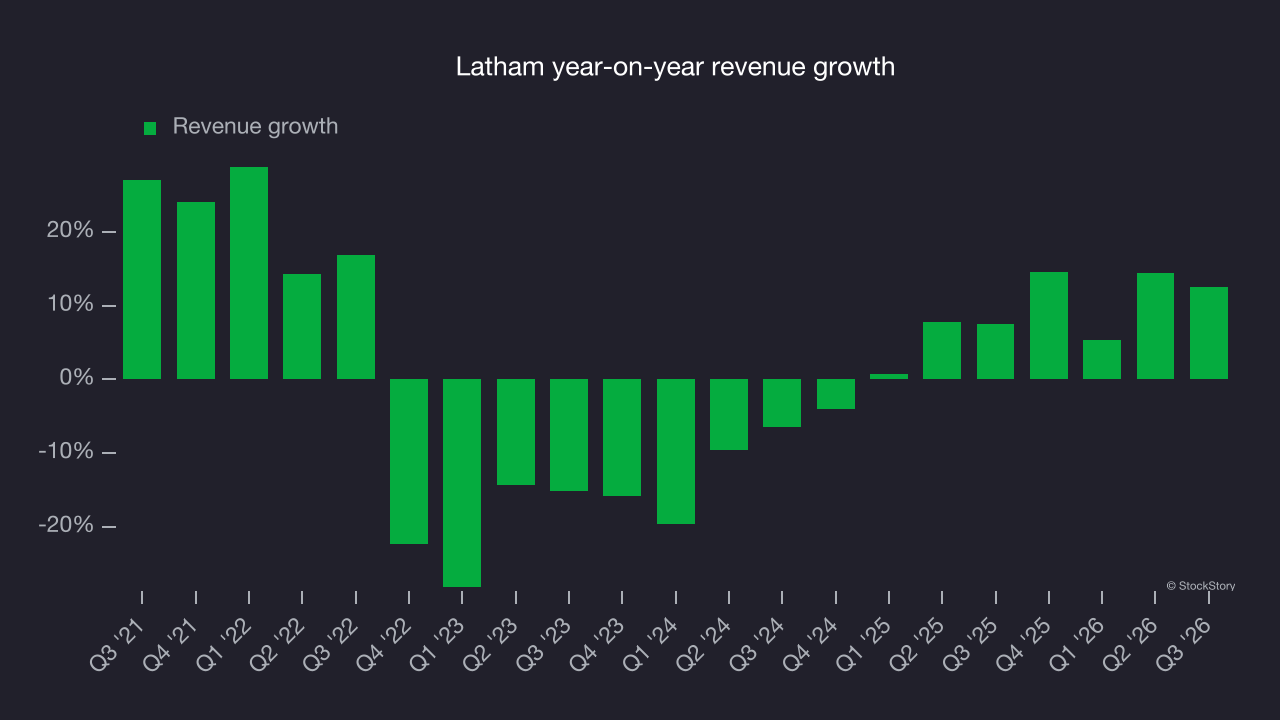
This quarter, Latham reported year-on-year revenue growth of 12.5%, and its $182.2 million in revenue exceeded Wall Street’s consensus estimates by 0.6%.
Looking ahead, sell-side analysts expect revenue to grow 6.8% over the next 12 months, according to S&P, similar to its two-year rate. This projection is underwhelming and indicates its products and services will see some demand headwinds.
Operating margin
Operating margin is an important measure of profitability as it shows the portion of revenue left after accounting for all core expenses, from the cost of goods sold to advertising and wages. It’s also useful for comparing profitability across companies with different levels of debt and tax rates because it excludes interest and taxes.
Latham’s operating margin has been largely unchanged over the last 12 months, and rising margins driven by economies of scale and cost efficiency are generally preferable over time.
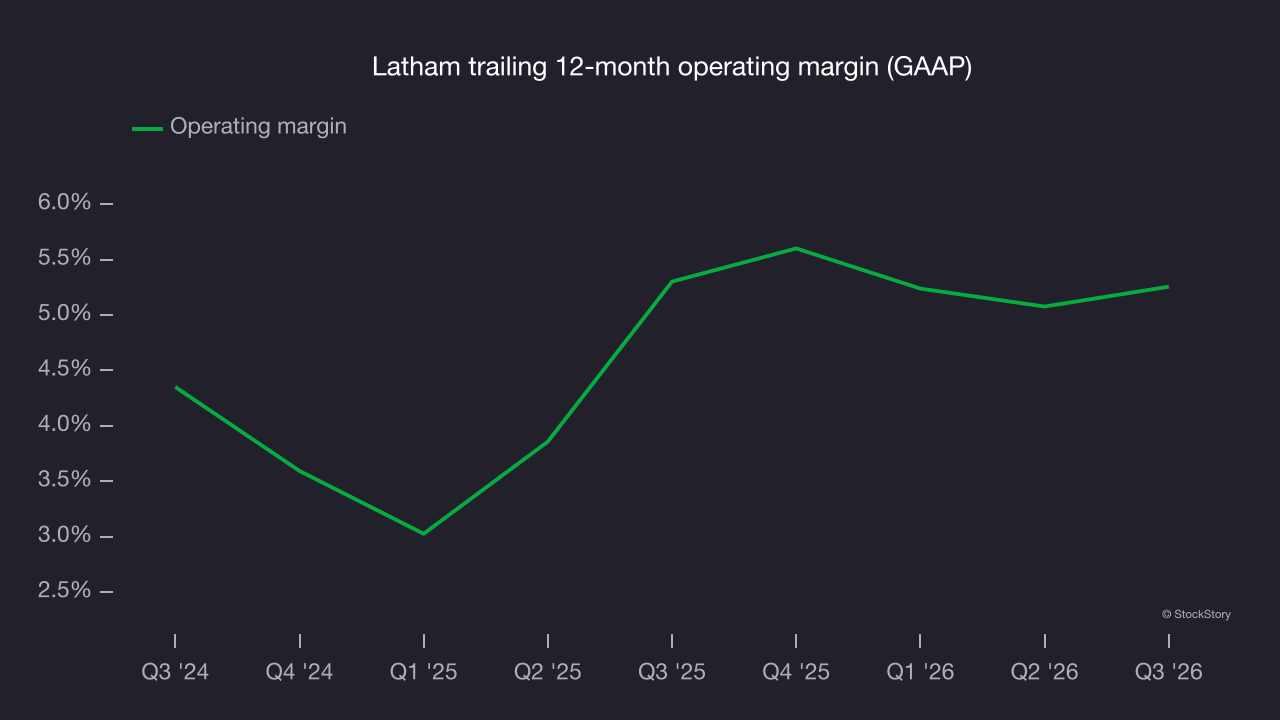
This quarter, Latham generated an operating margin of 13%, in line with the same quarter last year. This indicates the company’s overall cost structure has been relatively stable.
Earnings per share
Revenue trends explain a company’s historical growth, but the long-term change in earnings per share (EPS) points to the profitability of that growth – for example, a company could inflate its revenue through excessive spending on advertising and promotions.
Latham’s full-year EPS turned positive over the last five years. This improvement is a positive sign and marks a critical point for the company.
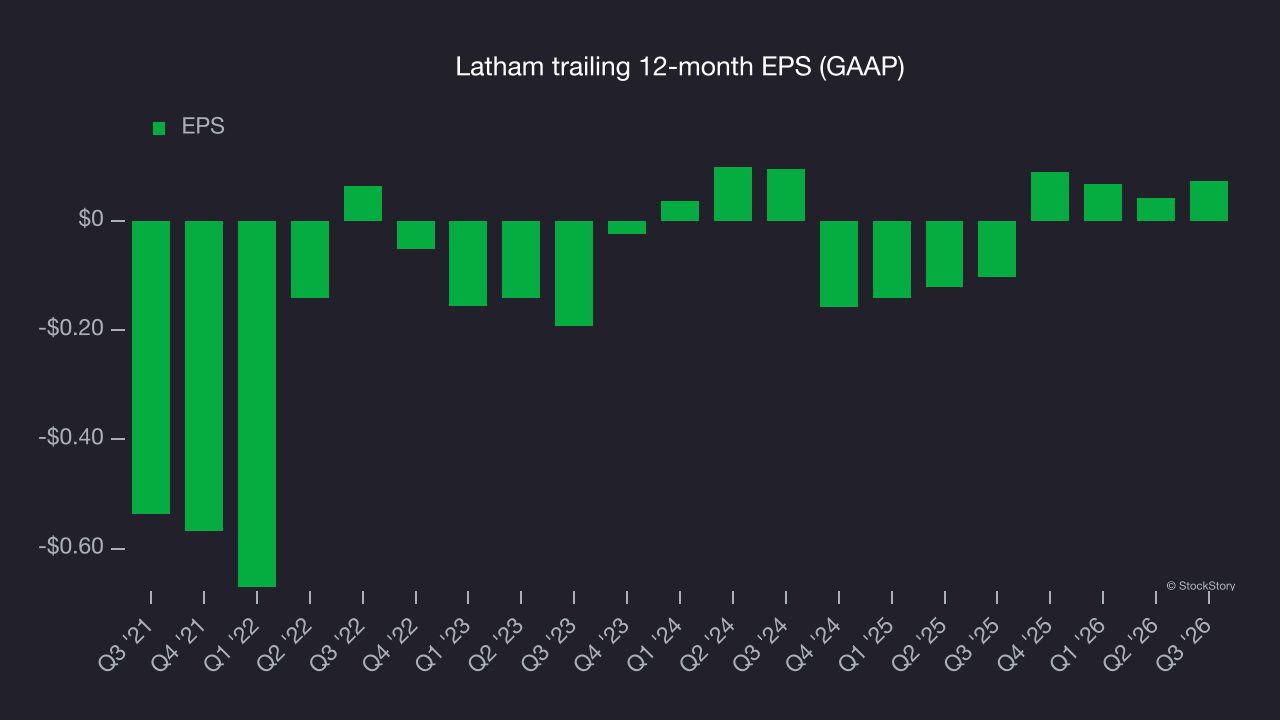
In Q3, Latham reported EPS of $0.10, up from $0.07 in the same quarter last year. Despite growing year on year, EPS missed analysts’ consensus estimates. Over the next 12 months, Wall Street expects Latham’s full-year EPS to grow 219% from $0.07 to $0.23, according to S&P.
Key takeaways from Latham’s Q3 results
Latham delivered a weaker quarter, with EPS missing consensus estimates but full-year revenue guidance meeting analysts’ consensus expectations. Shares rose 3% to $7.53 immediately after the results.
Is Latham an attractive investment at its current price? That decision calls for a broader look at valuation, business quality and the latest earnings. Read the full research report here (it’s free).