


The Zhitong Finance App learned that at a time when market concerns about the return on investment in artificial intelligence (AI) infrastructure, the sustainability of capital expenditure of technology giants, and the chip industry's valuation level continue to heat up, AMD (AMD.US) handed over a persuasive third quarter report card after the US stock market on November 3 (Tuesday).
Thanks to continued growth in demand for AI chips and strong performance in the data center business, AMD's third-quarter revenue and adjusted earnings per share exceeded market expectations. More importantly, the fourth quarter revenue guidance given by AMD was also significantly higher than analysts' expectations, indicating that demand brought about by AI infrastructure construction is still being released at an accelerated pace.
After the financial report was announced, AMD's stock price once rose more than 9% in after-hours trading, and rose more than 7% as of press release, reflecting investors' recognition of its AI business growth prospects and short-term performance visibility. Although the market had already experienced a round of sentiment before AMD announced its earnings report, what is more important is the overall strength of the fundamentals shown in this financial report — there are no “thunderstorms” in performance, guidance, and cash flow itself, and the demand side continues to accelerate rather than slow down.
Emarketer analyst Jacob Bourne said, “AMD's earnings report tested both its own performance and the broader AI market. Given the recent sell-off in technology and semiconductors, investors are increasingly concerned about AI spending and its returns, and this result will be encouraging for investors.”
The significance of this financial report goes beyond exceeding expectations in terms of revenue and profit. Against the backdrop of recent market doubts about the return on AI investment and weak Intel (INTC.US) performance guidance impacting the semiconductor sector, AMD's data center business still nearly doubled, and gave a stronger than expected outlook for the next quarter, providing a new verification of AI infrastructure needs. However, as the share of the AI business in the company's revenue continues to rise, the market also needs to decide whether AMD can transform current orders and demands into continuous delivery, increased profit margins, and stronger cash flow.
1. Revenue and EPS both exceeded expectations, and the fourth quarter guidance further raised growth expectations
Judging from overall financial performance, AMD's third-quarter results were significantly better than market expectations.
According to financial reports, AMD's third-quarter revenue increased 45% year over year to US$13.377 billion, better than analysts' general expectations of US$13.08 billion. In terms of profitability, adjusted gross margin was 56%, up 2 percentage points year over year, slightly lower than analysts' general expectations of 56.1%. Adjusted operating profit increased 75% year over year to US$3.92 billion, better than analysts' general expectations of US$3.68 billion; adjusted operating margin was 29%, better than analysts' general expectations of 28%. Adjusted earnings per share rose 74% year over year to $2.09, better than analysts' general expectations of $1.97.
Capital expenditure of US$648 million, compared to US$258 million in the same period last year, is basically in line with analysts' general expectations of US$647 million. Free cash flow was $554 million, a decrease of 64% year over year, and analysts generally expected $1.97 billion.
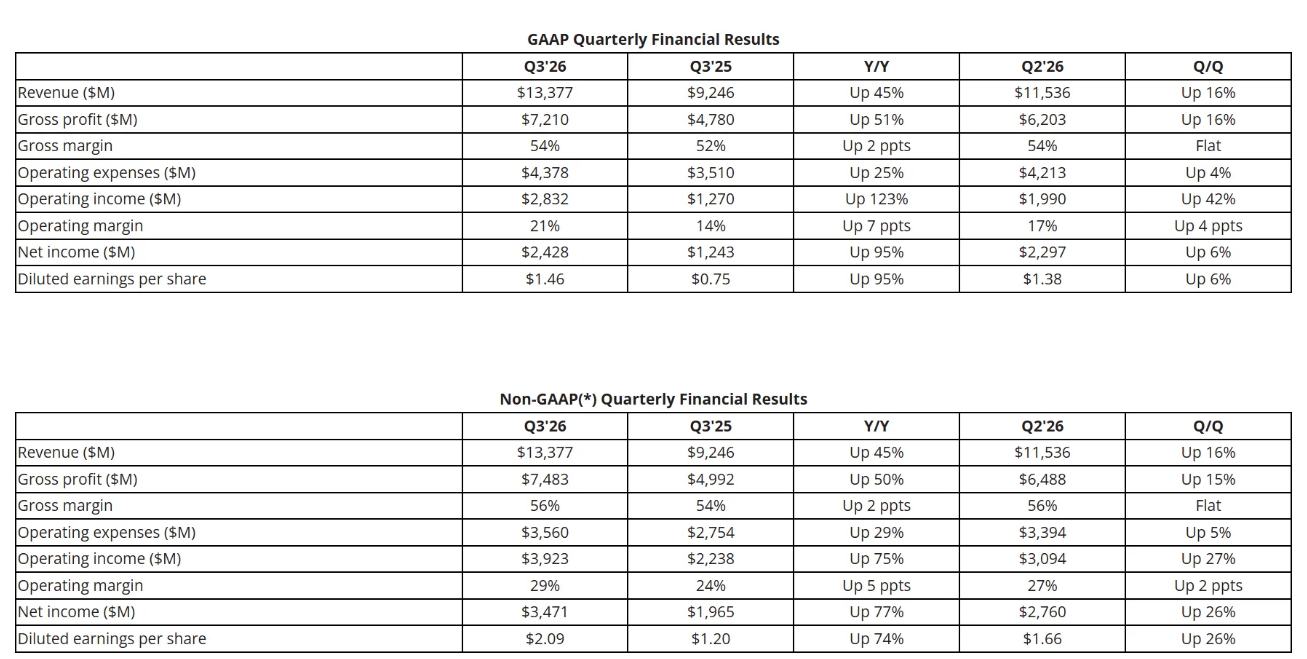
This means that AMD not only continues its previous rapid growth trend, but the profit growth rate further exceeds the revenue growth rate, indicating that the company still has a strong ability to grow profits while expanding the scale of its business.
The adjusted gross margin is basically in line with the expectations of about 56% that the market had previously focused on. Considering AMD is expanding shipments of AI accelerators and rack-scale systems, this performance is of some positive significance. Earlier, the market feared that the AI accelerator business might face high product costs, supply chain investment, and price competition pressure during the rapid climbing phase, thus dragging down the overall gross margin. The gross margin remained at 56% in the third quarter, indicating that the AI business expansion did not significantly disrupt the company's overall profit level for the time being.
However, it is still worth paying attention to whether gross margin can remain stable over the next few quarters. AMD expects adjusted gross margin for the fourth quarter to be about 55%, down about 1 percentage point from the third quarter. As the Mi450 series accelerators and Helios rack-scale systems are gradually deployed, the company will need to bear more high-bandwidth memory, advanced packaging, system integration, and other supply chain costs. Whether the AI business can maintain a healthy balance between revenue growth and profit margins will later become an important indicator for testing the quality of its growth.
Looking at the outlook for the next quarter, the guidance given by AMD is particularly impressive. The company expects revenue for the fourth quarter to be approximately US$17 billion, fluctuating 3% up and down, and the corresponding range is approximately US$16.49 billion to US$17.51 billion. This guidance is higher than the market's previous general estimate of about US$16.23 billion, which also means that the company expects revenue to increase further by about 27% compared to the third quarter.
It is worth noting that before the financial report was announced, the market had high expectations for AMD's fourth quarter results. Previously, analysts generally expected fourth-quarter revenue of about US$16.1 billion to US$16.3 billion, which meant that the company needed to achieve significant month-on-month growth based on revenue of about US$13 billion in the third quarter. AMD's current $17 billion guideline not only exceeds this threshold, but also further strengthens the market's expectations that its AI business will continue to grow at the end of the year.
For investors, the fourth quarter guidance is even as significant as the third quarter results themselves. The third-quarter data reflects previously realized demand, while the fourth-quarter outlook reflects the company's judgment on future orders, customer deployments, and supply chain delivery capabilities. In a context where the return on AI investment is being scrutinized by the market, AMD can provide higher than expected revenue guidance, which means that its management still has strong confidence in short-term demand and business growth.
2. Data center business revenue reached a record high of 97% year-on-year, and AI business has become the core growth engine
If overall revenue and adjusted earnings per share reflect extensive improvements in AMD's third-quarter results, then the data center business is undoubtedly the most important highlight of this financial report. In the third quarter, AMD's data center business revenue reached 8.55 billion US dollars, up 97% year over year, reaching a record high, exceeding the market's previous forecast of about 8.2 billion US dollars. Compared with the same period last year, the business's revenue almost doubled; compared with revenue of about $6.72 billion in the second quarter, it also achieved a month-on-month increase of about 27%.
The data center business is now the most important component of AMD's revenue structure, accounting for about 64% of the company's total third-quarter revenue, compared to 47% a year ago. This means AMD's business focus is shifting further towards AI and data center infrastructure.
The growth of the data center business mainly comes from two directions: first, demand for EPYC server CPUs continues to be strong, and second, the deployment scale of the Instinct series AI accelerators continues to expand.
First, as cloud computing service providers, hyperscale data center operators, and enterprise customers continue to expand investment in AI infrastructure, demand for server CPUs is also growing at the same time. AI computing is not just a single market for GPUs; model training, inference, data processing, and the operation of the entire data center require a large amount of CPU resources. AMD continues to expand its influence in the server CPU market through the competitiveness of EPYC series processors in terms of performance and energy efficiency.
Second, the Instinct series of AI accelerators is gradually becoming an important gripper for AMD to challenge Nvidia (NVDA.US). As AI applications gradually expand from model training to large-scale inference and actual business scenarios, customer demand for GPUs and other AI computing resources continues to expand. With the Instinct series of products, AMD hopes to provide customers with an alternative to Nvidia and increase customer adoption through a more complete software and hardware platform.
Reports indicate that AI workloads are gradually shifting from model training to model operation in real application scenarios, and this change is driving simultaneous growth in GPU and CPU demand. AMD's data center business has benefited from this and continues to expand its competitive advantage in the server processor market.
More importantly, the growth of the data center business has begun to change AMD's revenue structure. As the share of this business rises, AMD's performance will increasingly depend on the AI infrastructure investment cycle, and no longer only on the boom in traditional PC and gaming markets.
This also means that in the future, investors' valuation logic for AMD may further shift to an AI infrastructure supplier. But at the same time, market requirements for its AI business will also increase: simply achieving revenue growth is not enough; companies also need to prove that they can continue to expand their market share and turn rapidly growing revenue into higher profits and cash flow.
3. At a time when the AI business is growing rapidly, the PC and game business are still under pressure
Despite strong performance in the data center business, not all segments of AMD's business saw growth in the third quarter. In the third quarter, the total revenue of the client and game business fell 8% year over year to US$3.72 billion, below market expectations of about US$3.79 billion. The business covers products such as PC processors and game console related chips, and its performance reflects that the traditional consumer electronics market is still under some pressure.
Previously, the market was concerned that the PC industry may be affected by factors such as rising memory prices, changes in consumer demand, and prudent corporate IT spending. Intel's recent weak performance guidance has also heightened investors' concerns about PC market demand.
AMD's PC business is also unable to completely avoid these industry pressures. Although the company's current revenue growth is increasingly dependent on the data center business, the client and game business still accounts for a certain share of revenue, and its performance will affect the company's overall growth structure. Fortunately, strong revenue growth in the data center business has offset the decline in the client and game business.
This further highlights changes in AMD's current growth model: AI and data center businesses have become the main drivers of the company's performance expansion, while the impact of cyclical fluctuations in the traditional PC and gaming business on overall growth has declined relatively.
However, if the PC and gaming markets continue to weaken and the data center business is affected by changes in the supply chain or customer capital expenses, AMD's revenue structure may face new pressures. Investors still need to pay attention to whether the company can maintain diversified growth outside of the AI business.
On the other hand, AMD's embedded business revenue in the third quarter increased 29% year over year to about 1.1 billion US dollars, indicating that the company also showed some improvements in industry, communications, and other embedded computing fields. Although this business is smaller than a data center, it helps to diversify the company's dependence on a single market.
4. The Helios rack level system has entered the production stage, and AMD is transforming from a chip supplier to an overall AI infrastructure solution provider
In addition to continued growth in data center business revenue, another important step forward in AMD's product strategy is to accelerate the transformation from a single chip vendor to an overall AI infrastructure solution provider.
Nvidia's competitive advantage in the AI market comes not only from GPUs themselves, but also from high-speed connectivity, networking equipment, software ecosystems, and complete rack level systems. By integrating GPUs, CPUs, networks, and software into a unified platform, Nvidia is able to provide customers with a more complete AI computing infrastructure. And AMD is advancing a similar strategy with the Helios rack-scale system.
Helios integrates AMD's Instinct MI450 series accelerators, EPYC server processors, and network and software technology into an overall system. The goal is to provide large-scale AI customers with a computing platform that can be deployed on a large scale. Compared to selling GPUs separately, rack-level systems can help AMD expand the value of individual customer projects, and also help increase the customer's reliance on its hardware and software ecosystem.
According to reports, AMD's flagship Helios rack system has entered the production phase and plans to further expand production in the fourth quarter. The system uses the MI455x accelerator and a next-generation Venice server chip, and the first systems are being tested at Meta (META.US).
Customer cooperation is an important support in Helios's commercialization process. AMD previously reached an agreement with Meta to supply AI chips worth up to 60 billion US dollars to Meta over the next five years. According to the relevant arrangement, Meta may also receive purchase opportunities equivalent to up to 10% of AMD's shares. At the same time, AMD is also promoting cooperation with other large AI customers, hoping to expand its penetration rate in the AI infrastructure market through Instinct accelerators and Helios systems. In addition to Meta, Anthropic, Microsoft, OpenAI, and Oracle (ORCL.US) cloud infrastructure are also running models and workloads on the first AMD Helios rack-scale systems.
Judging from the competitive landscape, the significance of Helios is not only to add a new product, but also to the fact that AMD is beginning to try to participate in AI infrastructure competition with a complete system. As large customers continue to increase their requirements for computing power scale, energy efficiency, deployment speed, and total cost of ownership, the performance of a single chip is no longer sufficient to form an overall competitive advantage. Being able to provide an overall solution from processors and accelerators to networks and software will help AMD enhance customer value and market position.
However, commercializing a rack-scale system is also much more complicated than a single chip. Its delivery requires GPUs, CPUs, high-bandwidth memory, networking equipment, cooling systems, and other components to work together, while also ensuring compatibility at the software and system levels. Even when customer demand is strong, supply chain and system integration capabilities may determine the actual speed of shipment. Therefore, the volume of Helios in the fourth quarter and the delivery scale in 2027 will be key indicators for judging whether AMD can actually expand its AI market share.
5. High-bandwidth memory supply and system delivery capabilities may be key constraints to the continued expansion of AI business
While demand for AI continues to be strong, AMD's future growth is also facing supply chain challenges. Tight global memory supply is affecting the semiconductor industry, and high-bandwidth memory (HBM) is particularly scarce. Since AI processors require a large amount of high-performance memory, and global manufacturers are striving to expand production capacity, HBM supply has become an important part of the AI chip production expansion process.
For AMD, supply chain challenges aren't limited to GPUs themselves. As the company gradually expands the delivery scale of rack-level systems such as Helios, product production needs to coordinate GPUs, CPUs, HBM, advanced packaging, network components, and other system components. A shortage in any critical link could affect the delivery schedule of the final system. This is why the market needs to pay attention to AMD's actual shipments in the fourth quarter, and not only judge future revenue based on customer orders or cooperation agreements.
Furthermore, as the scale of AI infrastructure construction continues to expand, customer requirements for return on computing power investment are also increasing. Previously, market concerns about the sustainability of AI capital expenditure mainly focused on whether large technology companies and AI companies could turn huge computing power investments into actual revenue, improved production efficiency, and sustainable cash flow.
AMD's data center revenue nearly doubled in the third quarter, indicating that AI computing demand is still resilient. But for chip vendors, strong demand doesn't mean that all orders are immediately converted into revenue. Customer deployment progress, supply chain delivery, system acceptance, and subsequent expansion plans will all affect the pace of actual performance implementation. Therefore, what AMD needs to prove in the future is not only that customers are willing to buy its AI chips, but that the company can deliver products according to plan and maintain reasonable profitability during large-scale deployment.
Summary: A strong financial report is only the beginning; the ability to deliver on growth in 2027 will be a greater test
Overall, AMD's third-quarter earnings report exceeded market expectations in several key dimensions: revenue increased 45% year over year, adjusted earnings per share increased 74% year over year, and data center business revenue increased 97% year over year and reached a record high. At the same time, the fourth quarter revenue guidance given by the company was also significantly higher than analysts' expectations.
These data show that at a time when the market has doubts about the return on AI investment and the sustainability of infrastructure construction, demand for AI chips still provides a strong growth engine for AMD. The further increase in the share of data center business also shows that AMD is transforming from a traditional CPU and GPU vendor to an AI infrastructure platform provider.
As an upstream “seller”, AMD is in a position where AI demand transmission is more direct and revenue recognition is more advanced — chips, devices, storage, and power/liquid cooling components are the first step in receiving payments or confirming revenue in the downstream capital expenditure implementation process. As long as there is no real reduction in downstream capital expenditure, upstream orders, revenue, and cash flow will take the lead in reflecting prosperity. J.P. Morgan also determined that incremental AI spending will “benefit computing vendors and extend throughout the semiconductor value chain, including storage, networking, and devices/EDA.”
But from an investment perspective, strong third-quarter results don't mean all issues have been resolved.
First, whether the data center business can continue to grow rapidly depends on whether demand for Instinct accelerators and EPYC server processors continues, and whether AMD can expand production capacity to meet the deployment plans of large customers.
Second, Helios rack-scale systems will enter a more important phase of deployment in the fourth quarter and 2027. Its production schedule, customer test results, delivery scale, and profitability will directly affect whether AMD can move further from chip sales to the overall system solutions market.
Third, gross margin and cash flow still need to be tested continuously. As the AI business expands, the costs of HBM, advanced packaging, and system integration are likely to increase. Companies need to rapidly expand their market share while avoiding a clear divergence between revenue growth and profit margins.
Finally, whether AMD can deliver on its 2027 growth expectations will determine whether the market is willing to continue to give it a higher valuation. Currently, the market has included quite a bit of future AI business growth in stock prices. Therefore, single-quarter results exceeding expectations may not be enough to continue to drive upward valuations. The company needed to prove that growth was sustainable through more defined orders, capacity, delivery, and profit performance.
In other words, AMD's third-quarter earnings report confirms that AI demand is still strong, and further proves that the company is becoming an important player in the AI infrastructure market. However, the core test in the next phase will be a shift from “whether orders can be obtained” to “can be delivered on a large scale” to “whether AI revenue can be converted into continuously growing profits and cash flow.” This will be the key for AMD and Nvidia to compete for AI market share and support medium- to long-term valuations.