


- CAE has agreed to a proposed CA$38.25 million class action settlement related to past disclosures, subject to court approval and available to shareholders who bought shares between August 2022 and May 2024 and held them through a specified period in 2024.
- The settlement focuses attention on CAE's disclosure practices and governance controls at a time when the business is pursuing a multi year transformation and cost reduction program.
- We will now examine how CAE's investment narrative could be affected by the proposed CA$38.25 million class action settlement.
Stress test your reaction to CAE's disclosure risks by comparing it with peers in our hand picked 9 resilient stocks with low risk scores, which is focused on balance sheet strength and lower risk scores.
CAE Investment Narrative Recap
To own CAE, you need to believe the training and simulation business can turn its multi year transformation into higher quality earnings, despite recent margin pressure and one off items. The immediate operational swing factor is execution on cost reductions and footprint rationalization, while keeping civil and defense training volumes healthy enough to support that plan.
The proposed CA$38.25 million settlement looks manageable relative to a CA$11.8b market cap, so the direct financial hit appears limited. The bigger short term risk still sits in civil training softness and the balance sheet, with leverage and funding needs for the US$200 million to US$250 million program remaining key watchpoints.
The proposed class action settlement is the announcement most tied to this situation. It targets investors who bought CAE shares between August 2022 and May 2024 and held them through a defined window in 2024, and it addresses allegations that shareholders bought at inflated prices due to past disclosures.
For you as a potential or existing shareholder, the link to catalysts is about trust in future reporting and management execution. The business is already working through a large cost out and portfolio refocus, and the settlement process adds scrutiny to governance and disclosure just as investors are watching debt levels, margin repair and free cash flow more closely.
How the CAE class action interacts with the earnings story
CAE's proposed settlement lands against analyst expectations that the business can compound revenue at 2.7% a year, lift profit margins from 5.8% to 9.7%, and grow earnings from CA$286.9 million today to CA$523.0 million by 2029. That earnings path implies an increase of about CA$236 million, which is far larger than the CA$38.25 million settlement. The key question for you is whether the disclosure issues behind the class action make it harder to have confidence in those longer term assumptions.
On the top line, analysts are tying their forecasts to a CAE revenue figure of CA$5.4b and earnings of CA$523.0 million by 2029, off a multi year program that targets higher training utilization, lower structural costs and better mix. Those same models lean on a 33.7x P/E on forecast earnings, compared with 37.8x on current profits and a 33.9x multiple for the wider US Aerospace & Defense peer group, so they already bake in a modest derating. A disclosure settlement that prompts tighter controls around guidance and risk reporting could reinforce or challenge those assumptions, depending on how management responds.
For anyone tracking CAE, the practical issue is how to weigh legal overhang against these financial yardsticks. Analysts are looking for revenue to grow steadily at 2.7% each year, earnings to rise from CA$286.9 million to CA$523.0 million by 2029, and profits to expand by about CA$236 million over that span. You can stress test your own comfort level with the class action by asking whether the governance questions it raises change your confidence in those revenue and earnings trajectories, especially while the firm is spending US$200 million to US$250 million on its transformation and still carrying net debt around 2.27x adjusted EBITDA.
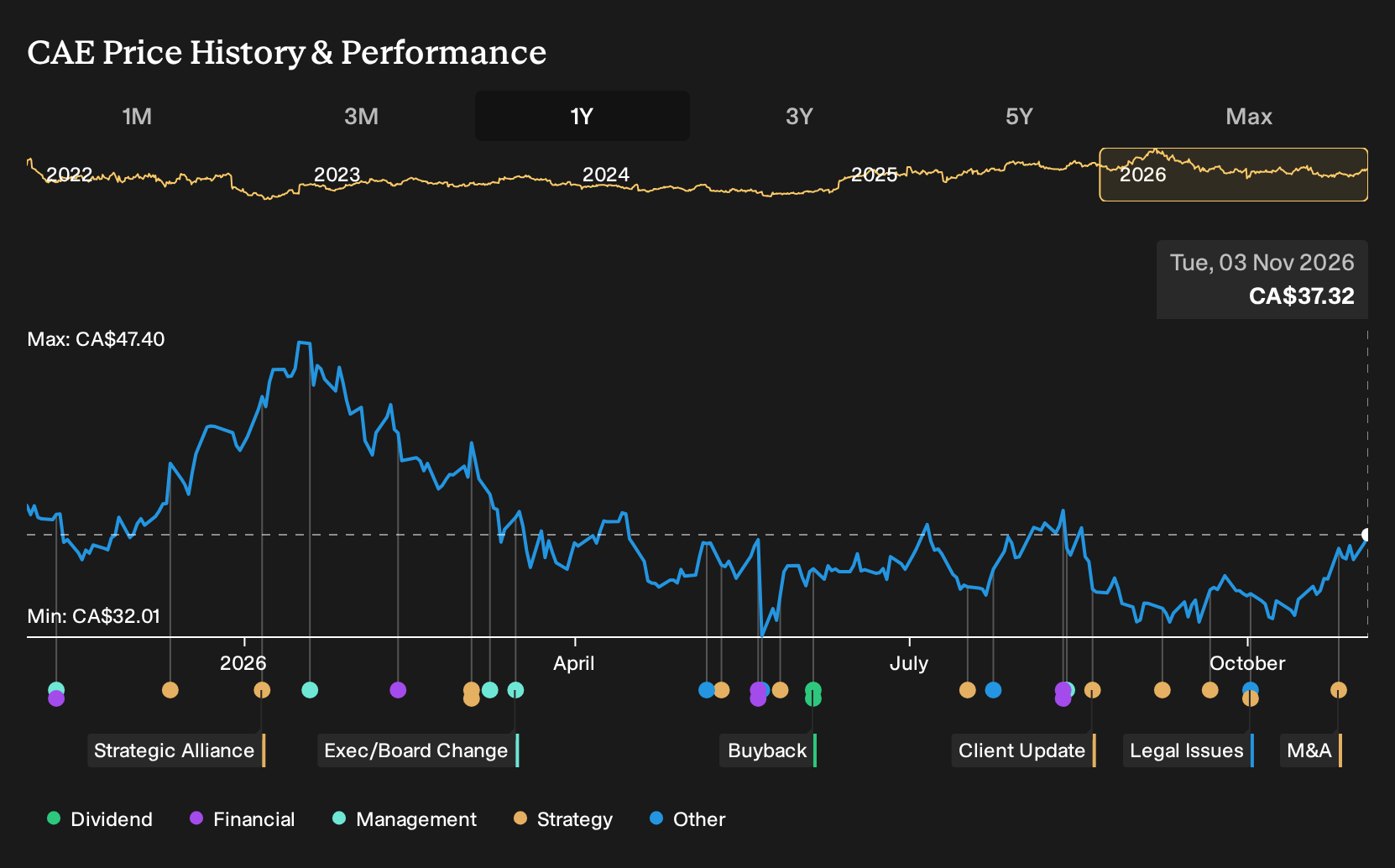
CAE's story currently links that earnings ambition to a consensus price target of CA$44.47, set against a recent share price of CA$33.86 and a spread of analyst views from CA$28.0 up to CA$54.0. The settlement puts an extra spotlight on how management communicates as it pursues cost savings of CA$125 million to CA$150 million and targets CA$950 million to CA$1b of adjusted segment operating income by fiscal 2030. For you as a shareholder or potential buyer, the class action does not change those numbers on its own, but it does add one more lens for judging whether future disclosures will help you track progress against them with more clarity.
CAE's narrative projects CA$5.4b revenue and CA$523.0 million earnings by 2029. This assumes 2.7% yearly revenue growth and an earnings increase of roughly CA$236 million from CA$286.9 million today.
Uncover why CAE's fair value indicates a 19% potential upside to its current price, which could narrow quickly.
Exploring Other Perspectives
One alternative view on CAE leans hard into the bullish earnings path. The most optimistic analysts were modelling about CA$5.8b of revenue and CA$572.2 million of earnings by 2029, with a CA$54.0 price target, before this settlement news. You can treat the lawsuit as a fresh test of that confidence and compare several viewpoints.
Explore 3 other CAE fair value estimates, including one that suggests as much as 45% potential upside from the current price.
Decide For Yourself
Don't just follow the ticker. Dig into the data and build a conviction that's truly your own.
- A great starting point for your CAE research is our analysis highlighting 2 key rewards and 2 important warning signs that could impact your investment decision.
- See our latest analysis for CAE. The report includes a comprehensive fundamental analysis summarized in a single visual, the Snowflake, making it easy to evaluate CAE's overall financial health at a glance.
Looking for more CAE sized investment ideas?
If the CAE story has you thinking more broadly about where to put fresh capital to work, it can help to scan a wider field of opportunities that match different risk and income preferences.
- For income focused investors who want yield with some buffer around the payout, start with a shortlist of 3 dividend fortresses and see which businesses align with your risk tolerance.
- If capital preservation and balance sheet resilience matter most to you, filter for companies with sturdier finances using a list of solid balance sheet and fundamentals (6 results) that can handle tougher conditions.
- When you want to broaden your watchlist beyond widely followed stocks, use a curated mix of 8 high quality undiscovered gems to surface candidates that may not yet be crowded trades.
Have feedback on this article? Concerned about the content? Get in touch with us directly. Alternatively, email editorial-team@simplywallst.com