


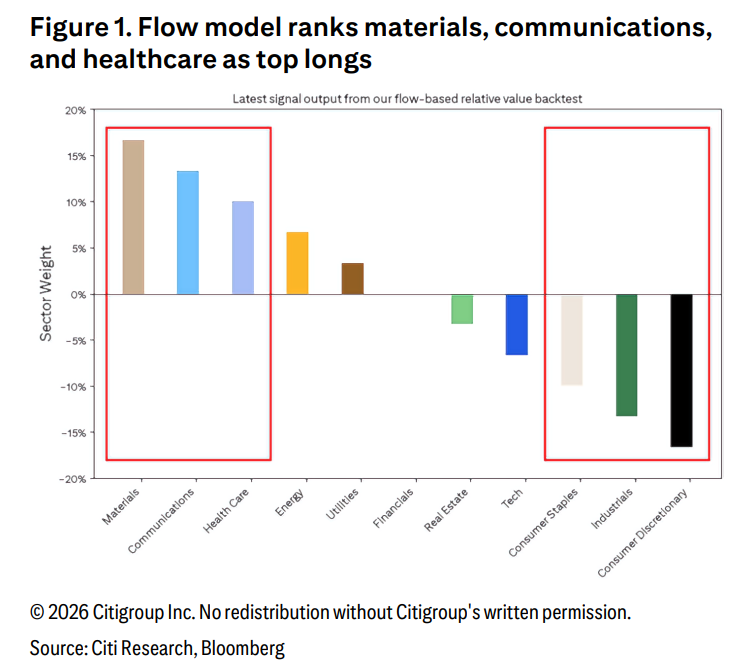
The Zhitong Finance App learned that in the newly released research report, Citi indicated that its capital flow model has completed a decisive divestment operation in the technology sector, establishing the materials, communication services, and healthcare sectors as a priority direction for diversification, and at the same time pushing the technology sector into a net short area. This change in position marks that the sell-off pressure previously indicated by the bank has officially reached its peak. Institutional allocators are expanding de-risking operations and further withdrawing from the capital-intensive artificial intelligence (AI) infrastructure sector.
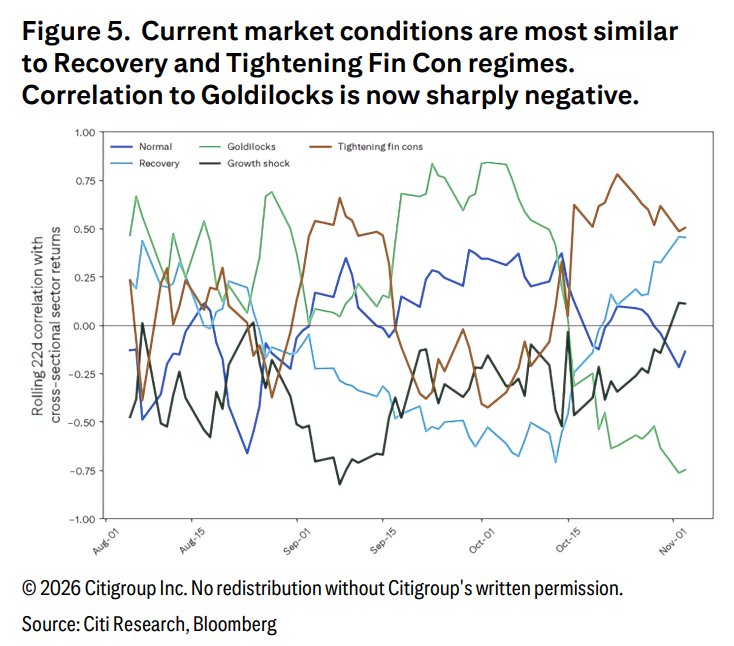
In the investment outlook for the next two months, optional consumption, industrial, and essential consumer goods have now become the sectors with the largest short positions in the model. The consolidated capital flow of institutional managers over the past month shows that capital is being withdrawn from the technology sector while continuing to rotate to cyclical value stocks and high-quality defensive assets. The technology sector has been doubly sold by long-term funds and hedge fund accounts, and the scale of the sell-off far exceeds that of any other sector. At the same time, judging from the cross-sectional correlation of industry returns, the market environment has clearly moved away from the “Golden Girl” state to the “tightening of financial conditions” stage in the later stages of the cycle.
Specifically, Citi pointed out that the relative value capital flow model has completely abolished the previous favorable allocation position on the technology sector, and instead gave positive weight to cyclical sectors and defensive sectors supported by real assets. The model currently gives the materials, communications services, and healthcare sectors the most positive weight, while the optional consumer, industrial, and essential consumer goods sectors rank at the bottom. The technology sector previously ranked as the first choice for model growth for several weeks, but now there has been a sharp reversal, directly shifting to a low allocation state, and medium-term capital flow support no longer exists.
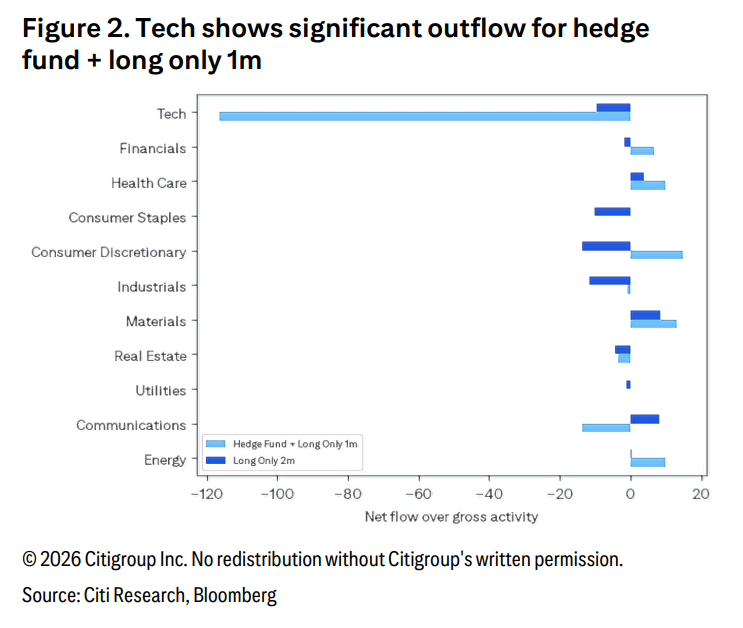
The clear differentiation between previous 1-month and 2-month positions highlighted large-scale industry rotation in institutional portfolios. The consolidated capital flow of hedge funds and long-term funds in the past month was mainly in the optional consumption and materials sector, although the cumulative capital flow of long-term funds over the past two months still showed a large net outflow to the optional consumption and industrial sectors. This also explains why despite recent tactical purchases, the optional consumer sector is still listed as the main shorting target in the model; at the same time, the materials sector has shown resilience in both time dimensions.
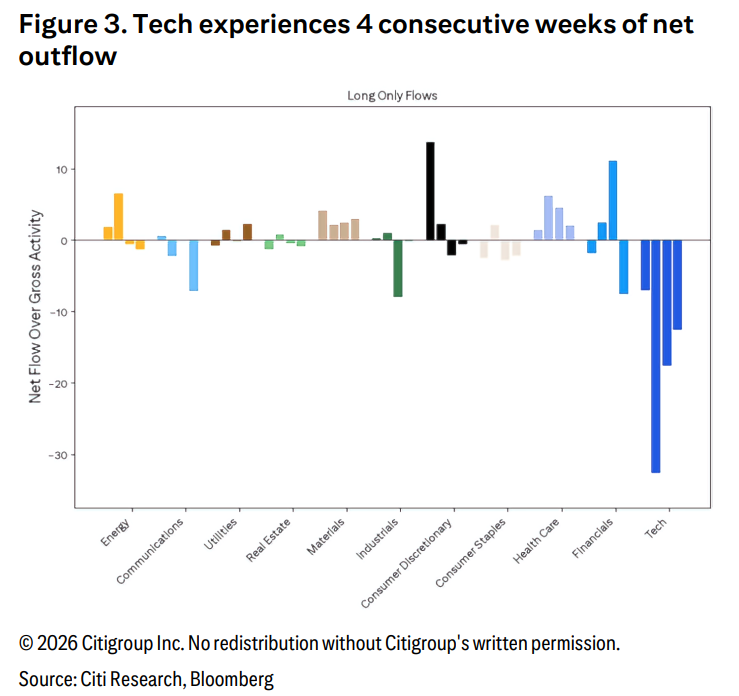
Over the past week, long-term investors have stepped up their exit from the technology sector while actively increasing their holdings in the materials, utilities, and healthcare sectors. Long-term fund managers generally saw net sales, with the technology, industry, and communications services sectors experiencing large-scale liquidations. In contrast, long-term fund managers have begun to increase their holdings in the materials, utilities, and healthcare sectors, reflecting a clear shift in capital to assets supported by physical assets and low beta values.
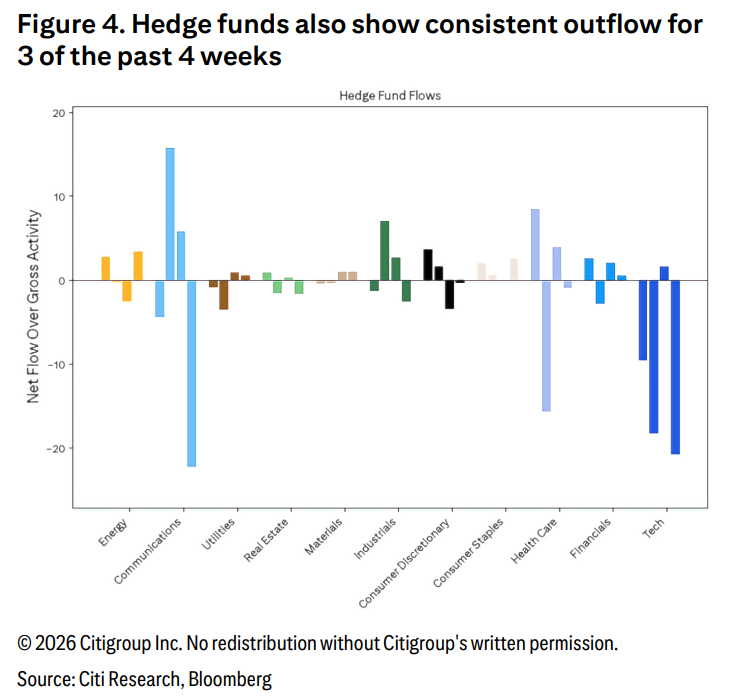
Hedge funds are also leaving the technology and communications services sector in large numbers, shifting their tactical risk exposure to the energy and essential consumer goods sectors. The sharp decline in hedge fund capital flows was mainly driven by large-scale deleveraging operations in the technology and communications services sector. After a steady increase in holdings in the communications services sector for several weeks, this change marks a sudden reversal in the sector's capital flow. The remaining capital is being transferred to the energy and essential consumer goods sectors to seek cash flow assets that can withstand inflation; however, overall, net sales still dominate.
Cross-sectional market dynamics confirm that the market environment is undergoing a decisive institutional transformation, from a “golden girl” status to a “tightening of financial conditions” stage in the later stages of the cycle. Tracking the rolling cross-sectional correlation between actual industry returns and the historical market environment template shows that the correlation between the market and the “Goldilocks” status has fallen sharply into a deep negative range. At the same time, the market's correlation with the state of “tightening financial conditions” has risen sharply. As market concerns about large-scale capital expenditure in the technology industry continue to grow against the backdrop of stubborn inflation and ongoing geopolitical risks, this trend is also becoming more obvious.
The relative performance of the industry over the past month shows that the market is undergoing defensive rotation at the cost of selling off high-beta growth stocks. Sectors with leading relative returns include essential consumer goods, healthcare, utilities, finance, and energy, while the technology and communications services sector experienced severe relative retracement. This fragmentation of performance between sectors further confirms the shift in the macro environment, and also explains why institutional managers are acting quickly to reduce exposure to crowded technology stocks.