


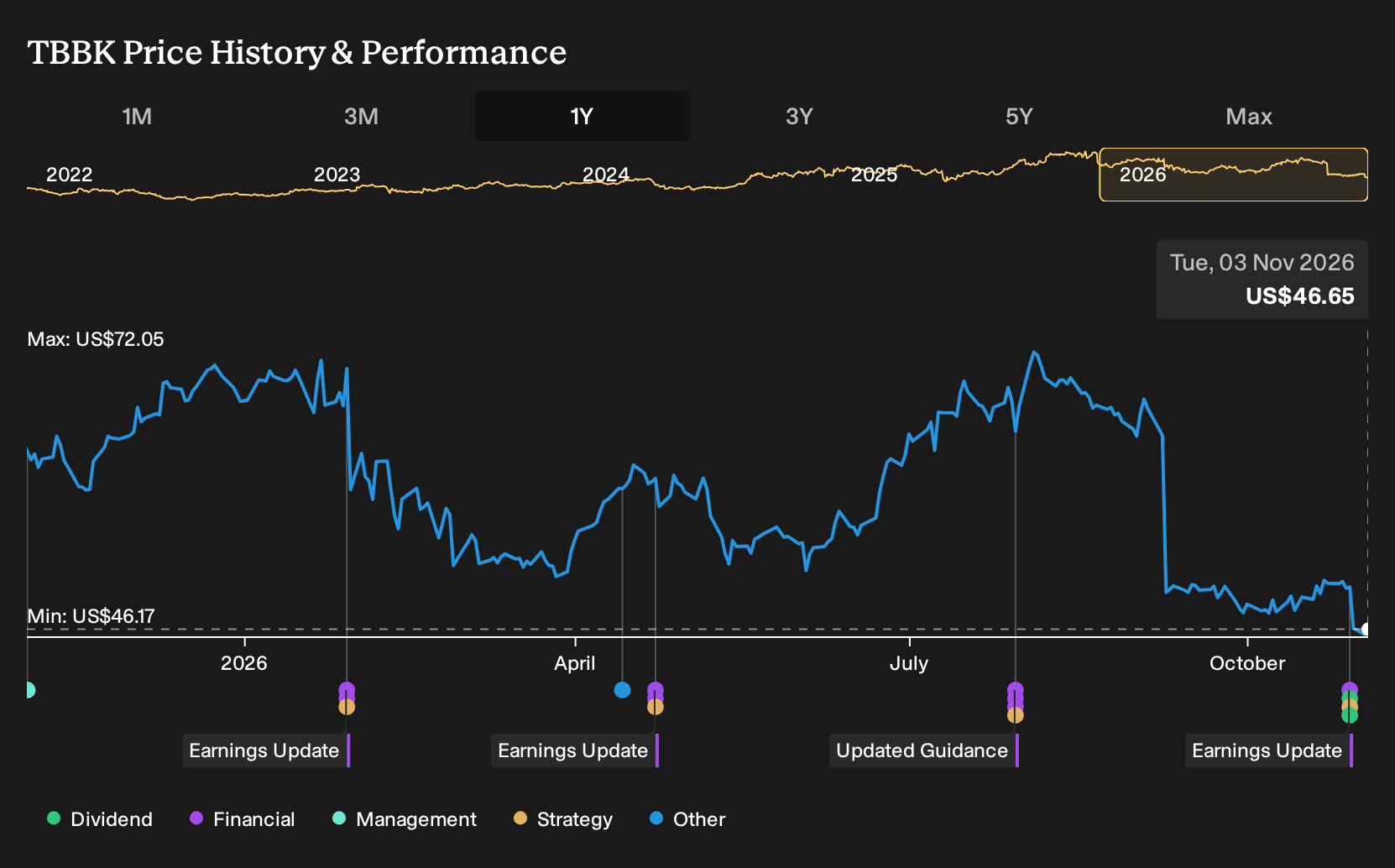
- The Bancorp reported Q3 2026 net income of US$62.78 million and diluted EPS from continuing operations of US$1.53, alongside total net charge offs of US$40.66 million that were broadly similar to the prior year period.
- Along with these results, The Bancorp completed a US$150 million buyback and introduced a new program tied to cumulative adjusted net income through early 2028, highlighting its current focus on capital returns.
- This article examines how The Bancorp's investment narrative is influenced by its Q3 earnings and the expanded cumulative adjusted net income buyback.
Scan beyond Bancorp by comparing its latest buyback activity and credit trends with the curated 30 resilient stocks with low risk scores that focuses on resilience when conditions change.
Bancorp Investment Narrative Recap
Bancorp still asks you to believe in a niche, fee-heavy model tied to fintech partners and specialized lending rather than a broad retail footprint. Q3 results kept that story intact, with higher net income and EPS alongside charge offs that were close to last year. The near term swing factor remains how smoothly management reshapes the client mix as large fintech programs such as Chime transition away.
The biggest risk right now sits in that concentration. Any disruption with key fintech relationships or the REBL and consumer credit books could matter quickly. Management’s restructuring push is aimed at keeping earnings power intact as that partner mix changes, but revenue pressure from lower prepayment fees and client shifts still hangs over the next few quarters.
The new buyback framework, which is linked to cumulative adjusted net income through early 2028, is the announcement that really connects to this quarter. It ties capital returns directly to the profits the bank actually generates. That makes execution on fee income, credit costs, and expense control even more important for anyone watching near term EPS momentum.
For you as an investor, this plan sharpens the trade off between returning cash and keeping flexibility for credit costs or growth investments. If earnings come under pressure from fintech churn, REBL credit issues, or margin compression, the tension between maintaining the program and preserving balance sheet strength could become a central catalyst to track.
What The 2028 Analyst Framework Implies For Bancorp
Analysts now pin Bancorp's medium term story to a 2028 destination where earnings are expected to reach US$337.0 million on a revenue base of US$497.5 million. That profile leans heavily on profit margins rising from 43.9% today to 67.7% in 2028, even as revenue is projected to edge down by 0.1% per year rather than expand. For investors, that means the thesis is less about pursuing top line growth and more about assessing whether a fee heavy, fintech centric model can generate more profit from a roughly similar revenue pool.
Bancorp's narrative projects US$497.5 million revenue and US$337.0 million earnings by 2028. This assumes revenue decreases by 0.1% per year and implies an earnings increase of about US$119.5 million from the current US$217.5 million level.
The same forecasts also incorporate a shrinking share count, with analysts expecting outstanding shares to fall by about 7% annually over the next three years. The new buyback framework, which is tied to cumulative adjusted net income through early 2028, aligns with that assumption. If actual repurchases follow that pace, each remaining share would represent a larger claim on earnings, even if overall profit trends remain consistent with the current consensus path.
Valuation expectations sit on top of this earnings profile. The current analyst framework is based on Bancorp trading at a P/E of 9.3x on 2028 earnings, compared with 10.0x today and an industry level cited at 10.7x. That structure asks investors to consider a higher earnings base and wider margins while also accepting the possibility that the stock could trade at a slightly lower earnings multiple than it does today.
Price targets then follow from those building blocks. With a current share price of US$45.82 and a consensus target of US$69.00, the implied upside is 33.6% if the revenue, margin, and earnings path develops in line with the analyst template. For portfolio decisions, the key question is not the exact target level but whether the assumptions around flat to slightly weaker revenue, much higher profitability, and ongoing buybacks appear realistic given Bancorp's fintech exposure and credit mix.
Uncover why Bancorp's fair value indicates a 64% potential upside to its current price, which could narrow quickly.
Exploring Other Perspectives
The Bancorp attracts three fair value views from the Simply Wall St Community, stretching from about US$52 to roughly US$133 per share. That gap signals widely different expectations around fintech fee durability, REBL credit risk, and the new earnings linked buyback. Use those contrasting opinions to stress test your own thesis before acting.
Explore 2 other Bancorp fair value estimates, including one that suggests potential upside of up to 186% from the current price.
Reach Your Own Conclusion
Disagree with existing narratives? Extraordinary investment returns rarely come from following the herd, so go with your instincts.
- A great starting point for your Bancorp research is our analysis highlighting 5 key rewards and 2 important warning signs that could impact your investment decision.
- See our latest analysis for Bancorp. The report includes a comprehensive fundamental analysis summarized in a single visual, the Snowflake, making it easy to evaluate Bancorp's overall financial health at a glance.
Looking For More Investment Ideas Beyond Bancorp?
Once you have a view on Bancorp, it can help to set it beside other opportunities that fit different roles in your portfolio. The Simply Wall St Screener gives you ready made shortlists so you can quickly compare quality, balance sheet strength, and income potential without starting from scratch each time.
- For investors hunting for quality at a discount, review a curated 34 high quality undervalued stocks that combine solid fundamentals with pricing that may not fully reflect them yet.
- If capital preservation and financial strength matter most to you, focus on companies with cleaner balance sheets through the list of solid balance sheet and fundamentals (24 results).
- Those building an income focused portfolio can zero in on reliable payers by scanning the 4 dividend fortresses that aim to pair yield with resilience.
Have feedback on this article? Concerned about the content? Get in touch with us directly. Alternatively, email editorial-team@simplywallst.com