


- VeriSign reported third quarter 2026 sales of US$443 million with net income of US$212.6 million, and updated full year 2026 guidance to revenue of US$1.755 billion to US$1.760 billion and operating income of US$1.188 billion to US$1.192 billion, incorporating a US$7.5 million third quarter expense.
- The board also approved a US$0.81 per share cash dividend payable in November 2026, which indicates that current earnings power is being shared with shareholders while the business refines its outlook.
- We will now examine how VeriSign's refreshed 2026 guidance could influence the investment narrative built around its domain registry franchise.
VeriSign Investment Narrative Recap
To own VeriSign, you need to be comfortable with a concentrated domain registry model, where .com and .net remain the engine and contract terms with regulators stay favorable. The refreshed 2026 guidance, including revenue of about US$1.76b and operating income near US$1.19b, suggests management still sees the current run rate as intact despite the US$7.5 million expense.
The near term swing factor is whether domain registration and renewal trends hold up as new products, price increases and .web rollout plans develop. The main operational risk remains any slowdown in .com and .net demand or rising scrutiny around future contract renewals that could constrain pricing or economics.
The most relevant update here is the 2026 earnings guidance revision. It explicitly absorbs the US$7.5 million third quarter charge into a still tight operating income range of US$1.188b to US$1.192b. That indicates the underlying cost structure and capital light model remain central to how VeriSign frames its outlook.
For you as a shareholder, this matters because many of the key catalysts, from announced wholesale price increases on .com and .net to upcoming security products and .web, rely on consistent execution on an already profitable base. Any future change to that guidance, or to domain registration momentum, would likely be the first place to watch for cracks in that thesis.
VeriSign's current analyst narrative points to revenue of US$2.3b and earnings of US$1.2b by 2029, built on a forecast 9.4% yearly increase in revenue and a move from US$849.8 million in earnings today to the US$1.2b consensus, which is an earnings rise of roughly US$350 million over that period.
Uncover how VeriSign's fair value indicates a 7% potential upside to its current price before the market closes that gap.
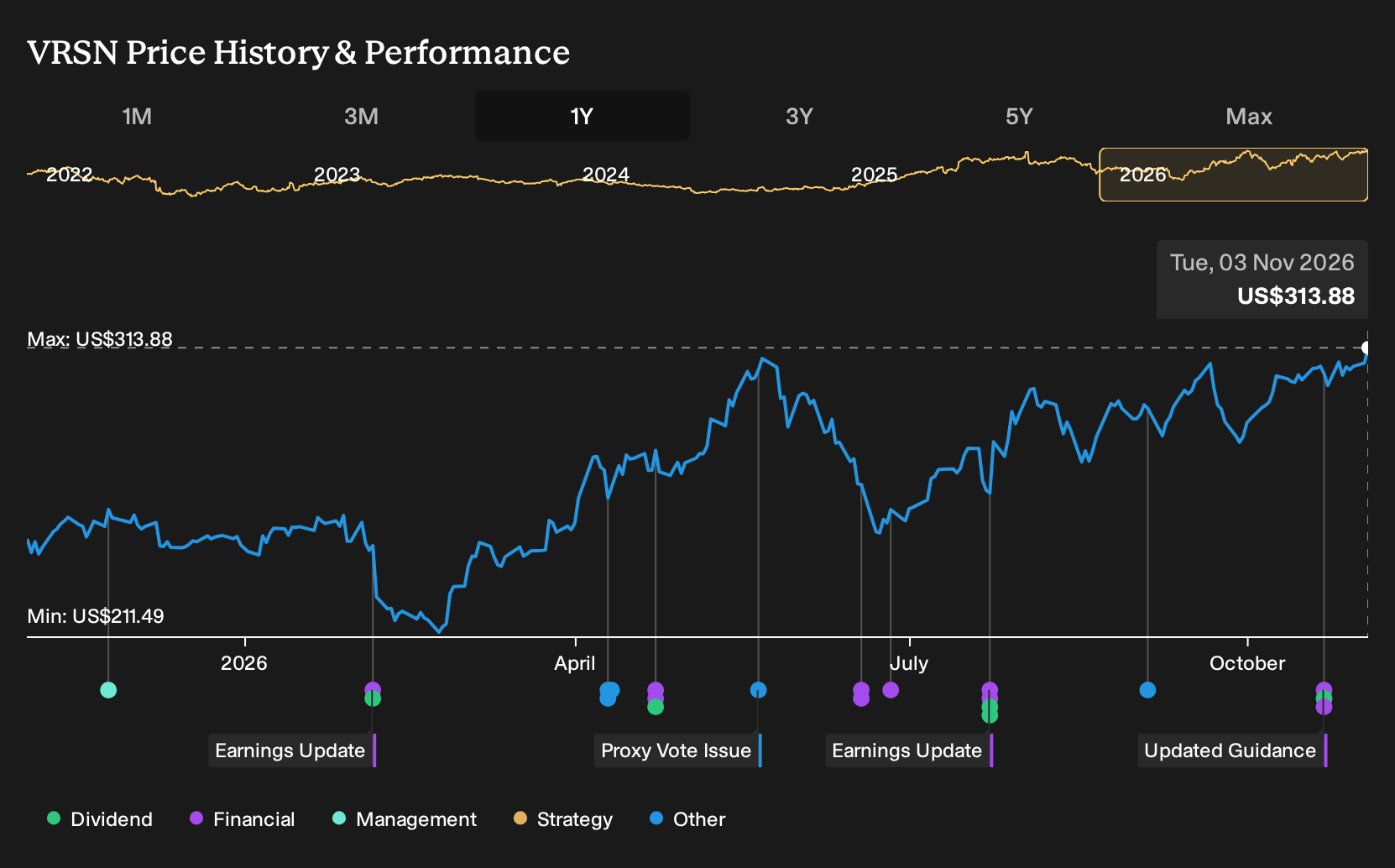
Exploring Other Perspectives
Some of the lowest ranked analysts focus on a different risk for VeriSign. They worry that AI agents could gradually reduce the need for traditional domains, which would matter a lot more than the updated 2026 guidance. Those forecasts were already cooler, with projected 2029 revenue near US$2.2b and earnings around US$1.1b. That is a more cautious story than the consensus, and both sets of expectations were built before this guidance change. You may want to compare how each view could shift as fresh data lands.
Explore 5 other VeriSign fair value estimates, including one that suggests as much as 47% downside from the current price.
The Verdict Is Yours
Don't just follow the ticker. Dig into the data and build a conviction that's truly your own.
- A great starting point for your VeriSign research is our analysis highlighting 2 key rewards and 3 important warning signs that could impact your investment decision.
- See our latest analysis for VeriSign. The report includes a comprehensive fundamental analysis summarized in a single visual, the Snowflake, making it easy to evaluate VeriSign's overall financial health at a glance.
Looking For More Ideas Beyond VeriSign?
Once you have formed a view on VeriSign, it can help to set it alongside other businesses with different strengths. The Simply Wall St Screener lets you do that quickly by filtering the market for the traits you care about most.
- If you want resilience to be front and center, focus your search on companies with sturdy balance sheets and consistent fundamentals through our list of solid balance sheet and fundamentals (23 results).
- For investors who care about compounding income as well as price moves, narrow in on steady cash distributors using the 4 dividend fortresses.
- When the goal is to find quality at a price that still looks reasonable, shift your attention toward companies that pair strong financial profiles with appealing valuations via the 19 high quality undiscovered gems.
Have feedback on this article? Concerned about the content? Get in touch with us directly. Alternatively, email editorial-team@simplywallst.com