


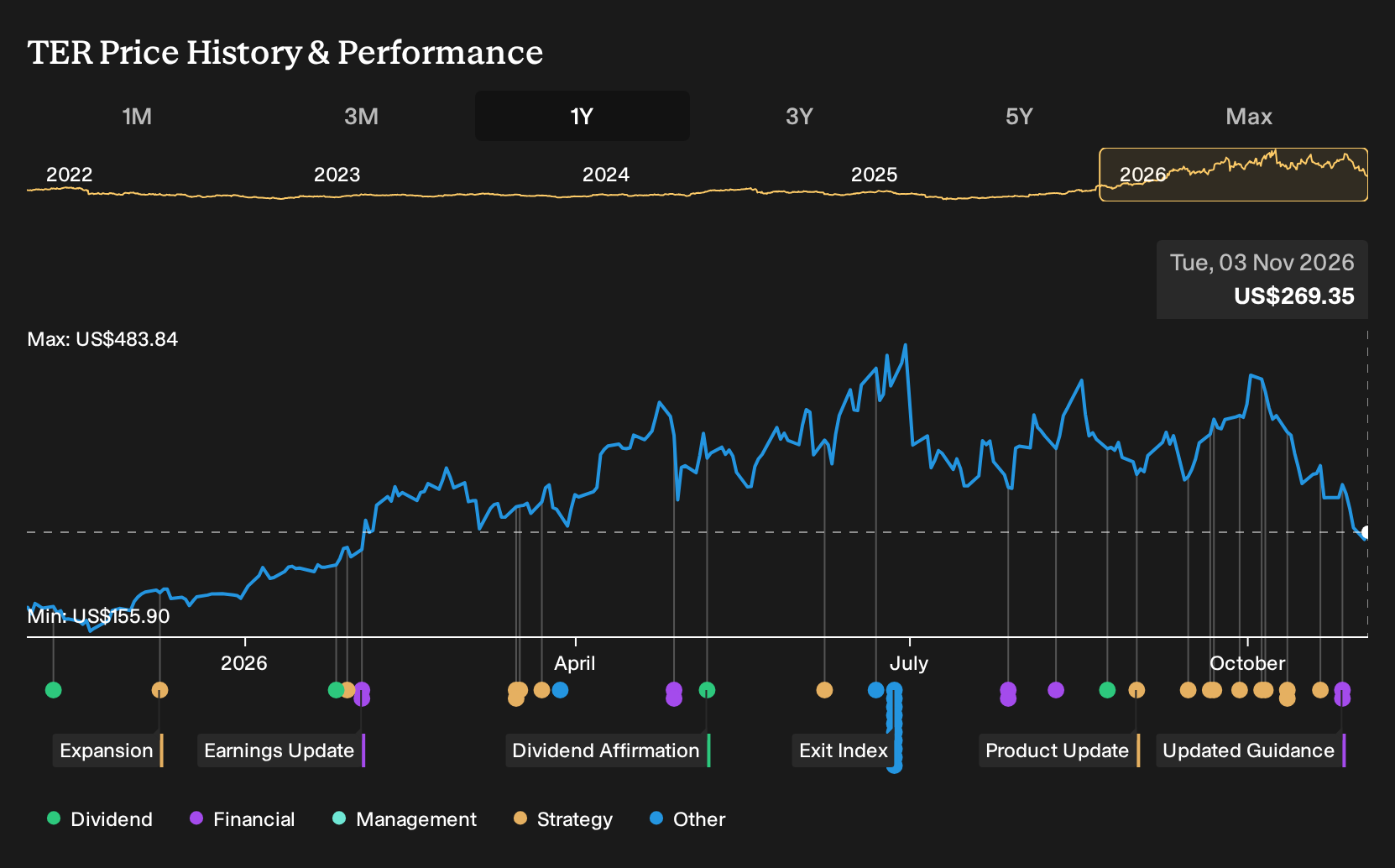
- Teradyne reported third quarter 2026 sales of US$1,305.95 million and net income of US$342.41 million, with earnings per share from continuing operations above the prior year period, and issued fourth quarter guidance that frames revenue between US$1,250 million and US$1,350 million.
- Behind the headline figures, Teradyne is tying stronger earnings to efficient asset utilization and expanding AI focused test and robotics activity. A new robotics partnership with Sereact shows how its automation technology is being applied to real world logistics tasks such as fashion returns processing.
- This article examines how Teradyne's investment narrative around AI driven test and robotics is affected by its recent earnings strength.
Teradyne Investment Narrative Recap
To stay comfortable as a Teradyne shareholder, you need to believe the firm can keep turning AI driven test demand and robotics into durable earnings, not just a one year spike. The latest quarter, with US$1,305.95 million in sales and US$342.41 million in profit, supports that operating story. The near term swing factor is how long AI focused capital spending and complex chip testing needs stay firm.
The biggest risk still sits in product mix and volume. Management has already talked about margin pressure when orders tilt away from compute heavy testers, and higher R&D for compute and robotics raises the bar for future payback. Fourth quarter guidance of US$1,250 million to US$1,350 million in revenue and US$1.88 to US$2.18 in GAAP EPS frames expectations but does not remove that execution risk.
Among the recent news, the Teradyne Robotics partnership with Sereact is the one that ties closest to the current AI and automation story. Sereact’s Cortex platform runs Universal Robots arms, giving retailers and logistics providers a way to automate messy work such as processing returned fashion items. Hundreds of robots are already deployed at customer sites across Europe.
That roll out matters because it shows Teradyne’s robotics unit handling real world, unstructured tasks at scale, not just pilot projects. If those deployments keep broadening into use cases such as replenishment, piece picking and kitting, robotics could become a more meaningful offset when semiconductor test mix or volumes soften, while still carrying its own execution, adoption and pricing risks.
Analysts currently frame Teradyne's outlook around revenue growing at 21.2% a year, with earnings today of about US$1.4b expected to reach US$2.9b by 2029. This represents a value increase of roughly US$1.5b, which in turn underpins forecasts for 2029 revenue of about US$8.9b.
Uncover why Teradyne's fair value indicates a 58% potential upside to its current price, which could narrow quickly if sentiment around Teradyne shifts.
Exploring Other Perspectives
Some of the most optimistic Teradyne analysts lean hard into AI data center demand. Before this earnings release, they were penciling in about 29% annual revenue growth and US$3.6b in earnings by 2029, compared with the US$2.9b consensus. You can treat this quarter’s robotics and AI test strength as a new input and compare several different narratives.
Explore 4 other Teradyne fair value estimates, including one that suggests as much as 96% upside from the current price!
Reach Your Own Conclusion
Don't just follow the ticker. Dig into the data and build a conviction that's truly your own.
- A great starting point for your Teradyne research is our analysis highlighting 5 key rewards that could impact your investment decision.
- See our latest analysis for Teradyne. The report includes a comprehensive fundamental analysis summarized in a single visual, the Snowflake, making it easy to evaluate Teradyne's overall financial health at a glance.
Looking for more ideas beyond Teradyne?
Once you are comfortable with Teradyne's story, it can help to line it up beside a few alternatives so you can judge risk and reward in context rather than in isolation.
- If you want a starting point for quality at a discount, scan a curated set of 35 high quality undervalued stocks that pair stronger fundamentals with what may be more modest expectations baked into the price.
- For steadier profiles with a focus on resilience, filter the market by balance sheet strength using this list of solid balance sheet and fundamentals (23 results) and compare how those companies fund growth and handle downturns.
- When you are hunting for less crowded opportunities with healthier fundamentals, set aside a few minutes to review this 19 high quality undiscovered gems and see which businesses deserve a closer look next.
Have feedback on this article? Concerned about the content? Get in touch with us directly. Alternatively, email editorial-team@simplywallst.com