


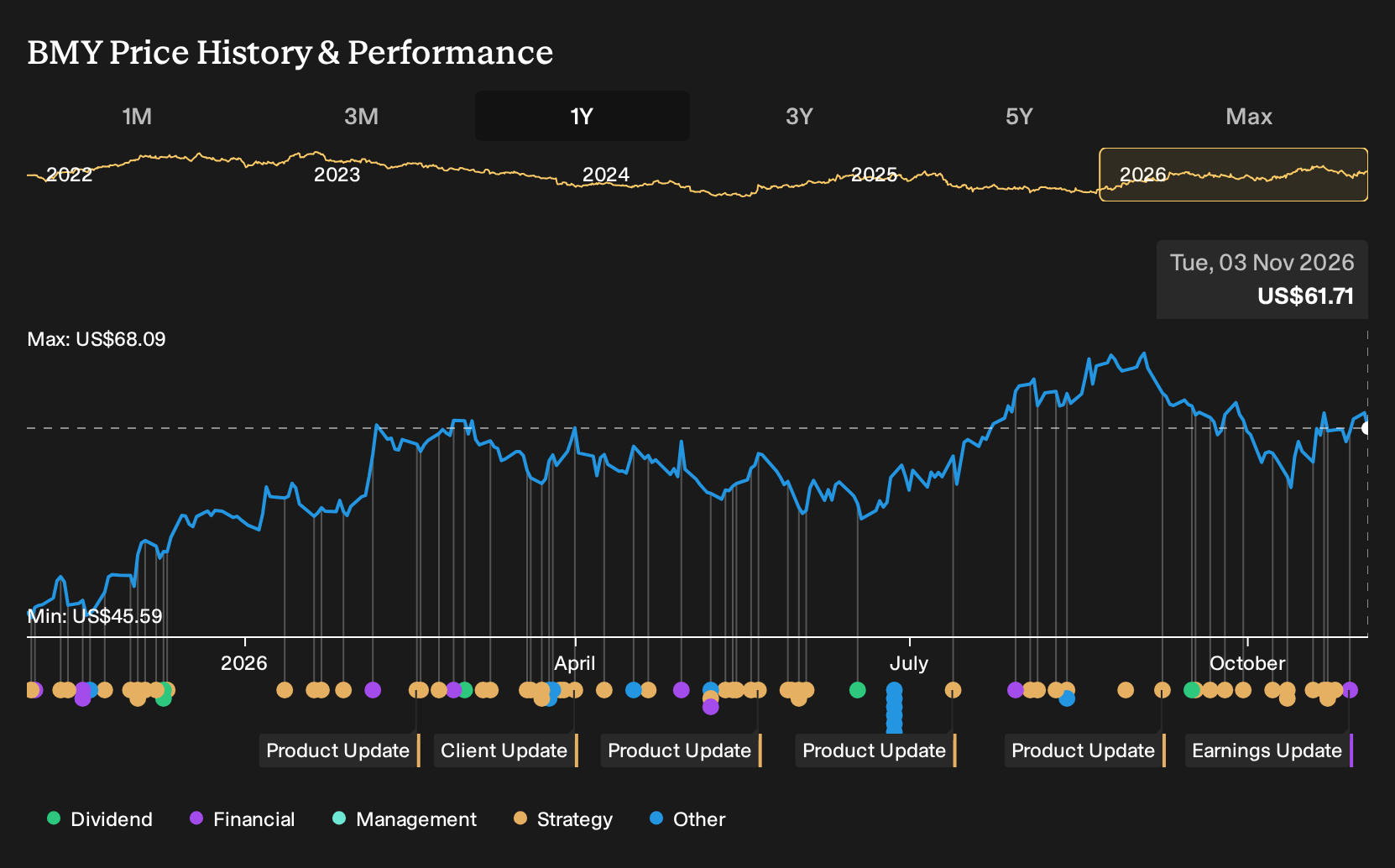
If you had bought Bristol-Myers Squibb on 3 November 2025, the past year would have looked very different depending on which narrative you trusted about its patent cliffs and pipeline. For Bristol-Myers Squibb shareholders, the return over the past year was 41.4%, including dividends. If that decision were on the table again, would you focus more on the looming expiries and lawsuits, or on the string of late-stage cancer and cardiology trial wins now on show?
Bristol-Myers Squibb is not the only name tied to this theme. Zero in on 34 healthcare AI stocks and compare how each one is priced.
The Two Stories Bristol-Myers Squibb Investors Had To Weigh
The shares cost US$46.02 at the start of the period, and Bristol-Myers Squibb holders were effectively choosing between two sharply different stories.
The bullish view pointed to aging populations and genomics. It treated a Fair Value of US$53, the price implied by its own assumptions, as reasonable if revenue declined 4.7% a year while profit margin rose to 22.4% and the future P/E reached 14.4x.
The bearish narrative leaned into debt and patent pressure, with a Fair Value of US$34. It focused on the risk that loss of exclusivity for drugs like Eliquis, Opdivo, and Revlimid would erode pricing power and earnings.
What The Results Changed For Bristol-Myers Squibb
The biggest new fact was Bristol-Myers Squibb booking Q3 2026 revenue of US$13,069m with net income of US$2,162m, which kept the business firmly profitable but with net margin slipping from 18.0% to 16.5%. That challenged the clean margin expansion assumed in the bullish case, so the period’s evidence leaned toward the cautious read rather than fully validating either side.
The useful takeaway is simple. When a thesis leans on future profitability, keep track of reported net margin and not just new product headlines. That single figure tells you whether promised efficiency is actually showing up in the numbers.
What Bristol-Myers Squibb's Current Price Already Assumes
Today Bristol-Myers Squibb trades at US$61.71, with the selected Narrative’s Fair Value sitting below that quote. The Narrative frames a mature pharma group with wide disease coverage and an established position in large-cap healthcare.
The core question is what must keep working for this level to hold. A buyer here has to judge whether future cash flow can cover patent cliffs, potential pricing pressure and any acquisition risks highlighted by the Narrative.
"The business checks I run look healthy: dividend safety, returns on equity and capital, liquidity, leverage, debt service, revenue, earnings, cash generation, margins and accounting quality all come out fine. What holds me back is not quality but price. At current levels the stock trades above fair value and above my entry filters, so the buy signal stays Risky."
One Narrative has put a figure on that disagreement. → See the Narrative with its lower Fair Value, assumptions and all
Find Your Own Contrarian Opportunity
By the time a rally makes headlines, you are reading about returns someone else has already earned. Why not go straight to the source and look for your own contrarian opportunity? These three companies trade below our estimated value.
- Company 1 - 43% below our estimate - targets larger LED display projects using software, services and manufacturing upgrades.
- Company 2 - 28% below our estimate - embeds chips and software in digital infrastructure that keeps data moving and secured.
- Company 3 - 42% below our estimate - expands protective film production and installer networks to deepen ties with automakers.
Those are three of them. See the full list of 35 companies trading below our fair value estimates →
Have feedback on this article? Concerned about the content? Get in touch with us directly. Alternatively, email editorial-team@simplywallst.com