


Also “Silver Ten,” car companies are not the same in their sorrow and joy. Some car companies continue to deliver more than 100,000 vehicles in a single month, and some are still hovering on the edge of breaking 10,000, yet there are still “variables” in the automotive industry pattern.
The Zhitong Finance App learned that recently, with 492,000 vehicles, BYD (01211) is in an absolute leading position with 492,000 vehicles, while Zero Run (09863) is leading the new forces with 1061 thousand faults. Xiaopeng and Xiaomi both stand with 50,000 cars. Other new forces are also struggling to catch up. One Super League is still the main pattern, but this monthly fluctuation may mean that the knockout tournament has entered a critical stage.
The pressure on the industry is gradually showing. According to the estimates of the Passenger Federation Branch, passenger cars in the narrow sense of the word were retailed in October, down 1.1% from the previous month, down 28.9% from the previous year. Of these, 1.07 million new energy vehicles were sold, with a penetration rate of about 66.9%. Under a high base and high penetration rate, the growth rate of new energy vehicles is clearly slowing down. The head is expanding, the end is internal, and the sales differentiation in the industry is prominent. So who will be the final winner?
“One super, many strengths” main pattern, multiple echelons are trying their best to catch up
Under the main pattern of “one super many strong”, the leading performance is still stable. BYD sold 492,000 units in October, up 11% year on year, and sold 3.6217 million units in the first 10 months, maintaining the top sales volume by brand. Among them, 483,300 new energy passenger vehicles were sold, up 10.6% year on year, and is in an absolute leading position.
Many traditional car companies have accelerated the new energy conversion process, with a penetration rate of more than 60%. SAIC Motor sold 258,600 new energy vehicles in October, up 25.12% year on year, with a penetration rate of 60.14%. Geely New Energy sold 140,800 pure electric vehicles, up 43% year on year, and the penetration rate increased sharply to 69.3%; Great Wall Motor sold 49,500 new energy vehicles, with a penetration rate of 41.1%. Furthermore, GAC and Changan have yet to announce sales volumes, but according to the previous three quarters, the penetration rate was over 60%.
Zero Run was the most stable new force winner in October. In October, the world delivered 106,1,000 vehicles, up 51% year on year, and sold 100,000 units per month for four consecutive months; it delivered 773,000 units in the first 10 months, up 65.9% year on year, making it the brand with the best combination of scale and growth rate. By the end of October, Zerosport had delivered more than 1.9 million vehicles worldwide, and the 2 millionth vehicle is expected to be launched in November.
Xiaopeng and Xiaomi are in the same “little” generation, and they all stood on the steps of 50,000 cars. Xiaopeng delivered 50,200 vehicles in October, a year-on-year increase of 19.6%, a record high in a single month. Among them, 13,326 vehicles were delivered overseas, up 166% year on year. Xiaomi delivered more than 50,000 vehicles in October, breaking 50,000 for the first time in a single month. The first complete delivery month of the “Pengcheng” series launched in September contributed more than 20,000 vehicles, making it the second curve outside of pure electricity.
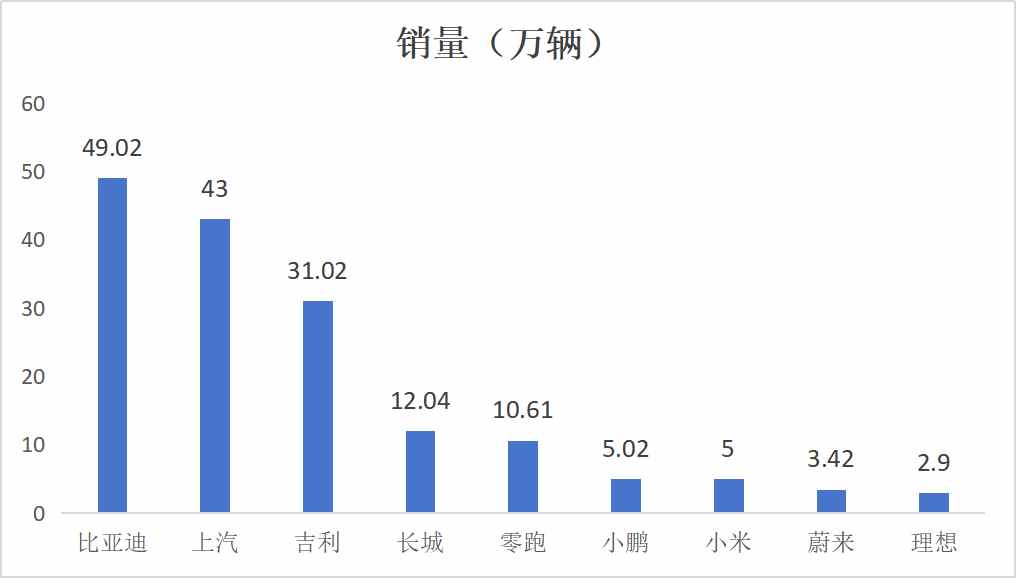
Data source: Publicly disclosed data
Judging from the competitive landscape, there are many strengths, and multiple echelons are clear: BYD is the general leader in the industry, and traditional car companies such as SAIC Motor and Geely are the Chinese army to support overall new energy sales; new forces are leading the team with Zero Run, and Xiaomi and Xiaopeng are catching up at an accelerated pace, while NIO and Ideal are looking for breakthroughs in the high-end market of 300,000 yuan or more. However, the core of competition in the industry has changed from “whether there are any new energy vehicles” to “who can achieve the ultimate configuration, smart driving, and cost at the same time in the same price range.”
In fact, as the growth rate is slowing down and living space is being reduced, car companies are showing ingenuity to seize their core advantages. In the case of brands that are selling well by new forces, Zero Run Global has continuously improved its product power and built good and inexpensive cars with the ultimate price-price ratio, winning recognition from car owners; Xiaomi has the dual identity of technology and traffic, making cars for young people, and the fan effect has a big impact; Xiaopeng uses smart driving as a selling point to develop its own intelligent driving technology and downgrade it to the price level of 100,000 to 150,000 yuan.
Exports have become the engine of growth, and Zero Run is still rushing for new forces
The penetration rate of domestic new energy is high, but overseas new energy development is slow, the penetration rate is low, and there is a huge market growth in the industry for exports, which has also become a new battleground for major brands.
According to data from the China Automobile Association, in the first 9 months of 2026, domestic automobile sales were 15.66 million units, down 22.4% year on year, while automobile exports were 8.205 million units, up 65.8% year on year. Among them, exports of new energy vehicles were 4.06 million units, up 1.3 times year on year, accounting for nearly 50%. On a monthly basis, 571,000 new energy vehicles were exported in September, an increase of 1.6 times over the previous year, accounting for 54.2% of exports, more than half for four consecutive months.
The export volume of car companies has maintained a high growth trend. Chery is the export leader. In October, the export volume was 194,700 vehicles, and BYD followed closely, with an export volume of 170,200 vehicles. Geely's export growth rate was the most impressive. The export volume was 107,200 vehicles, an increase of 158% over the previous year. Among the new power brands, Zero Run still maintains the leading trend. Reading exports remain number one. Xiaopeng made the most effort. In October, 13,326 units were exported and delivered, a sharp increase of 166% over the previous year, and the share of overseas sales increased to 26.5%.
Going overseas is also divided into two styles of play. Chery and BYD are large-scale and rely on vehicle exports and overseas factories to quickly increase volume; Great Wall, Wuling, and Zero go to the local area to take root, and CKD, assemble, and build factories step by step. The former is growing faster, and the latter has more room for maneuver in the face of changes in tariffs and access.
Europe is the market with the most definite increase and volume. According to Cui Dongshu's data, China exported 1.83 million vehicles to the EU in the first nine months of 2026, surpassing last year's full year. The single month of September soared 128% year-on-year, with a cumulative increase of 87%. Structurally, plug-in exports soared 372%, while pure electricity still nearly tripled under high tariffs, and mixed media grew 91%. Tariffs have raised the cost of vehicle exports, but have forced Chinese car companies to localize: Zero Run, Great Wall, and SAIC-GM-Wuling accounted for 34.6%, 41.9%, and 42.1% of CKD respectively. Spare parts first, then local assembly, and finally factory construction have become a realistic path to bypass the switch tax.
For car companies, exports have gone from being the “icing on the cake” to “the key to the finals,” but for every less car sold domestically, it is necessary to sell nearly two more cars overseas to make up for the balance, and every time they sell one more vehicle overseas, they also have to face the triple erosion of tariffs, exchange rates, and localization investment. Exports can save scale; they can't save profits. The real watershed is localization rate and bicycle gross profit. In this regard, Zero Run's successful profit model has brought a model for the industry to learn from.
“Smart driving+robots” advance simultaneously, and institutions prefer leaders
Intelligent driving is still the pinnacle of victory for car companies. Huawei's Qiankun, Xiaopeng's second-generation VLA, Ideal Mach M100 chip, and Xiaomi's self-developed big model are all increasing research and development, gaining a competitive advantage by installing new models, and the intelligent arms race has gone from “whether it is good or not” to “good or not to use.”
2026 is known as the first year of L3 mass production. In the first quarter, the first batch of L3 class autonomous mass-produced cars with special license plates were unveiled on designated highways and urban expressways in Beijing and Chongqing; Changan Deep Blue SL03 and BAIC Jihu Alpha S took the lead in commercialization pilot projects in Chongqing's inner ring and designated road sections in Beijing. The two mandatory national standards for intelligent connected vehicles will be implemented on January 1, 2027. L3 safety requirements, data records, and test methods will be written into the national standard, and the boundaries of authority and responsibility will be defined by the pilot notice.
The policy accelerates the arrival of L3. At the same time, it is also driving intelligent driving into a low price range. Urban NOA, automatic parking, and cabin driving have all sunk to the mainstream price of 150,000 yuan to 200,000 yuan, above 200,000 yuan. Smart driving is even more standard. However, intelligent R&D is a cost that is easily overlooked. Computing power, lidar, data compliance, and OTA recalls are all eating up gross profit. When car companies make smart driving a standard, the cost changes from “users pay” to “car companies pay”. This is also one of the reasons why the new forces are still generally losing money until now.
Notably, car companies are opening up a new growth curve, namely the robotics business. Among traditional car companies, the robot code “Yao Shunyu” project developed by BYD has been iterated to a seventh-generation prototype and has entered the product implementation stage; among the new power brands, Xiaomi, Xiaopeng, and Zero Run are all increasing their layout. Among them, in August of this year, Xiaopeng's robot business completed the first round of financing of more than 900 million US dollars, and the post-investment valuation exceeded 6.3 billion US dollars; the overseas brand Tesla Optimus has started early production on the Fremont plant's high-capacity production line, and the first batch of robots that met mass production quality standards officially went offline.
Taken together, the October sales list conveyed three signals: first, the main pattern of the industry is stable, but there are still variables. BYD and Zero Run maintain their leading positions in their respective markets. Traditional car companies have accelerated their penetration rate, and other new forces are also trying hard to catch up, and some brands are struggling to survive in the gap; second, exports have become a growth engine, and the share of new energy exports has increased, and Europe is the mainstream export market; the third signal has little impact on car companies but is the highest expected.
In the capital market, car companies' valuations have declined sharply since April of this year, and the NEV sector has risen by more than 4% in the past two trading days, and individual stocks have generally risen. Under the dominant pattern of many strengths, they are all at the bottom of valuations, and institutions still prefer industry leaders.