


The Zhitong Finance App learned that European defense stocks fell in response on Wednesday as the US Democratic Party swept away the election and hit investors' optimistic expectations of easing regulations and boosting economic growth through stimulus measures. The market structure of the day also highlighted policy rotation. The European Stoxx 600 index rose nearly 1%, leading the way in banking and clean energy sectors, while military stocks lagged behind clearly. Funding is being reallocated bets on the beneficiary paths and directions of the different Democratic Party policies in the context of the Democratic Party's sweeping the National Assembly.
The sharp decline in the European defense and military sector was mainly due to the Democratic Party's overwhelming victory in the midterm elections, which dampened market expectations for a further sharp increase in US military spending. A basket of European military stocks compiled by Goldman Sachs Group fell 4.1% on Wednesday, the biggest drop in more than four months. Nearly half of the revenue data contributed to the British BAE Systems, which came from the US market, once fell 5.9%, the worst target of the decline.
Mwb Research analyst Jens Peter Rick said in an email comment that the election results also dispelled “concerns that America will completely abandon the defense of its European allies,” and this concern was one of the factors driving the sector's rise in 2025.
Last year, under US President Donald Trump, America contracted its security commitments to Europe, prompting European governments to start drastically increasing defense spending, and European defense stocks rose sharply as a result.
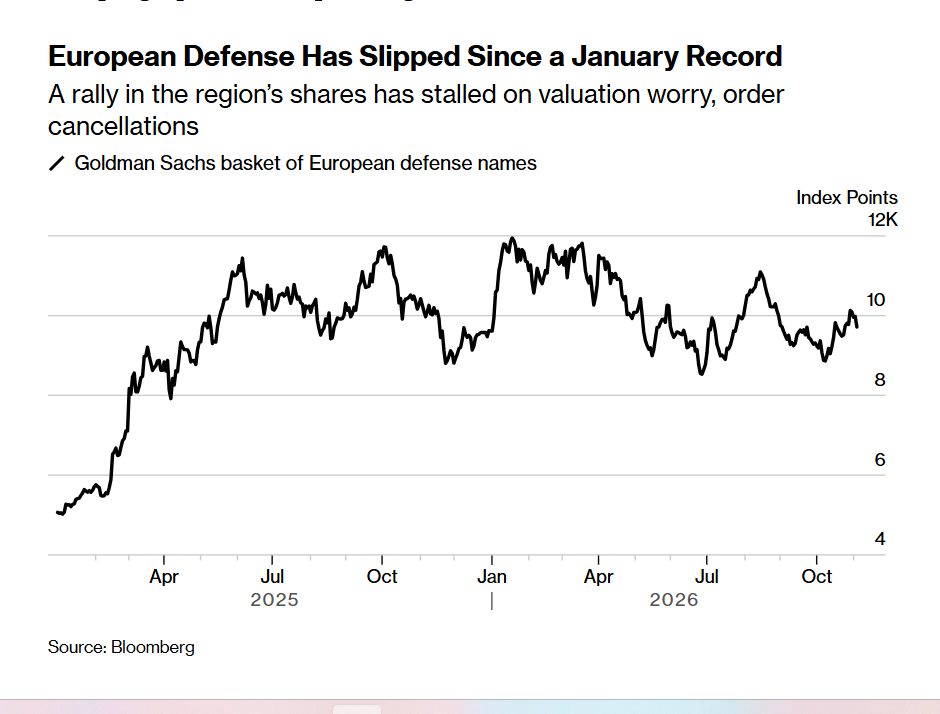
As shown in the chart above, European defense stocks have retreated since reaching record highs in January — valuation concerns and order cancellations have brought European military stocks to a standstill.
However, Alessandro Pozzi, a senior portfolio manager from Mediobanca, believes that the European market's reaction to the election news is somewhat surprising, considering that polls and forecasts have been pointing to the Democratic Party swept away for weeks.
Pozzi wrote, “Key air defense and missile defense projects, the 'Golden Dome' program, and shipbuilding received broad bipartisan support, although funding arrangements still depended on political discussions.”
Rick believes that the midterm election results “have a slight negative impact on market sentiment in German defense stocks”; stock prices may fluctuate even more when Hensault, Rheinmetall, and Renk Group announce their third-quarter results on Thursday.
“Blue Congress” lowers expectations of military spending expansion
The Democratic Party swept through both houses of Congress in the US midterm elections, causing the market to re-evaluate the viability of Trump's further drastic increase in military spending, and also weakened the trading logic of “America's contraction of European security commitments and forcing Europe to accelerate its expansion.” The “blue parliament” means that the Democratic Party controls both houses of the Senate and the House of Representatives at the same time.
However, the first impact of this adjustment is the increase in military spending and policy premiums that investors take into account in stock prices in advance. Subsequent profit impacts will still have to be reflected through budget allocations and procurement progress.
US military spending expectations are the most direct transmission channel. Trump's proposed $1.5 trillion defense spending plan for the 2027 fiscal year has not yet been approved. After the Democratic Party takes control of Congress, budget negotiations, project supervision, and fund allocation may all be more strongly constrained. For European contractors, which account for a relatively high share of US business, the speed of approval of new projects and the scale of procurement are expected to be adjusted accordingly. According to the Dow Jones report, Lockheed Martin, Northrop Grumman, and RTX also fell by more than 2% before the market on the same day, which is enough to explain the sell-off across European and American military companies.
European military stocks are also facing second-tier valuation pressure. The sharp rise in 2025 was based on expectations for Europe to fill security gaps and expand autonomous defense capabilities; after the January high, valuation concerns and order cancellations have dragged down the market. Mwb Research analyst Jens Peter Rick believes that the Democratic Party's victory allayed market concerns about America's “abandonment of Europe.” According to this judgment, investors will reduce the weight of the scenario where Europe is forced to expand its military urgently, thereby reducing the valuation premium they were previously willing to pay. However, these are all rejudgments of policy prospects; it is not that Europe has announced cuts in military spending.
Demand for military expansion is still supported, and order fulfillment will determine the next round of differentiation
European defense construction is still supported by a multi-year policy framework. The NATO summit in The Hague promised to raise defense and related security spending to 5% of GDP by 2035, including at least 3.5% of core defense spending and up to 1.5% of related infrastructure and security investment. These promises need to be implemented through member countries' annual budgets, and a change of ownership in the US Congress will not directly cancel European procurement arrangements.
Mediobanca analyst Alessandro Pozzi also pointed out that key air defense and missile defense projects, the “Golden Dome” program, and shipbuilding still have broad bipartisan support from the US. As a result, the main change facing military enterprises is that the size, structure, and speed of implementation of the new budget is more difficult to obtain unconditional approval from the market.
Company-level data shows that order growth and execution risk are simultaneously affecting valuations. Defense sensor supplier Hensalt's new orders in the first half of the year reached 2,812 billion euros, an increase of 100.1% over the previous year, and order reserves reached 10.356 billion euros, indicating that European procurement demand has entered the contract stage. On the other hand, Rheinmetall revealed in August that the cancellation of the F126 frigate project is expected to affect revenue of up to 300 million euros in 2026. The background of the project involves issues such as delays and cost overruns. The expansion of military spending does not guarantee the smooth delivery of every project; enterprises must turn orders into inspectable equipment and actual payments.
The next round of pricing will return to earnings reports soon. Hensault, Rheinmetall, and Renk all plan to announce quarterly results on November 5. Key observations include whether new orders can cover delivery consumption, whether expansion of production can improve profit margins, and whether preparation and construction investment can be offset by customer prepayments and delivery payments. Pozzi was surprised by the post-election decline, and reminded of an important fact: the Democratic Party's sweep had previously been widely anticipated by public opinion polls and forecasting markets. Next, incremental information that can support stock price recovery is more likely to come from companies raising profit and cash flow expectations rather than repeating the expansion theme again.