


- Dover reported third quarter 2026 results with sales of US$2,233.84m and net income of US$333.33m, with adjusted earnings and revenue above consensus expectations on broad based demand and operational execution.
- Management backed the operating momentum with full year 2026 GAAP EPS guidance of US$8.93 to US$9.08, framed around 7% to 8% revenue growth. This suggests confidence in the company’s current demand environment and cost discipline.
- Attention now turns to how Dover’s better than expected third quarter execution shapes the broader investment narrative around its earnings power.
Dover Investment Narrative Recap
To own Dover, you need to be comfortable with an industrial group leaning into refrigeration, data center cooling, clean energy components and other secular projects while still fixing execution pain points like the Conyers plant consolidation. The recent earnings beat and reaffirmed 2026 EPS outlook keep that operating thesis intact and support the idea that demand is currently holding up.
The immediate swing factor remains execution on capacity and margins in those growth areas, not the headline refinancing alone. The biggest short term risk is still operational slippage that delays revenue conversion or squeezes segment profitability, which could blunt the benefit of healthy order activity even as Dover invests for future projects.
The most relevant update alongside the refinancing is Dover’s reaffirmed 2026 GAAP EPS guidance of US$8.93 to US$9.08 on 7% to 8% revenue growth. That outlook, together with the new €800m 4.350% Euro notes due 2030, gives you a clearer picture of both earnings intent and how the business is structuring its debt stack.
For catalysts, the combination matters. Management is committing to a specific earnings range while also terming out funding and running tender offers to reshape older, higher coupon US$ notes. That financing activity interacts with the operating story in data center cooling, clean energy and biopharma by aiming to keep balance sheet flexibility in place as larger projects move from orders to shipment.
Dover Analyst Framework And What It Implies
For anyone tracking Dover, the analyst playbook is now fairly clear. The story that sits behind the price targets is built on revenue expanding at 4.8% a year, profit margins stepping up from 13.4% today to 15.7% by year three, and earnings rising from US$1.1b now to US$1.5b by 2029. That earnings path works out to a US$0.4b increase on current profit, alongside a modest 1.8% yearly reduction in the share count and a P/E assumption that moves from 23.1x today to 25.5x on those 2029 earnings. This is slightly above the 24.2x multiple cited for the wider US Machinery peer group.
Dover's narrative projects US$9.7b revenue and US$1.5b earnings by 2029. This rests on 4.8% yearly revenue growth and a US$0.4b earnings increase from US$1.1b today.
Uncover how Dover's fair value indicates a 12% potential upside to its current price, which could narrow quickly if Dover keeps executing against its earnings plan.
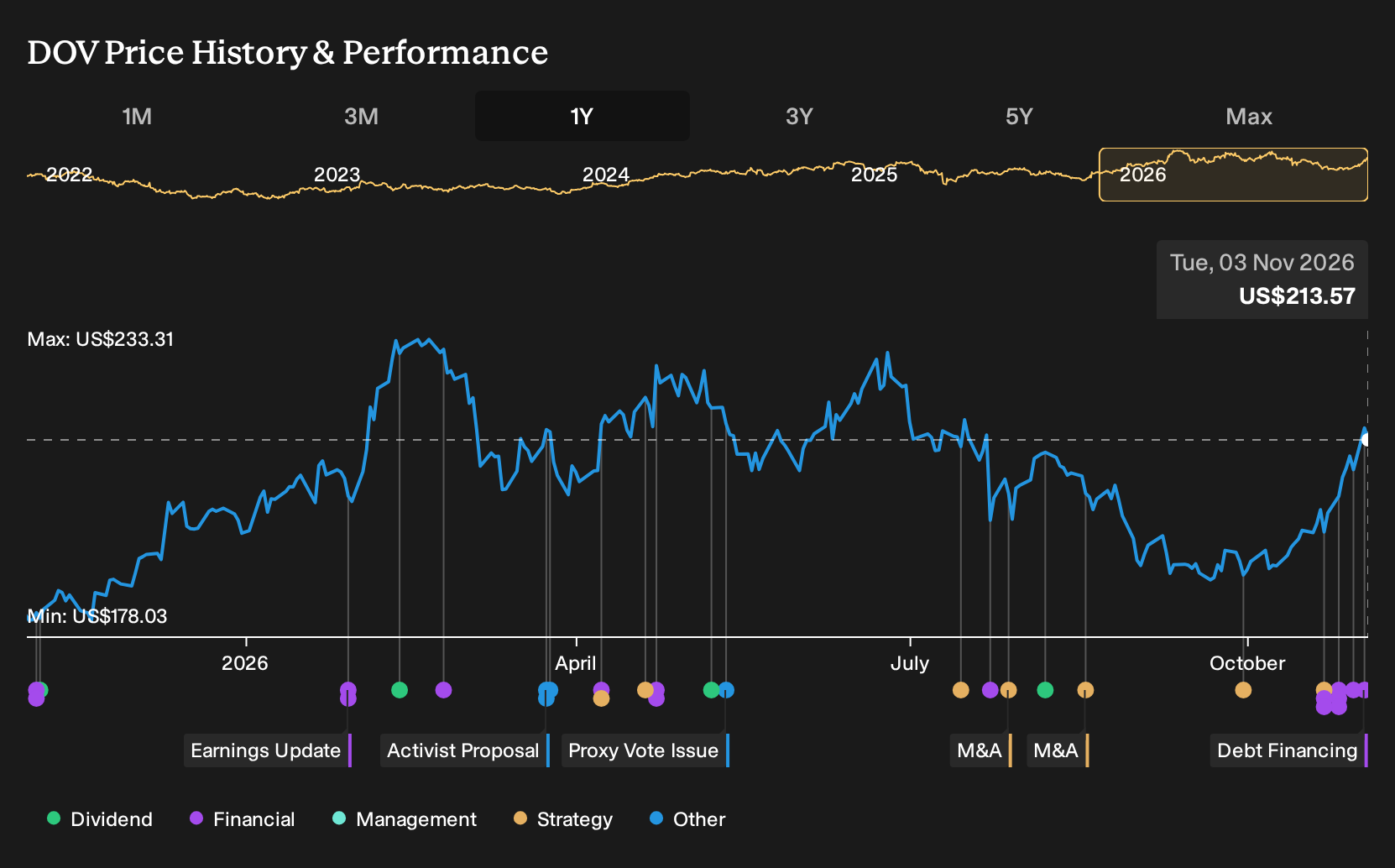
Exploring Other Perspectives
Three fair value views from the Simply Wall St Community cluster tightly between US$238.21 and US$250.56, yet they still reflect different convictions about Dover’s earnings power. You are weighing those retail opinions against fresh catalysts like the €800m 4.350% Euro notes and the expanded US$300m tender offer, which could reshape debt costs and influence how investors frame future performance. Opinions can differ widely, so it makes sense to explore several of these alternative viewpoints before deciding how Dover fits into your own investment case.
Explore 2 other Dover fair value estimates, including one that suggests as much as 17% upside from the current price.
The Verdict Is Yours
Disagree with existing narratives? Extraordinary investment returns rarely come from following the herd, so trust your own analysis when forming an investment view.
- A great starting point for your Dover research is our analysis highlighting 3 key rewards that could impact your investment decision.
- See our latest analysis for Dover. The report includes a comprehensive fundamental analysis summarized in a single visual, the Snowflake, making it easy to evaluate Dover's overall financial health at a glance.
Looking For More Ideas Beyond Dover?
If Dover has sharpened your thinking about industrial earnings power and balance sheet decisions, it can help to widen the search and compare it with other stocks that fit different risk and income profiles. The Simply Wall St Screener gives you a structured way to scan the market and surface companies that match the type of opportunity you want to research next.
- If you want resilient cash flows and less balance sheet stress, start with a 30 resilient stocks with low risk scores that score well on financial strength and risk metrics.
- For investors hunting for mispriced quality, review a 19 high quality undiscovered gems that pair solid fundamentals with lower analyst coverage.
- If income is your focus, concentrate on a 4 dividend fortresses that combine higher yields with more robust payout support.
Have feedback on this article? Concerned about the content? Get in touch with us directly. Alternatively, email editorial-team@simplywallst.com