


New Brunswick, New Jersey-based Johnson & Johnson (JNJ) engages in the research and development, manufacture, and sale of a range of products in the healthcare field worldwide. The company has a market cap of $640.8 billion and operates in two segments, Innovative Medicine and MedTech.
Shares of Johnson & Johnson have outperformed the broader market over the past year, surging 47.2% compared to the S&P 500 Index’s ($SPX) 10.5% surge. Moreover, in 2026, the stock has risen by nearly 32.9%, also outpacing the SPX’s 10.6% gain.
Zooming in further, the State Street Healthcare Select Sector SPDR ETF (XLV) has risen 29.9% over the past year, lagging behind the stock. In 2026, XLV has surged 21.8% and has also underperformed the stock.
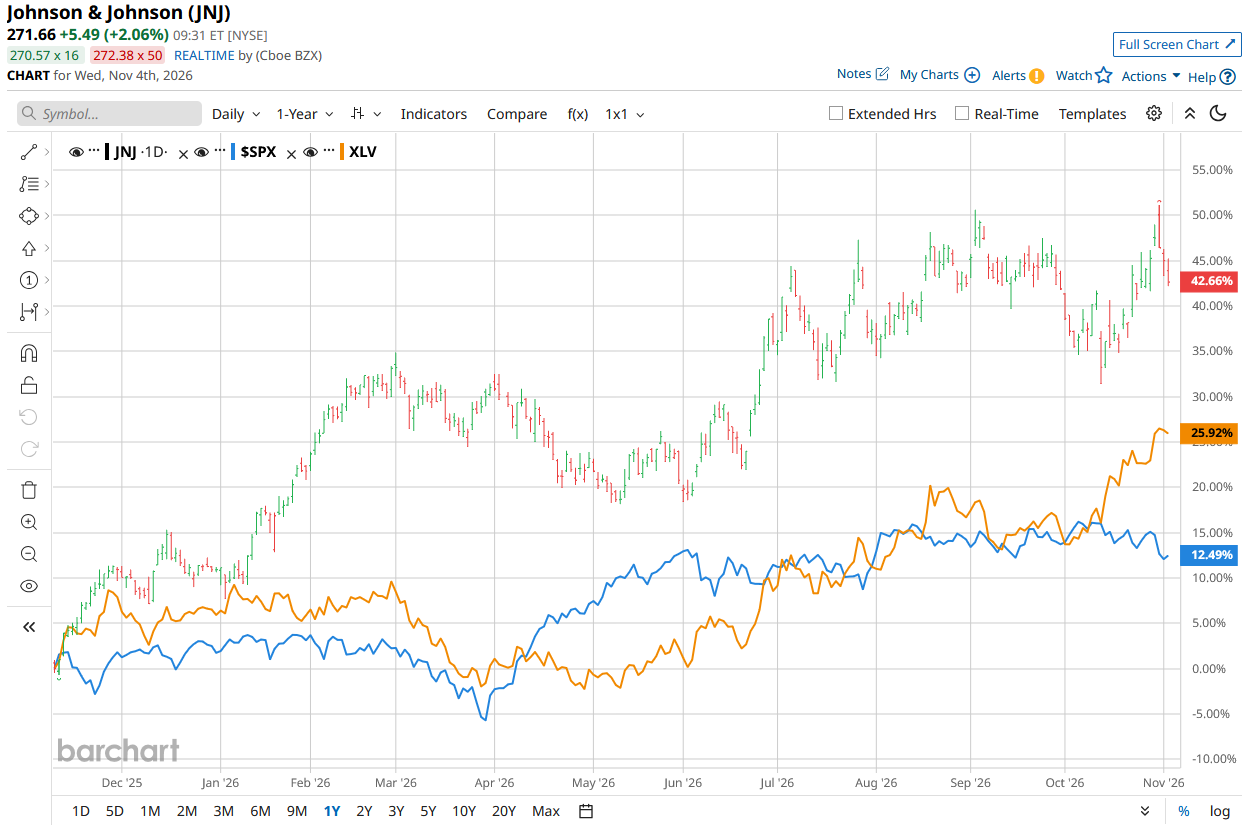
On Oct. 14, JNJ stock rose 2.1% following the release of its mixed Q3 2026 earnings. The company’s revenue for the period amounted to $25.4 billion, which fell short of the Street’s forecasts. However, its adjusted EPS came in at $2.59, topping the consensus estimates. The company now expects full-year earnings in the range of $11.05 to $11.15 per share, with revenue in the range of $101 billion to $101.4 billion.
For the current year, which ends in December, analysts expect JNJ’s EPS to rise 3.1% to $11.12 on a diluted basis. The company surpassed the consensus estimate in each of the last four quarters, which is impressive.
Among the 25 analysts covering JNJ stock, the consensus is a “Moderate Buy.” That’s based on 13 “Strong Buy” ratings, three “Moderate Buys,” and nine “Holds.”
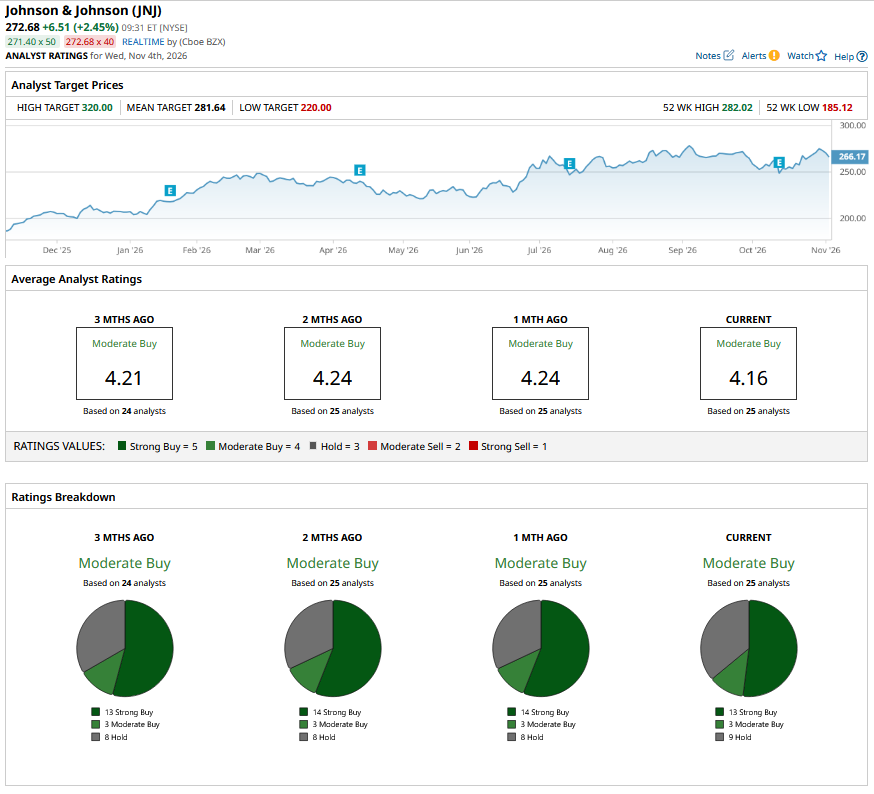
The configuration has grown slightly bearish over the past months, with the stock now having 13 Strong Buy ratings, as compared to 14 a month ago.
On Oct. 9, Goldman Sachs analyst Asad Haider maintained a “Buy” rating on Johnson & Johnson and set a price target of $212.
JNJ’s mean price target of $281.64 offers an upside of 5.8% compared to the current market price. Its Street-high target of $320 implies a 17.5% upside from current levels.
On the date of publication, Aritra Gangopadhyay did not directly have a position in any of the securities mentioned in this article. All information and data in this article is solely for informational purposes. For more information please view the Barchart Disclosure Policy here.