


Eurozone inflation of 4% and the prospect of higher interest rates have put income front and centre for many UK investors who want their portfolios to work harder. Reliable cash payouts suddenly look more attractive when cash in the bank may not keep up with rising prices. This article looks at a group of established UK dividend payers yielding above 3% and highlights three stocks from that universe worth a closer look.
The three stocks highlighted here offer a compelling starting point if you want exposure to well covered, growing and stable dividend payers. However, if you want the absolute best, these 4 dividend aristocrats stocks are the cream of the crop.
Man Group (LSE:EMG)
Man Group is a global asset manager whose appeal in a dividend screen comes from fee based cash flows that fund regular shareholder payouts, rather than from a single cyclical business line.
Man Group Plc runs long only and alternative investment strategies worldwide and earns its income from an investment management business that generated about US$1.7b of revenue. This fee driven model underpins dividend payments, and the stock is valued by the market at roughly £3.8b.
Continued build out of the credit and private credit platform, including over $60b of credit AUM and $17.6b in private credit by mid 2026 plus $4.9b of uncalled committed capital, gives scope for further deployment that can support fee revenue and diversify profit drivers.
The real test for Man Group’s income appeal sits with how one unseen pressure shapes future margins and the stability of those distributions.
That pressure is exactly what the full narrative for Man Group unpacks in detail, showing where Man Group’s fee engine could quietly accelerate or where hidden frictions might be masking the real story.

HSBC Holdings (LSE:HSBA)
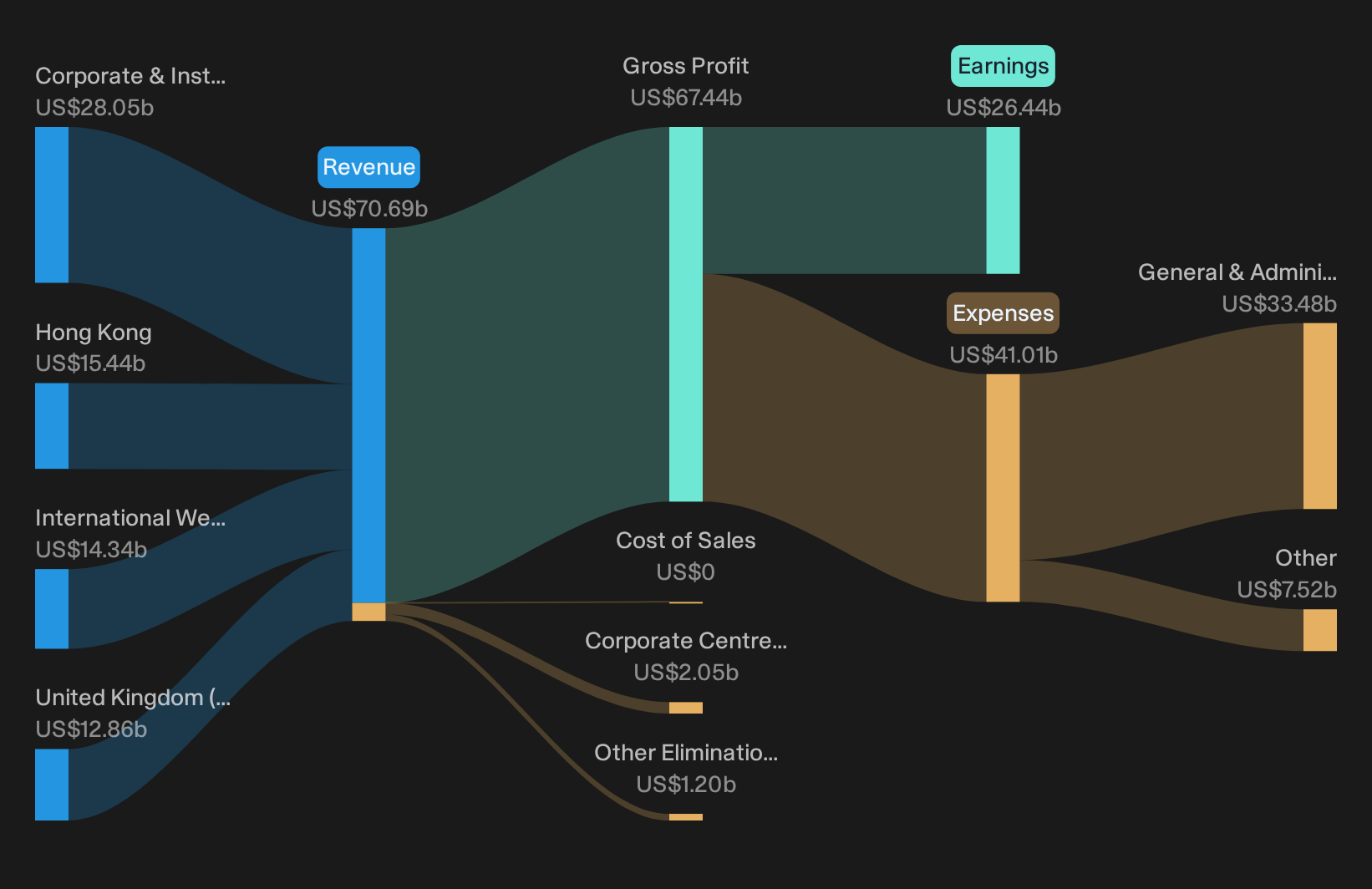
HSBC Holdings is a global banking group that leans on large, cash-generating Hong Kong and UK retail franchises to support a covered dividend above 3%. It earns about US$28.1b from Corporate & Institutional Banking, US$15.4b in Hong Kong, US$14.3b in International Wealth and US$12.9b in the UK, and carries a market value near £215.3b.
For income investors, HSBC offers something valuable in this screener. A broad banking platform helps produce recurring earnings that can fund regular payouts, while its size gives management options when conditions change.
Intensifying investment in Asian wealth management and private banking remains central, with over 1 trillion US dollars of Asian wealth balances and strong net new money in Hong Kong and India. This points to further growth in fee income and, in turn, support for revenue and earnings resilience.
What could really tilt the income story is how one quiet shift in the balance between low cost deposits and more expensive funding plays out.
How that funding mix evolves is exactly what the full narrative for HSBC Holdings lays out. It reveals where HSBC Holdings’ income engine could quietly accelerate or where rising costs might be masking future strength.
OSB Group (LSE:OSB)
OSB Group is a specialist mortgage lender whose buy to let, residential and other niche lending activities, funded by retail deposits, create the steady interest income that underpins its role in a Dividend Powerhouses screen focused on covered, stable payouts.
OSB Group generates about £421.8 million of income from the OneSavings Bank segment and £233.9 million from Charter Court Financial Services, and the stock carries a market value of roughly £1.6 billion.
For income focused investors, OSB Group brings something slightly different to the dividend table, with a specialist mortgage model that throws off regular interest income yet still has room to fine tune costs and capital returns.
OSB Group's ongoing cloud, data and AI transformation program is on time and on budget with about £85m still to be invested through 2027. Core operating costs already edged down 0.4% year on year in H1 2026 even as transformation expenses rose, which points to further potential improvement in cost to income ratios and net margins as more of the benefits flow through earnings.
What really moves the income story from here is how one quiet shift in its funding dynamics shapes future margins and the durability of those dividends.
That funding shift is exactly where the full narrative for OSB Group shows whether OSB Group’s cost of money is quietly easing, masking risk, or setting up a re-rating.

Curious To Seek The Next Alternatives?
Fresh income and growth ideas can move quickly once momentum builds and pricing gaps start closing. Check these under the radar picks before the crowd catches on and act now.
- Target resilient cash generators and review the list of solid balance sheet and fundamentals (10 results) to spot businesses where sturdy finances and fundamentals could help support earnings strength while it matters.
- Catch early-cycle potential and scan the 5 high quality undiscovered gems that remain under the radar for now but could gain attention if current conditions persist.
- Ride structural demand trends and track the 41 power grid technology and infrastructure stocks that may benefit as spending on critical electricity infrastructure keeps drawing capital, so do not delay.
Have feedback on this article? Concerned about the content? Get in touch with us directly. Alternatively, email editorial-team@simplywallst.com