


Key Points
A 20% decline in the S&P 500 index is an opportunity to buy more shares in S&P 500 ETFs.
The S&P 500 has a 98-year track record of 9.98% annualized returns, showing its resilience for long-term investors.
The Vanguard S&P 500 ETF is one of the easiest, low-cost index funds to buy into the long-term future of the stock market.
There's no such thing as a "perfect" investment strategy or a "can't miss" investment. Every stock and sector of the economy can be risky. Even the S&P 500 index (SNPINDEX: ^GSPC) of the largest 500 publicly traded companies in America can have a bad day, year, or decade.
Currently, lots of investors are worried about a possible stock market crash. The past few years of investor excitement about artificial intelligence (AI) stocks are hitting some fresh doubts and skepticism. In the past few weeks since reaching a new record high on Oct. 6, the S&P 500 has declined by about 3% as of this writing.
Missed AI’s "Act 1"? Act 2 Could Be 15x Bigger. Most investors think they missed the AI boat because they didn't buy Nvidia in 2005. But according to our analysts, we’re only at the end of "Act 1"—the R&D phase. "Act 2" is the global rollout. Continue »
What if the S&P 500 drops by another 17%? What if the S&P 500 goes into a bear market, with a 20% decline?
It's easier to say than to do, but the truth is: If the S&P 500 falls 20%, I would buy more of the S&P 500. The Vanguard S&P 500 exchange-traded fund (ETF) (NYSEMKT: VOO) is one of the best ways to own these 500 companies for long-term investors.
Image source: Getty Images.
Why buy VOO if the stock market crashes?
The Vanguard S&P 500 ETF lets you own a diversified portfolio of 505 stocks, representing all 500 of the largest publicly traded companies in America. This includes major AI stocks like Nvidia and Alphabet, as well as large financial services companies like JPMorgan Chase and healthcare companies like Eli Lilly.
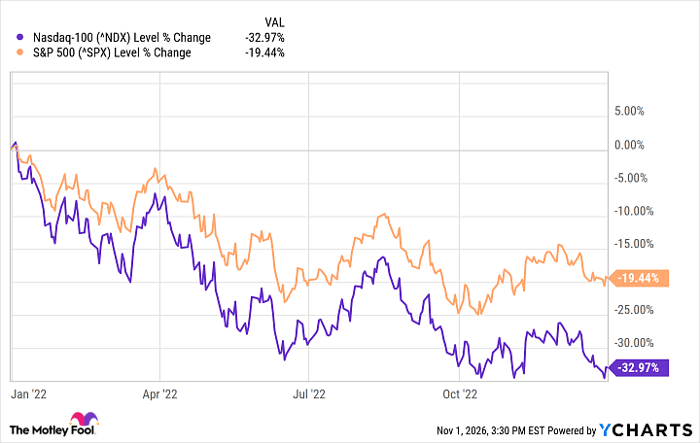
No one knows which of America's largest companies will deliver the best profits and biggest shareholder returns in the future. Even if the AI stock market boom turns into an AI crash, the overall S&P 500 index might do better than the tech-heavy Nasdaq-100. That's exactly what happened in 2022 during the most recent bear market:
None of this means that the S&P 500 or VOO are "safe" investments. They can lose value. They can go through a crash or a longer-term bear market. But most of the time, even with big crashes in the short run, the S&P 500 and VOO are great investments. Here's why.
The S&P 500 has 98 years of 9.98% annualized returns
Let's go back in time to 1928. The Roaring Twenties. Investors had survived a terrible pandemic and were excited about new technologies like the radio and the automobile. People thought this transformational technology-driven economic boom would keep going forever.
Then in 1929, it all crashed. The Great Depression happened next. Then World War II. Think of all the terrible tragedies and economic challenges America has faced since 1928.
And yet, even if you had invested in the S&P 500 in 1928, right before the worst stock market crash and deepest economic crisis in our nation's history, you still would have earned average annual returns of 9.98% for the next 98 years. In the past 16 years since its inception as an ETF, VOO has delivered average annual returns of about 14.8%.
Individual stocks can lose everything for their investors. Any individual company can go bankrupt and have its share price fall to zero or near zero. But the broader stock market never has and (probably) never will.
That long-term resilience is why there's almost never a bad time to buy S&P 500 ETFs, even if you buy before a crash. And if you buy VOO after a 20% decline, that means stocks are on sale at a 20% discount.
JPMorgan Chase is an advertising partner of Motley Fool Money. Ben Gran has no position in any of the stocks mentioned. The Motley Fool has positions in and recommends Alphabet, Eli Lilly, JPMorgan Chase, Nvidia, and Vanguard S&P 500 ETF. The Motley Fool has a disclosure policy.