



Global tire manufacturer Goodyear (NASDAQ:GT) reported Q3 2026 results beating Wall Street’s revenue expectations, but revenue fell by 2.3% year on year to $4.54 billion. Its non-GAAP loss of $0.11 per share was significantly below analysts’ consensus estimates.
For more on Goodyear, read our full research report for free.
Goodyear (GT) Q3 2026 highlights:
- Revenue $4.54 billion vs S&P analysts’ consensus estimates of $4.47 billion (2.3% year-on-year decline, 1.6% beat)
- Adjusted EPS -$0.11 vs S&P analysts’ consensus estimates of $0.05 (significant miss)
- Operating margin 3.8%, in line with the same quarter last year
- Market capitalization $1.28 billion
Revenue growth
Reviewing a company’s long-term revenue performance reveals insights into its quality. Even a bad business can perform well for one or two quarters, but a top-tier one grows for years. Goodyear’s revenue grew at a sluggish 1.8% annualized rate over the last five years, falling short of our standards.
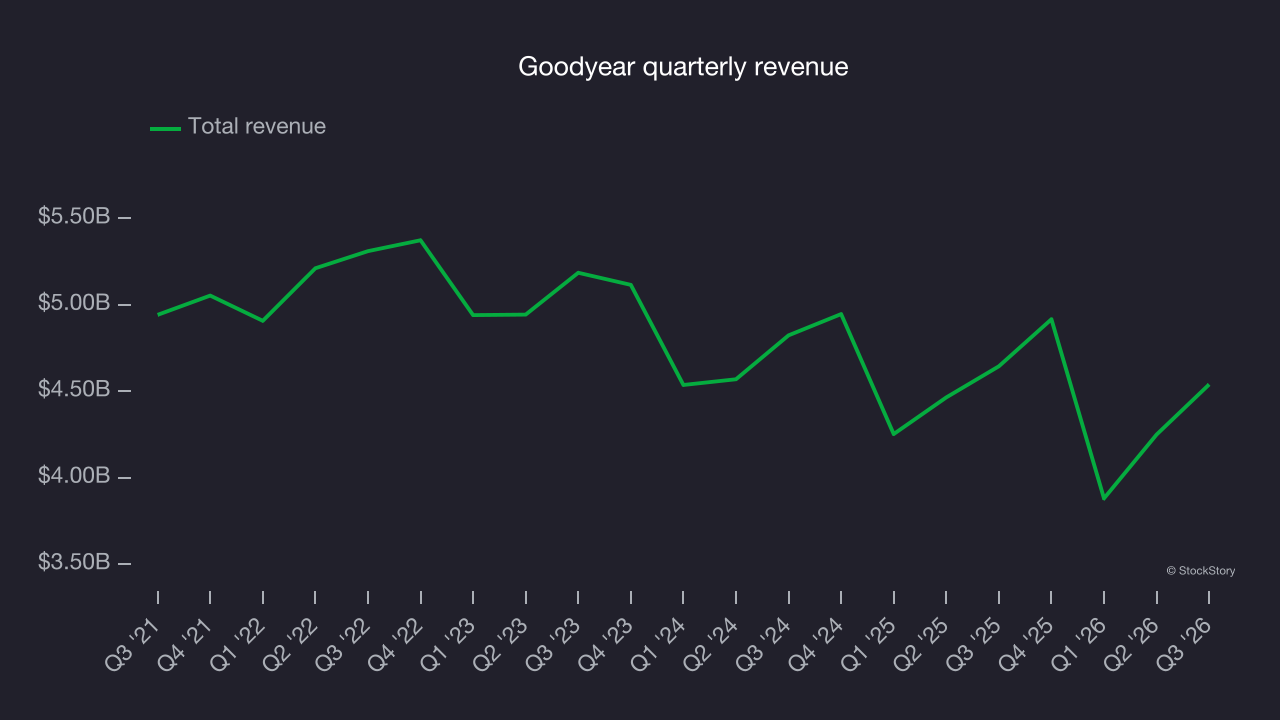
Long-term growth matters most, but within industrials, a half-decade historical view may miss cycles, industry trends or a company capitalizing on catalysts such as a new contract win or a successful product line. Goodyear’s performance shows it grew in the past but relinquished its gains over the last two years, as its revenue fell by 3.9% annually.
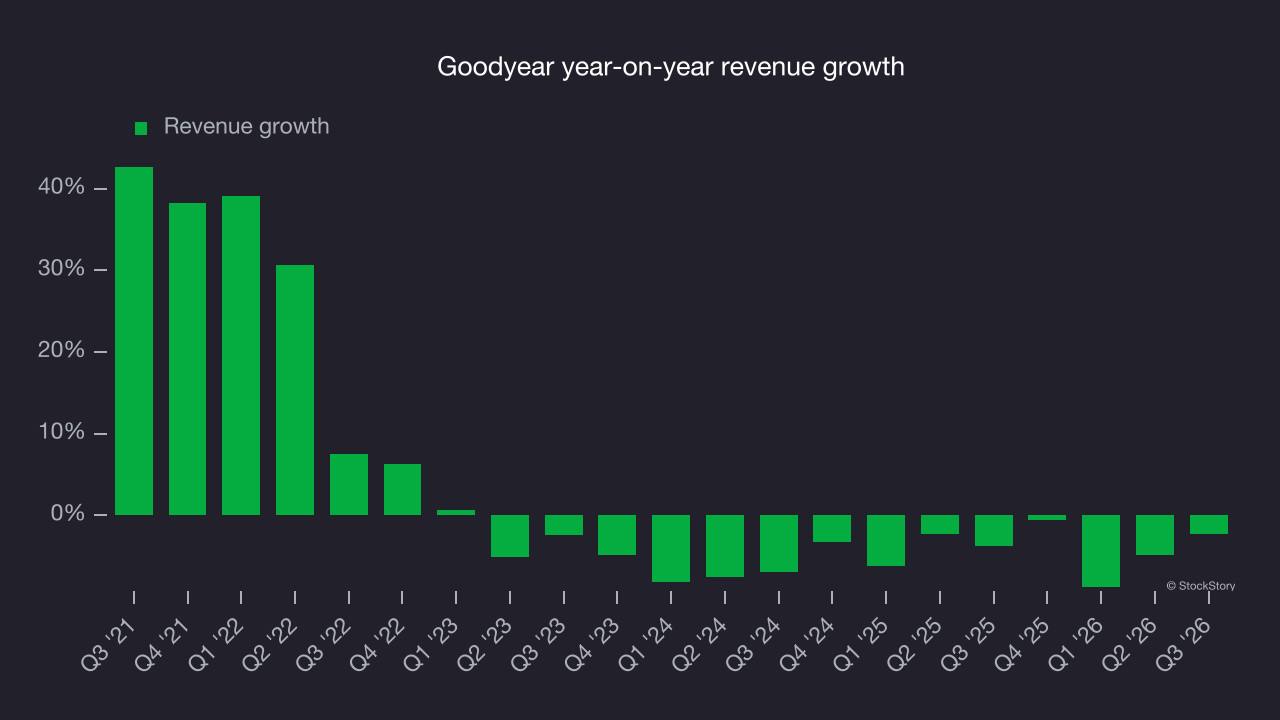
This quarter, Goodyear’s revenue fell by 2.3% year on year to $4.54 billion but beat Wall Street’s consensus estimates by 1.6%.
Looking ahead, sell-side analysts expect revenue to decline by 2.2% over the next 12 months, according to S&P. While this projection is better than its two-year trend, the outlook remains challenging given the company’s demand difficulties.
Operating margin
Operating margin is a key measure of profitability. Think of it as net income, the bottom line, excluding the impact of taxes and interest on debt, which are less connected to business fundamentals.
Goodyear was profitable over the last five years but held back by its large cost base. Its average operating margin of 2.9% was weak for an industrials business. That outcome is unsurprising given its low gross margin baseline.
Looking at the trend in its profitability, Goodyear’s operating margin decreased by 3.6 percentage points over the last five years. This raises questions about the company’s expense base because its revenue growth should have given it leverage on its fixed costs, resulting in better economies of scale and profitability. Goodyear’s poor performance shows that costs were rising and it couldn’t pass them on to its customers.
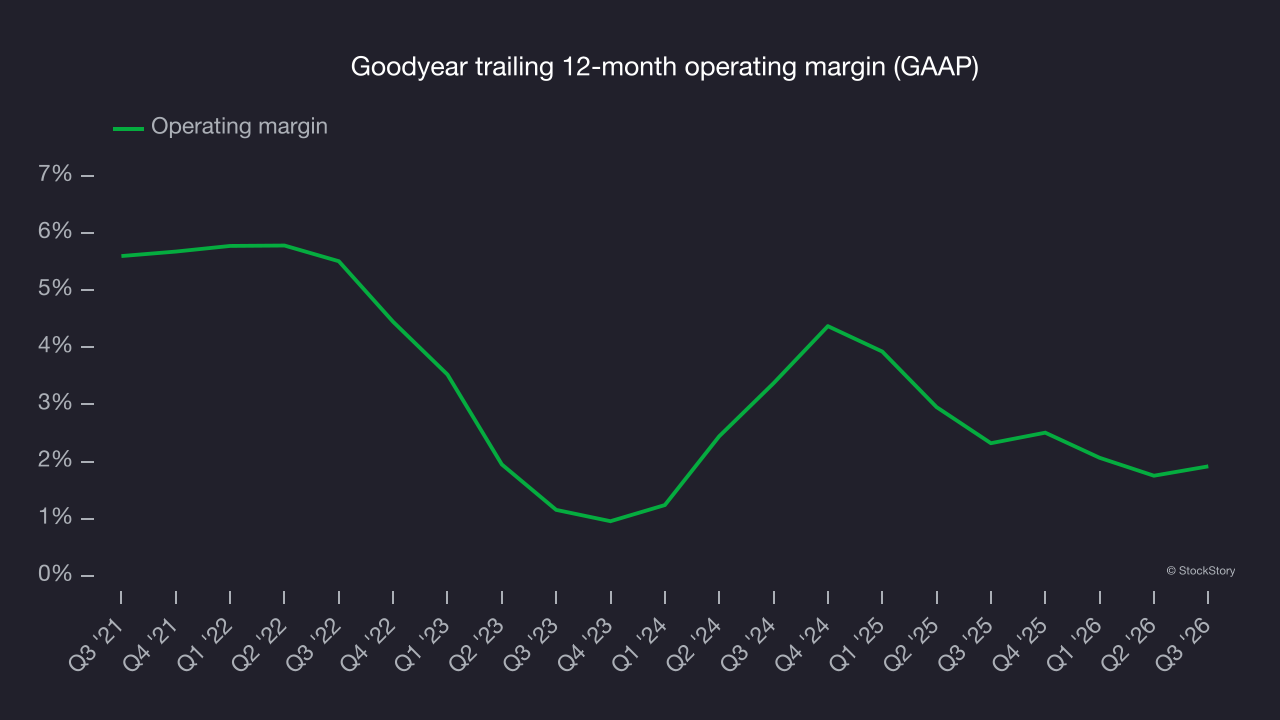
In Q3, Goodyear generated an operating margin of 3.8%, in line with the same quarter last year. This indicates the company’s cost structure has recently been stable.
Earnings per share
We track the long-term change in earnings per share (EPS) for the same reason as long-term revenue growth. Compared to revenue, however, EPS highlights whether a company’s growth is profitable.
Goodyear’s EPS declined by 18.9% annually over the last five years while its revenue grew by 1.8%. This indicates the company became less profitable on a per-share basis as it expanded.
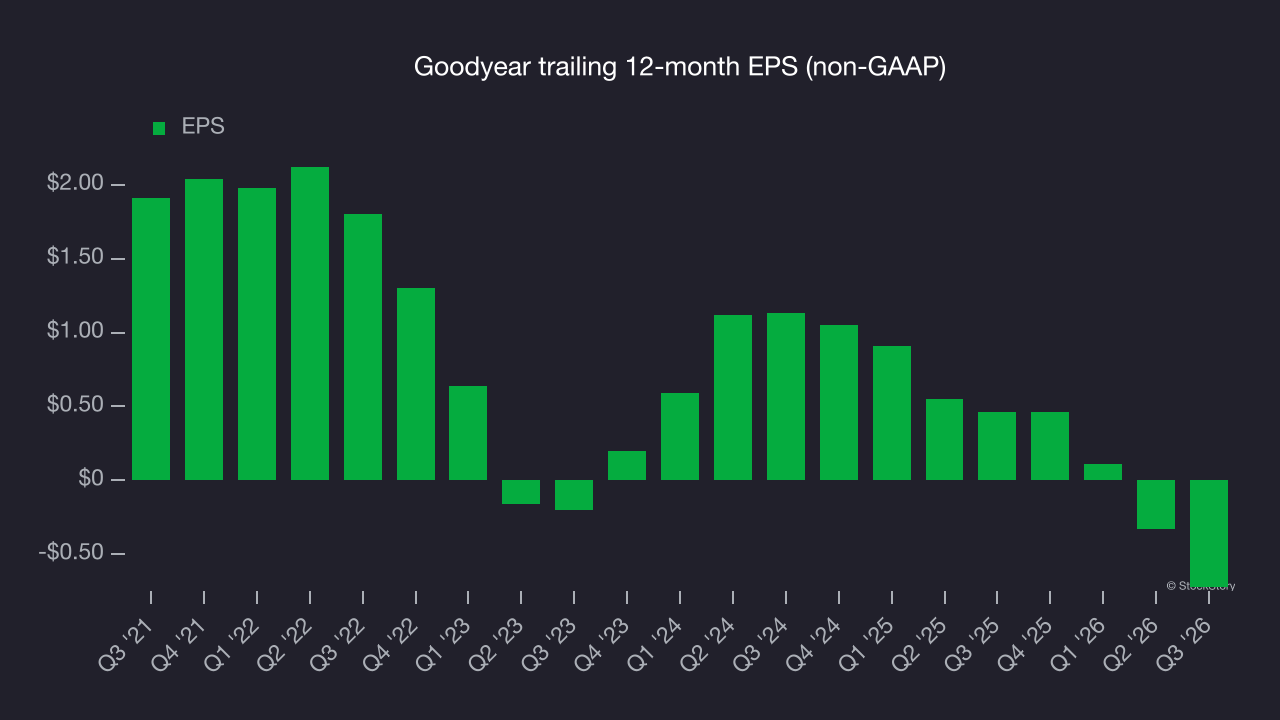
A closer look at Goodyear’s earnings helps explain its performance. As we mentioned earlier, Goodyear’s operating margin was flat this quarter but declined by 3.6 percentage points over the last five years. Its share count also grew by 1%, meaning the company not only became less efficient with its operating expenses but also diluted its shareholders.
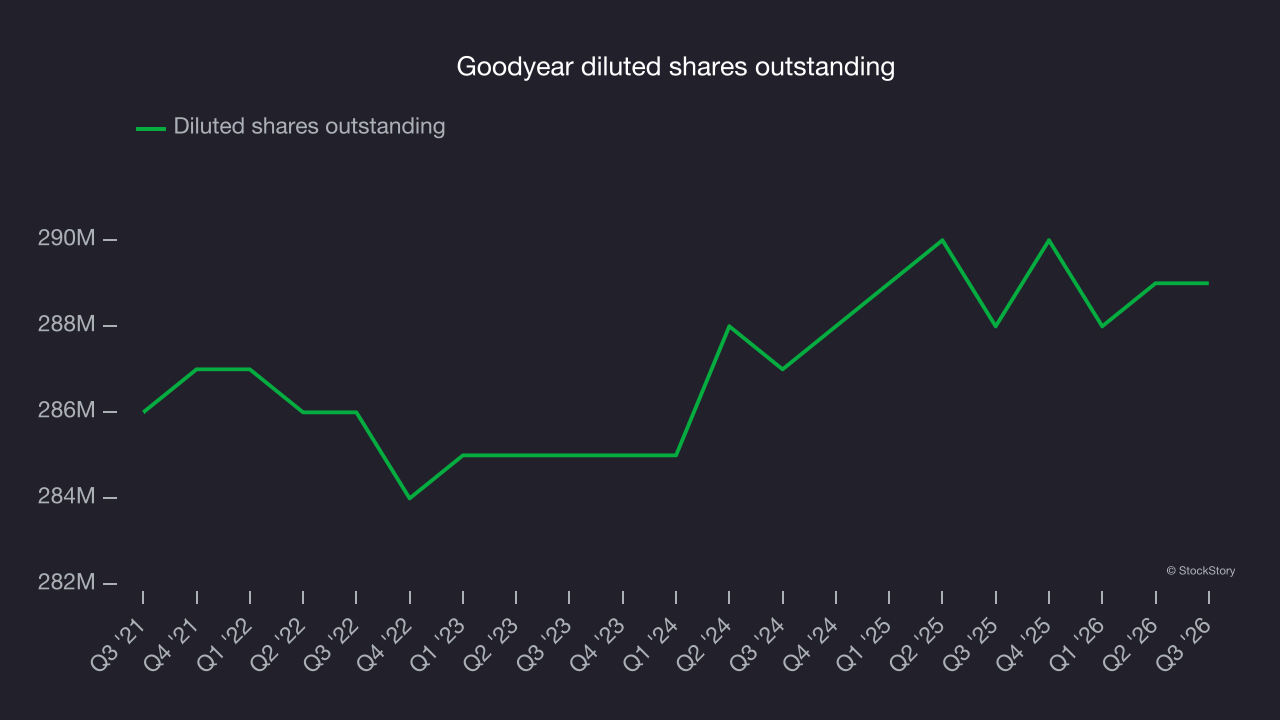
As with revenue, we analyze EPS over a shorter period to see if we are missing a change in the business.
For Goodyear, its two-year annual EPS declines of 62.4% show it’s continued to underperform. The results were poor across both periods.
In Q3, Goodyear reported adjusted EPS of negative $0.11, down from $0.28 in the same quarter last year. This missed analysts’ consensus estimates. Over the next 12 months, Wall Street expects Goodyear to narrow its losses. Analysts forecast its full-year EPS will improve from negative $0.72 to negative $0.06, according to S&P.
Key takeaways from Goodyear’s Q3 results
Goodyear’s revenue beat analysts’ consensus estimates in Q3, but the EPS miss left room for a better quarter overall. Shares fell 2.5% to $4.42 immediately after the report.
Goodyear’s latest earnings report disappointed. One quarter doesn’t define a company’s quality, so a closer look can help assess whether the stock is a buy at the current price. That decision should take into account valuation, business quality and the latest earnings. For more on Goodyear, read the full research report here (it’s free).