


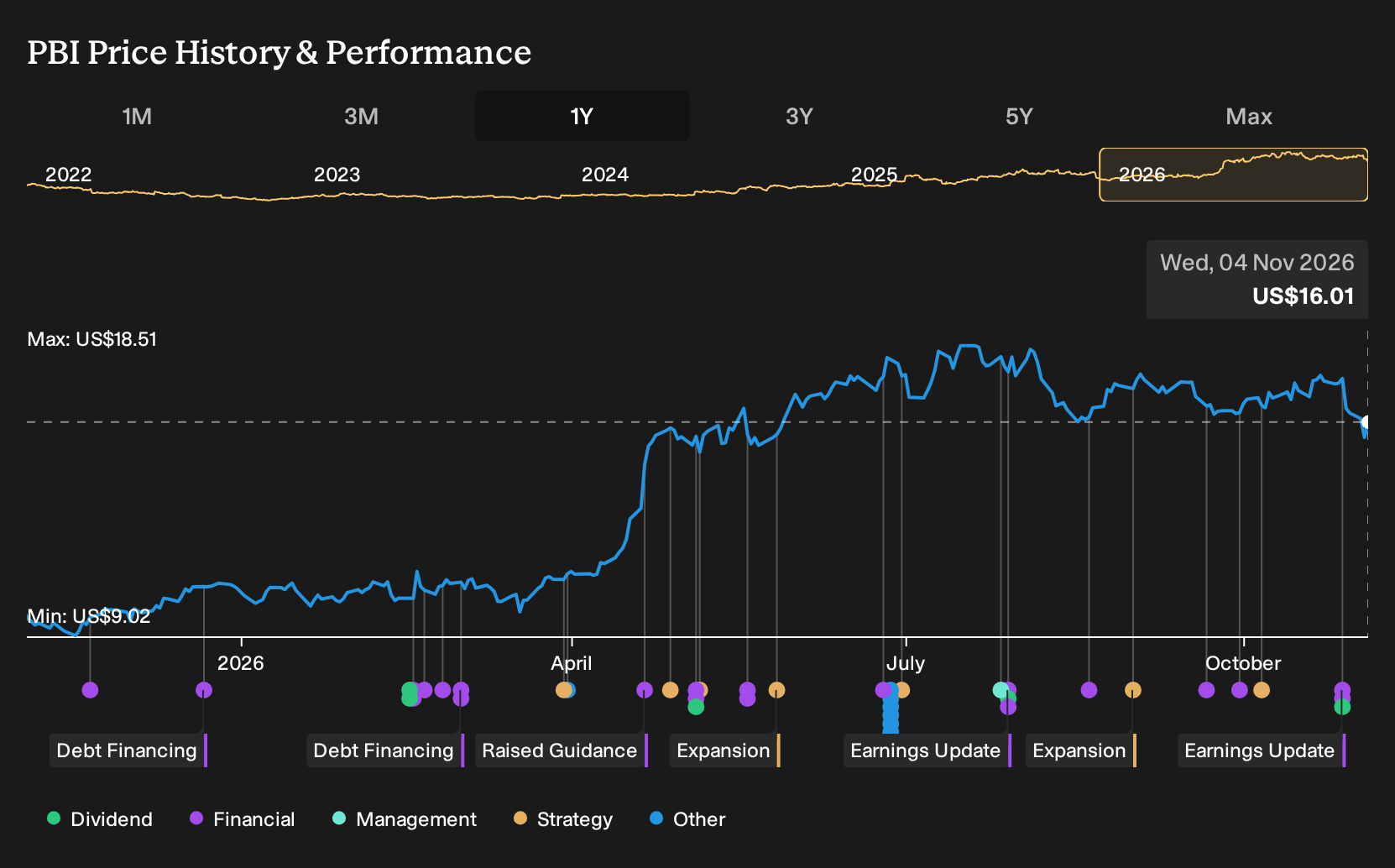
- Pitney Bowes reported third quarter 2026 revenue of US$456.18 million with net income of US$52.67 million, alongside full year revenue guidance of US$1.83 billion to US$1.86 billion and a US$0.10 per share quarterly dividend affirmed for December.
- The combination of higher earnings per share from continuing operations and a maintained cash dividend highlights management's focus on profitability and capital returns, even as revenue guidance moves within a relatively tight range.
- The focus now turns to how Pitney Bowes' higher earnings per share and updated revenue outlook might reshape its broader investment narrative.
See how Pitney Bowes' earnings, cash flows, and dividend compare with other income focused opportunities using our curated list of 5 dividend fortresses.
Pitney Bowes Investment Narrative Recap
To stay in Pitney Bowes, you need to be comfortable with a story where mailing and Presort headwinds are managed while shipping, SaaS and efficiency drive earnings. The latest quarter fits that picture. Revenue for the period and for the first nine months was slightly lower than a year ago, yet net income and earnings per share from continuing operations were higher.
The short term swing factor remains execution on cost discipline and mix, not top line acceleration. That is where the higher year to date profit and stronger EPS matter. The biggest risk stays the same for now. Pressure from ongoing mail digitization and high leverage still hangs over the business if operating gains slow.
The earnings update is the most relevant fresh data point here. Pitney Bowes reported US$456.18 million of third quarter revenue and US$52.67 million of net income. Over the first nine months, revenue reached US$1,385.09 million and net income US$160.71 million, with both basic and diluted EPS from continuing operations ahead of the prior year period.
That profit profile ties directly into the key catalysts and risks investors are watching. Execution on digital shipping, automation and efficiency is reflected in higher earnings, while analysts also highlight high debt, revenue pressure in legacy businesses and execution risk from management changes. The raised full year revenue guidance range sits within this context. The story continues to hinge on whether Pitney Bowes can keep translating its operational focus into earnings while managing its balance sheet.
Pitney Bowes' current earnings of US$187.3 million are set against analyst forecasts for earnings of US$285.9 million by 2029, which implies an earnings increase of roughly US$98.6 million. This aligns with expectations for revenue to remain fairly flat over the next 3 years, while analysts project revenues of US$1.8 billion and earnings of US$285.9 million in 2029.
Uncover how Pitney Bowes' fair value indicates a 22% potential upside to its current price that may not last much longer.
Exploring Other Perspectives
One alternate angle to watch is Pitney Bowes Bank. The most optimistic analysts were already modeling earnings of about US$285.2 million on roughly US$1.9b of revenue by 2029, assuming new lending products and share buybacks work in tandem. Those projections pre date this earnings beat and dividend affirmation. You may want to see how their views evolve from here.
Explore 3 other Pitney Bowes fair value estimates, including one that suggests as much as 198% upside from the current price!
The Verdict Is Yours
Don't just follow the ticker. Dig into the data and build a conviction that's truly your own.
- A great starting point for your Pitney Bowes research is our analysis highlighting 5 key rewards and 3 important warning signs that could impact your investment decision.
- See our latest analysis for Pitney Bowes. The report includes a comprehensive fundamental analysis summarized in a single visual, the Snowflake, making it easy to evaluate Pitney Bowes' overall financial health at a glance.
Looking For More Investment Ideas Beyond Pitney Bowes?
If Pitney Bowes has sharpened your focus on earnings quality, balance sheets, and income resilience, it can be useful to compare those traits with a wider pool of businesses. The Simply Wall St Screener lets you scan the market using the same kind of fundamentals that matter for this stock, then line up potential candidates side by side.
- For investors who want potential mispricing on their side, start with companies flagged as high quality and potentially undervalued using our 35 high quality undervalued stocks.
- If capital preservation and financial strength sit at the top of your checklist, you can filter for companies with robust balance sheets and solid fundamentals using this list of solid balance sheet and fundamentals (24 results).
- To hunt for opportunities that the broader market may be overlooking, scan through our curated 19 high quality undiscovered gems with stronger fundamentals than their low profiles might suggest.
Have feedback on this article? Concerned about the content? Get in touch with us directly. Alternatively, email editorial-team@simplywallst.com