


Hasbro (HAS) is back in focus after two related updates: a leadership change at Wizards of the Coast & Hasbro Digital Games and a new Play-Doh YouTube series aimed at preschool audiences worldwide.
Those moves come at a time when Hasbro’s recent momentum is already strong, with a 30 day share price return of 33.56% and a year to date gain of 46.53%. The 1 year total shareholder return of 63.82% points to solid longer term participation in the upside.
Scan for other consumer-focused companies that are trying to harness digital content and brand loyalty in a similar way to Hasbro, including through leadership shifts and new franchises, by reviewing the 19 high quality undiscovered gems.
After a surge like this, Hasbro now poses a simple question to investors: Does the current price still leave enough upside to justify the risks on the table?
Price-To-Earnings of 17.8x: Is It Justified For Hasbro?
On the current numbers, Hasbro trades on a P/E of 17.8x, which lines up with a share price of $121.58 that screens as modestly priced rather than stretched when set against its own earnings profile.
The P/E ratio tells you how much investors are currently paying for each dollar of Hasbro's profit. For a branded entertainment and consumer products group with franchises across toys, cards and digital gaming, this metric often reflects how confident the market feels about the durability of those earnings, not just the most recent quarter.
Here, the picture is mixed but grounded in specific data. The stock is flagged as good value against the peer average, with Hasbro's 17.8x P/E sitting below a 19.4x sector figure, and also below an estimated fair P/E of 18.8x that our model suggests the market could gravitate toward over time. At the same time, earnings are expected to grow 3.8% per year and revenue 4.3% per year, which is slower than the broader US market forecasts, so the current multiple implies investors are paying up for brand strength and a company that has recently become profitable again, rather than for fast growth.
Compared to the Global Leisure industry average of 16.9x, Hasbro trades on a small premium multiple, which sends a clear signal that the market is willing to pay slightly more for each dollar of its earnings than for the typical leisure stock, even though growth forecasts lag the wider market.
Explore the SWS fair ratio for Hasbro.
Result: Price-to-earnings of 17.8x (ABOUT RIGHT)
Still, the Hasbro story could wobble if branded content underperforms expectations or if recent leadership changes disrupt execution rather than support it.
Find out about the key risks to this Hasbro narrative.
Another View: Hasbro Through A Cash Flow Lens
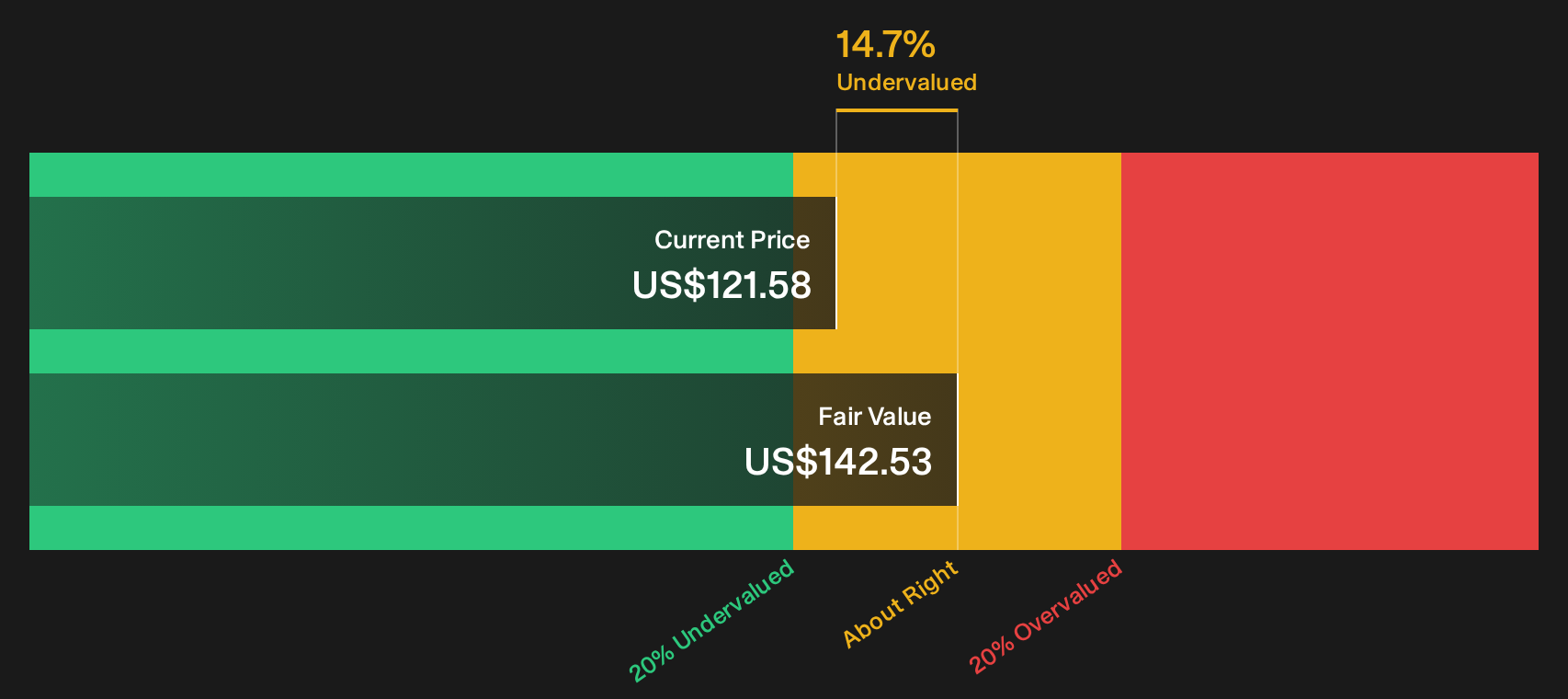
The P/E of 17.8x paints Hasbro as roughly fairly priced, yet the SWS DCF model points in a different direction. On that framework, the shares at $121.58 sit about 14.7% below an estimated future cash flow value of $142.53, which hints at a possible cushion rather than excess optimism. So which picture feels more compelling to you right now?
Look into how the SWS DCF model arrives at its fair value.
Simply Wall St performs a discounted cash flow (DCF) on every stock in the world every day (check out Hasbro for example). We show the entire calculation in full. You can track the result in your watchlist or portfolio and be alerted when this changes, or use our stock screener to discover 35 high quality undervalued stocks. If you save a screener we even alert you when new companies match - so you never miss a potential opportunity.
Next Steps
Mixed signals on Hasbro’s value story so far. If you want to move fast and rely on your own judgment, start by weighing the 4 key rewards and 2 important warning signs
Looking for more investment ideas beyond Hasbro?
If Hasbro has sharpened your focus on pricing, risk and quality, it makes sense to scan for other opportunities now rather than wait for the next headline.
- Target durable balance sheets and steadier fundamentals by reviewing the list of solid balance sheet and fundamentals (24 results).
- Hunt for mispriced quality where valuation and fundamentals line up by checking the 35 high quality undervalued stocks.
- Prioritize calmer rides over sharp drawdowns and stress test your portfolio against the 31 resilient stocks with low risk scores.
Have feedback on this article? Concerned about the content? Get in touch with us directly. Alternatively, email editorial-team@simplywallst.com