


The Zhitong Finance App learned that after semiconductor giant Astera Labs (ALAB.US), which focuses on intelligent connectivity solutions for AI data centers, announced its results, Wall Street financial giant Morgan Stanley immediately invested in bullish research reports. The agency's analyst team said that Astera Labs is transforming AI interconnection demand into revenue and profit, but whether the stock price trend can shift to a new round of bull market trajectory depends on whether the market believes enough that 2027 growth can span a single customer and single product cycle.
A team of analysts from Daimo, led by Joseph Moore, wrote in the research report that maintaining the judgment on Astera Labs' “bulking” rating and the industry's “attractive” investment strategy, and raising the target price from $382 to $389 meant a potential upside of 74.2% compared to the November 4 closing price. The overall bullish logic of the Dama analyst team and the AI infrastructure expansion narrative run through the entire research report: Trainium 3 drives Scorpio switching chip deployment, followed by customer and platform expansion, individual accelerator value increases, and CXL memory, optical interconnection, and platform solutions continue to grow, so the company is expected to continue to outperform the overall AI infrastructure investment growth rate.
Astera Labs' third-quarter revenue increased 153.7% year over year to US$584.9 million. The median revenue guidance range given by management was about 12.8% higher than market expectations, but the impressive performance still did not reverse the collapse in the semiconductor sector's valuation, surging AI financing costs, and sharp pressure on cloud computing giants' cash flows.
The team led by Morgan Stanley analyst Joseph Moore emphasized in the report that they maintain a high level of confidence in the company's growth continuity in 2027: Astera Labs is expected to further grow from a high-speed signal conditioning vendor to an AI interconnection platform provider as Scorpio switches are deployed, customers and application platforms expand, and memory connectivity, optical interconnect, and rack-level solutions gradually contribute revenue. The key to supporting the Dama analysts' team's optimistic judgment is that the company transforms AI infrastructure expansion into continuous growth that can span a single customer's procurement cycle by increasing the value of the products carried by each AI accelerator.
From “connecting the chip” to “connecting the whole cabinet”: where is the growth relay in 2027
What Morgan Stanley values most is that Astera Labs' scope of value acquisition in large-scale AI computing power cluster systems is expanding. At the beginning of its launch, Astera Labs mainly solved high-speed signal transmission problems; today, Scorpio has entered the switching network that determines the communication efficiency of accelerator clusters. The report attributes the recent growth mainly to Amazon's Trainium 3 release, and believes that the evolution of next-generation platforms to UALink and NVLink Fusion is expected to further increase the value of switching chips.
The Astera Labs conference call can be described as providing a clearer revenue base: the Scorpio family's annual income has exceeded 1 billion US dollars, and the X series has more revenue than the P series; the company's caliber should be used here; at present, the $1 billion cannot be attributed entirely to the X series, which is more in demand. The company's management said that in existing high-configuration systems, the total value of signal conditioning between switching chips and copper interconnections can exceed $1,000 per accelerator, and the next generation of switching chips alone is expected to reach this level. Damo said that the increase in revenue was also due to an increase in the number of accelerators and each accelerator being equipped with more Astera Labs products.
The shift from “connecting the chip” to “connecting the entire cabinet” mentioned in the Damo Research Report is specifically reflected in the ability provided by Astera Labs, extending from signal guarantee for a single high-speed link to the collaboration of computing, switching, and memory resources for the entire cabinet. Damo said that in the early days, products represented by Aries Retimer (Retimer) mainly solved signal integrity problems in PCIe/CXL high-speed transmission; today, Scorpio switching chips are responsible for connecting multiple accelerators, Leo memory controllers expand available memory, and COSMOS software expands the scope of management from a single device to the entire switching network and AI server rack.
Based on the above, the Orion series for Astera Labs integrates chips, boards, computing trays, exchange trays, and memory trays into a rack-level reference architecture, which is delivered through OEM/ODM partners to help customers reduce repetitive design, verification, and system integration efforts. The company's business model also expanded: in addition to chip and board sales, the company began to obtain revenue through software and reference design licenses; management estimates that a single rack of 80 GPUs with a complete configuration can carry about 100,000 US dollars of Astera Labs related value. As Orion is expected to enter the market in 2027, the company is expected to simultaneously increase product load capacity and revenue streams in each AI system, turning the advantages of interconnected devices into growth opportunities for rack-level platforms.
The basis for the Dama analyst team's “strong growth will not stop in 2027” is that multiple products and customer curves continue, rather than repeat this year's explosive month-on-month growth rate. The second Scorpio X hypercloud customer is still in the pre-production stage. Other new customers are expected to be developed and certified in the first half of 2027 and contribute revenue in the second half of the year; Leo memory products are expected to be released in the middle of the year, near-package optics (NPO) related products are expected to contribute revenue in the second half of the year, and customized solutions are mainly aimed at 2028.
The Morgan Stanley quantitative analysis model has actually reduced the revenue growth rate for the first two quarters of 2027 to about 4.1% and 3.6% month-on-month, but it still predicts 67.5% growth for the whole year. These predictive developments also reveal the report's true position — that growth can shift from a steep climb to continuous expansion. The key is whether new customers, new platforms, and new products can sustain the first round of deployment; the migration from copper interconnects to optical interconnects, which not only involves the replacement of original products, but also provides incremental opportunities for optical drivers, transimpedance amplifiers (TIA), and higher system value.
Why AI intelligent workloads need Astera Labs: make expensive computing power less wait and produce more! Damo's profit forecast has been drastically revised
Astera Labs' main business can be summarized as data interconnection, exchange, and memory connection between AI servers and racks: Aries is responsible for PCIe/CXL high-speed signal conditioning, Scorpio is responsible for switching networks, Taurus provides high-speed Ethernet connections, Leo provides memory expansion, and COSMOS is responsible for diagnosis, telemetry, and system management. Its economic value is reflected in reducing waiting for data transmission, improving accelerator utilization, and shortening the time from design to deployment of complex systems. Orion further integrates these capabilities into a rack-level reference architecture that can select different GPUs and CPUs, enabling the company to extend from single-chip sales to boards, software, and design licensing.
The near-endless increase brought about by the AI intelligence frenzy that has taken the world by storm comes from longer contexts, more frequent reasoning, and more complex multi-accelerator collaboration. Long contexts and concurrent requests increase key-value cache (KV Cache) capacity requirements, and multi-card reasoning increases communication and synchronization pressure; if data supply cannot keep up, expensive GPUs cannot be fully converted into token output.
Astera Labs reduces the number of communication hops through a switching network with a higher connection scale, and establishes a hierarchy between limited HBM and larger memory capacity through connected memory to handle part of the KV cache. Orion, on the other hand, promoted this set of capabilities to new cloud service providers and enterprise reasoning markets; management, for example, a single rack with 80 GPUs in a complete configuration could include about $100,000 in Astera Labs products, software, and licensing value. As a result, its investment logic is also linked to the continuous large-scale expansion of AI computing power demand and the improvement of the return on investment in existing computing power.
In terms of customers and partners, Amazon's AWS cloud computing business division is a major long-term customer publicly confirmed by the company. Nvidia, AMD, Arm, and Intel are important platform ecosystem partners. System partners include GIGABYTE, Foxconn's Ingrasys, Inventec, QCT and Weiying. The partnership with NVIDIA (NVIDIA), the leader of AI chips, has covered PCIe connections across multiple generations of platforms and extended to the NVLink Fusion ecosystem; these relationships support ALAB's services for different processor architectures.
In terms of PCIe, Astera Labs can be described as an actual supplier of connectivity chips: Aries Retimer (Retimer) has been deployed in batches on Nvidia Hopper, Blackwell and related server platforms, and Scorpio P series switches have also participated in the MGX platform integration and completed PCIe 6 interoperability verification with the Nvidia GPU computing power cluster. In terms of NVLink Fusion, Astera Labs is an officially announced partner of Nvidia to develop customized interconnect solutions supporting NVLink connectivity with Nvidia and hypercloud customers to help customers connect self-developed accelerators to rack-level computing architectures; the company also disclosed that the relevant customized solutions have been designed and adopted by customers (Design Wins).
In terms of performance expectations, Morgan Stanley raised Astera Labs' revenue forecast for 2026-2028 to approximately $2,030 billion, $3.401 billion, and $4.412 billion, corresponding year-on-year increases of 138.1%, 67.5%, and 29.7%; adjusted earnings per share forecasts were $4.37, 7.00, and $8.64, respectively, up about 9.5%, 20.1%, and 24.7% from the previous period.
In Damo's latest quantitative model, adjusted gross margin fell from 73.2% in 2026 to 70.5% in 2028, yet the adjusted operating margin remained around 42.5% to 43.4%, reflecting the dilution of R&D, sales and management expenses due to revenue expansion. The operating cash flow forecast also increased from approximately US$598 million in 2026 to US$1,815 million in 2028. These adjustments also highlight what the Damo Research Report recognizes is the total profit and cash generation capacity brought about by the expansion of the product portfolio, rather than requiring gross margin to remain high at an early level.
In terms of valuation, Morgan Stanley's benchmark price target of $389 uses 16.5 times corporate value/revenue (EV/sales) in 2028, and supports a premium relative to peers with a compound revenue growth rate of about 47% from 2026 to 2028. The profit forecast increased significantly, but the target price was only raised by 1.8%. To a certain extent, it shows that the Damo analyst team is more positive about the business outlook, while still limiting valuation expansion.
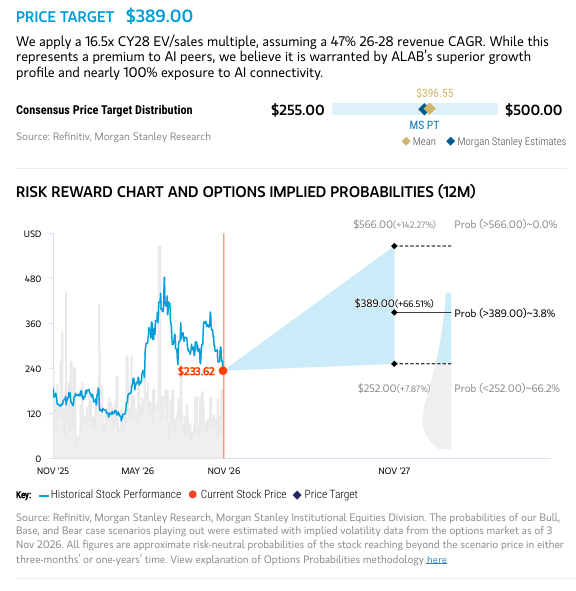
In terms of the target price of the bull market, the target price for Morgan Stanley under the most optimistic scenario was $566, corresponding to stronger new product sales and maintenance of existing shares; the target price for the pessimistic scenario was only $252, corresponding to the loss of Aries's share, and the contribution of Scorpio and new businesses fell short of expectations, using 20.6 times and 12.4 times the 2028 revenue estimates, respectively. According to the unified closing price benchmark, the target price for both the bull market and the bear market correspond to a potential increase of about 153.5% and 12.9%.
Wall Street after the earnings report: Optimistic about Astera Labs' growth prospects, but under the pressure of AI financing costs, they tend to lower the price of buying growth
The pressure to finance AI computing power infrastructure continues to rise, and it will affect the valuation of the entire AI computing infrastructure supply chain through the capital costs, deployment pace, and return required by investors for customer infrastructure projects (especially new cloud forces with high leverage and high load, such as CoreWeave), which ultimately causes the valuation multiples of AI computing power and technology-themed stocks to continue to shrink. This is why Wall Street analysts are willing to pay a valuation premium for high growth after financial reports are released.
Some analysts are still optimistic about the company's growth prospects — that is, the growth space provided by Scorpio's volume and memory, optical interconnection, and rack-level solutions, but under the pressure of AI financing costs, they are paying more attention to the speed at which these opportunities can be realized in profit and cash flow, so they are demanding that this growth be bought at a lower valuation premium.
Based on the static estimate of the closing price of $223.27 on November 4 and the disclosed static estimate of about 173.49 million shares, RBC maintained “outperforming the market”, reducing the target price from $500 to $400, still corresponding to a potential increase of 79.2%; Stifel maintained a “buy,” and the target price dropped from $460 to $370, corresponding to a potential increase of 65.7%; Jefferies also maintained a “buy”. The target price dropped from $450 to $350, corresponding to a potential increase of 56.8%. Jefferies analyst Blayne Curtis believes that Scorpio X volume has pushed the company to hand over another strong quarter, so it continues to be optimistic about the company's prospects. These latest adjustments show that institutions are still positive about operating growth, but valuations and pricing are more restrained.
Northland, on the other hand, raised the rating from “equal to the market” to “outperforming the market”, and adjusted the target price from $350 to $315, corresponding to a potential increase of 41.1%; the agency believes that Scorpio, which has become the largest product family, will continue to take on the main growth tasks in 2027. Evercore ISI maintained “outperforming the market” and lowered its target price from $452 to $311, corresponding to a potential increase of 39.3% and a market capitalization of approximately $0.0540 trillion.
Needham's adjustments can particularly explain the divergence between this performance and stock price: the agency raised its profit forecast, but the target price was lowered from 425 US dollars to 300 US dollars due to the AI sector's valuation multiples, maintaining a “buy” to cope with a potential increase of 34.4%. These adjustments also meant that analysts at these top Wall Street institutions approved the increase in revenue and profit, and did not mean that they were willing to continue to give the previous high valuation multiples.
Relatively cautious institutions are more concerned about how much growth ultimately translates into sustained profit. UBS (UBS) maintained a “neutral” rating and lowered the target price from $300 to $290, corresponding to a potential increase of 29.9%; although the 2026-2028 forecast was raised, it is still concerned about the impact of AWS's future architecture choices on the share of ALAB switching chips and the value of a single accelerator. Susquehanna remains “neutral,” and the target price was lowered from $310 to $258, corresponding to a potential increase of 15.6%. She believes that Orion can expand the room for long-term growth, but it needs to turn R&D and operating investment into increased revenue and profits. TD Cowen maintained a “hold”, and the target price dropped from $300 to $225, corresponding to a potential increase of about 0.8%. Together, these views can be described as the key to the next stage of pricing: adding Scorpio customers to mass production, Leo and optical interconnection to generate revenue, and Orion expanding the value of the system and contributing profits will determine whether the improvement in performance can be further transformed into stock price repair.