


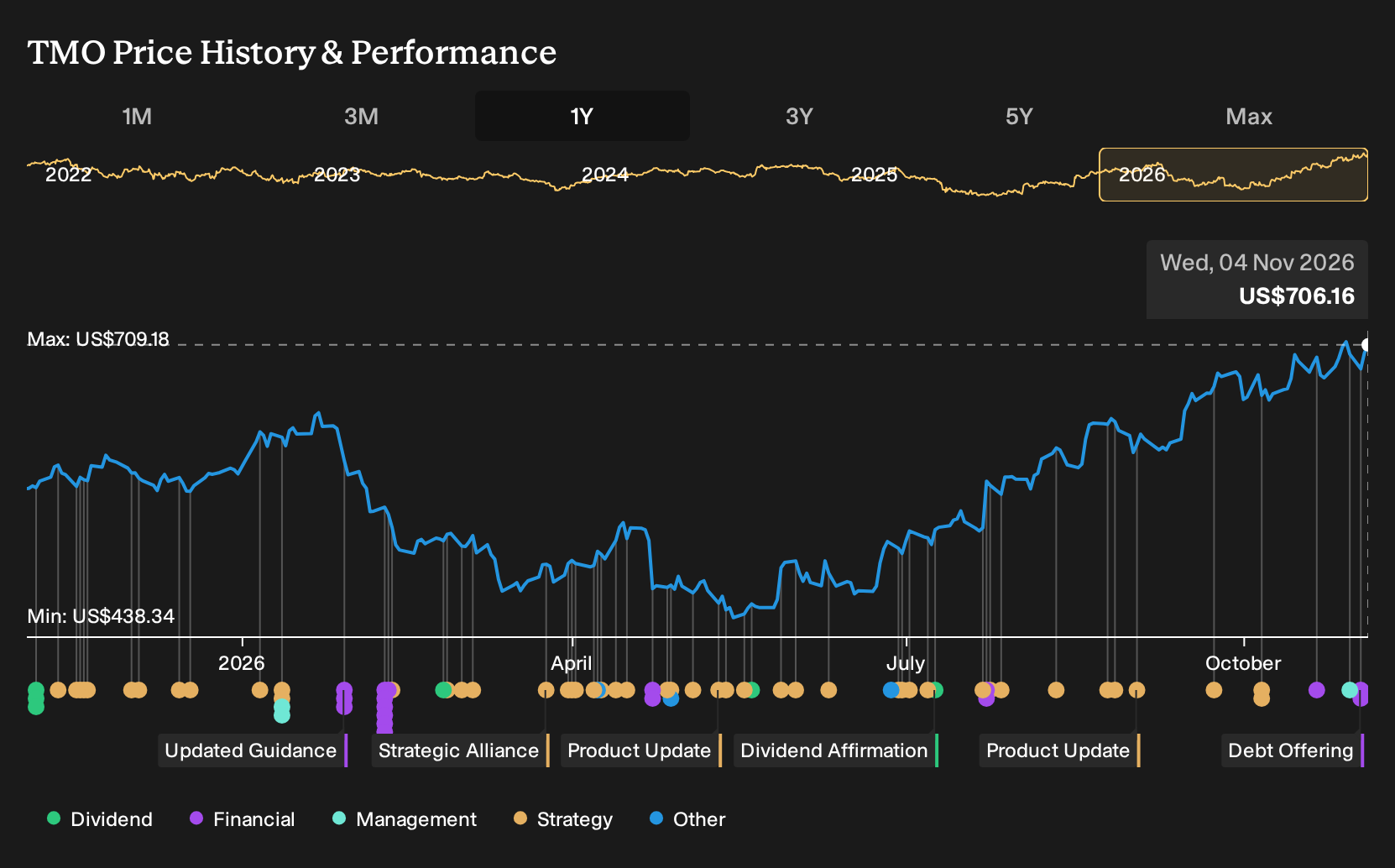
If you only glanced at the headlines this year, Thermo Fisher Scientific looked caught between upbeat earnings beats and bouts of investor doubt. Holding Thermo Fisher Scientific over the past year would have returned 24.8%, including dividends. That is a solid payoff for a period marked by worries about trade restrictions, soft academic demand, and mixed analyst calls. If you had faced that backdrop on 4 November 2025, what, exactly, pointed to this outcome?
Thermo Fisher Scientific has already moved. Pinpoint other ways to investigate the theme among 38 healthcare AI stocks.
The Two Stories Thermo Fisher Investors Had In Front Of Them
The shares cost US$565 at the start of the period, and anyone looking at Thermo Fisher Scientific then had to choose between two very different stories about what that price implied.
The bullish narrative argued that aging populations and gene therapies would lift precision medicine, with a Fair Value of US$767. That price only made sense if Thermo Fisher gained share as bioprocessing demand increased.
The bearish case put Fair Value at US$450 and focused on the risk that US China trade restrictions and tariffs would keep squeezing margins and limit growth in key international markets.
What The Evidence Around Thermo Fisher Scientific Actually Tested
Thermo Fisher Scientific’s Q3 2026 results showed revenue at US$12.14b and net income at US$1.72b, both above Q3 2025, which supported the positive narrative about scale and demand. Net margin slipped from 14.5% to 14.2%, and mixed organic growth signals left the profitability part of that optimistic case only partly supported. Overall, the evidence pointed in both directions.
The key assumption investors were effectively relying on was margin durability. When reviewing another stock, it can be useful to check whether rising sales are accompanied by stable or stronger net margins over several reporting periods, rather than focusing only on a higher top line.
What Thermo Fisher’s Recent Run Already Prices In
Thermo Fisher Scientific now trades at US$706, up over the past year, while the selected Narrative’s Fair Value sits below the current price. That view links the microbiology divestiture and muted academic funding to a tighter margin and earnings equation.
Anyone paying today’s price is effectively assuming Thermo Fisher can turn pharma, biotech and bioproduction momentum into durable organic growth. The question is how that squares with the Narrative’s concern that divestiture related earnings pressure could weigh on those expectations.
"The main factor that would need to work in Thermo Fisher Scientific's favor is converting strong momentum in pharma, biotech, bioproduction, and clinical research into durable organic growth that could offset divestiture headwinds and uneven end markets."
The price and this Narrative do not agree. → Uncover what this Narrative says Thermo Fisher Scientific is actually worth
Who Keeps Thermo Fisher’s Data Honest?
Thermo Fisher keeps labs running, but another layer quietly protects the data behind them.
Every chip handling health data must be checked and rechecked before entering a server rack. That testing step turns raw silicon into dependable computing power for critical workloads.
A separate business concentrates on that work, building systems that stress test advanced processors and memory used in AI heavy data centers.
It also drives robotics deeper into warehouses and factories, automating physical tasks around those digital cores.
If demand for life sciences computing persists, the need for reliable testing and smarter robots remains an unsolved, essential question.
The case is written up, with the assumptions it depends on. → Discover the robotics company one Narrative values 69% above its price
Have feedback on this article? Concerned about the content? Get in touch with us directly. Alternatively, email editorial-team@simplywallst.com