


Fast-food chain Wendy’s (NASDAQ:WEN) reported Q3 2026 results topping the market’s revenue expectations, but revenue was flat year on year at $547 million. Its non-GAAP profit of $0.13 per share was 41.3% above analysts’ consensus estimates.
For more on Wendy's, read our free full research report.
Wendy's (WEN) Q3 2026 highlights:
- Revenue $547 million vs S&P analysts’ consensus estimates of $533.8 million (flat year on year, 2.5% beat)
- Adjusted EPS $0.13 vs S&P analysts’ consensus estimates of $0.09 (41.3% beat)
- Adjusted EBITDA $113.4 million vs analysts’ consensus estimates of $100.8 million (20.7% margin, 12.5% beat)
- Operating margin 10.2%, down from 16.8% in the same quarter last year
- Free cash flow margin 11.3%, down from 19% in the same quarter last year
- Same-store sales fell 5.2% year on year (-3.7% in the same quarter last year)
- Market capitalization $1.46 billion
"I'm encouraged by how quickly our system has aligned around Dave's Way, our multi-year business strategy rooted in the values and standards established by our founder," said Bob Wright, President and Chief Executive Officer of The Wendy's Company. "During the quarter, we committed resources to support the work across five strategic pillars, and we already have tests and new initiatives underway. Dave's Way brings our areas of focus together in one integrated strategy with a clear objective: growing customer traffic and market share while strengthening restaurant profitability. While there is significant work ahead, I'm pleased with our early progress, including testing enhancements to our menu, improving marketing execution and accelerating our digital business. We are moving forward with focus and urgency to bring Wendy's to its full potential."
Revenue growth
A company’s long-term performance is an indicator of its overall quality. Even a poor business can perform well for one or two quarters, but a high-quality one grows for years.
With $2.20 billion in revenue over the past 12 months, Wendy's is a mid-sized restaurant chain, which sometimes brings disadvantages compared to larger competitors benefiting from better brand awareness and economies of scale.
Wendy's grew its revenue at a sluggish 3.9% compounded annual growth rate over the last seven years as it didn’t open many new restaurants.
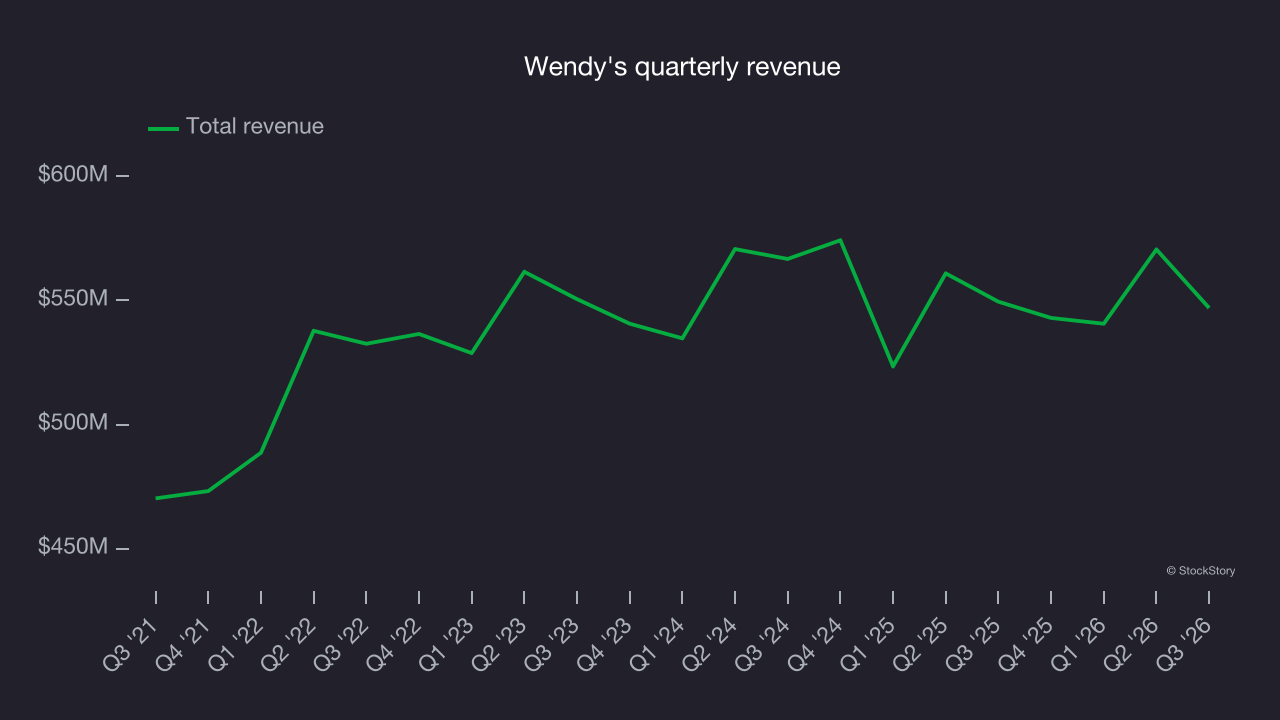
This quarter, Wendy’s $547 million of revenue was flat year on year but beat Wall Street’s consensus estimates by 2.5%.
Looking ahead, sell-side analysts expect revenue to decline by 1.1% over the next 12 months, according to S&P, a deceleration versus the last seven years. This underwhelming projection implies its menu offerings will face demand headwinds.
Restaurant performance
Number of restaurants
A restaurant chain’s total number of dining locations influences how much it can sell and how quickly revenue can grow.
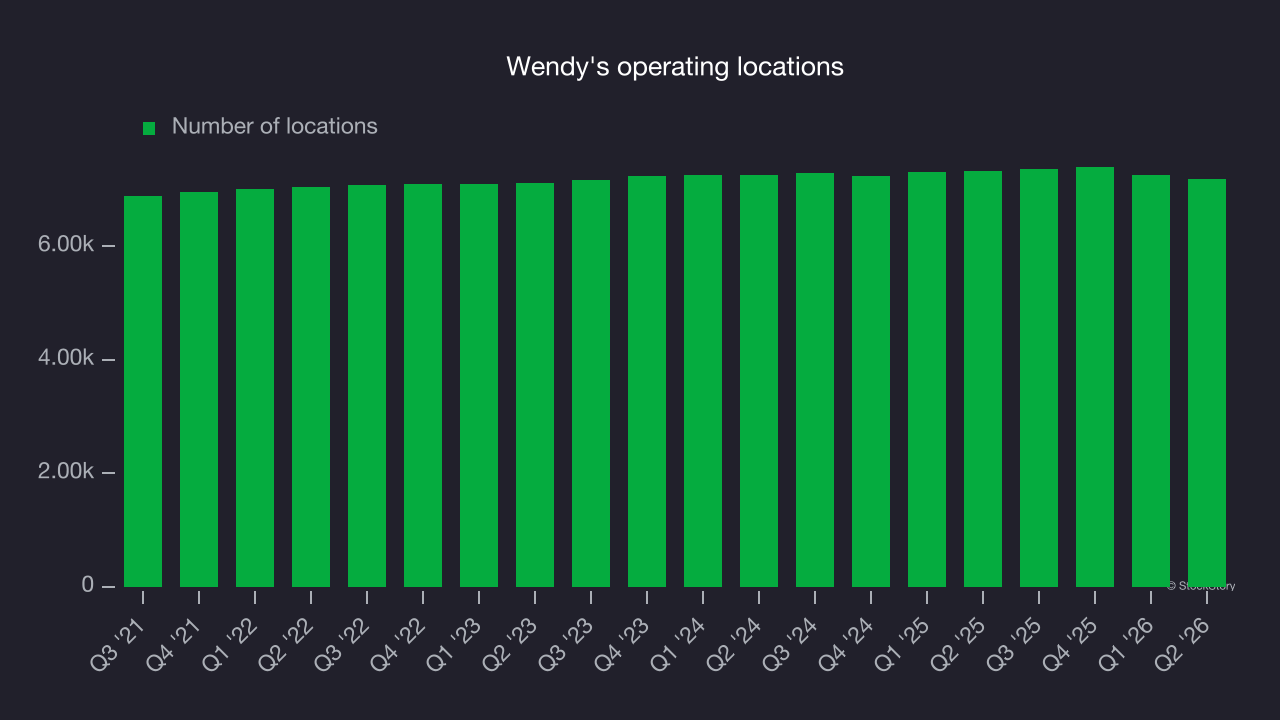
Over the last two years, Wendy's has kept its restaurant count flat while other restaurant businesses have opted for growth.
When a chain doesn’t open many new restaurants, it usually means there’s stable demand for its meals and it’s focused on improving operational efficiency to increase profitability.
Note that Wendy's reports its restaurant count intermittently, so some data points are missing in the chart below.
Same-store sales
A company’s restaurant base only paints one part of the picture. When demand is high, it makes sense to open more. But when demand is low, it’s prudent to close some locations and use the money in other ways. Same-store sales provides a deeper understanding of this issue because it measures organic growth at restaurants open for at least a year.
Wendy’s demand has been shrinking over the last two years as its same-store sales have averaged 4.1% annual declines. This performance isn’t ideal, and opening new restaurants to artificially boost revenue growth would be concerning.
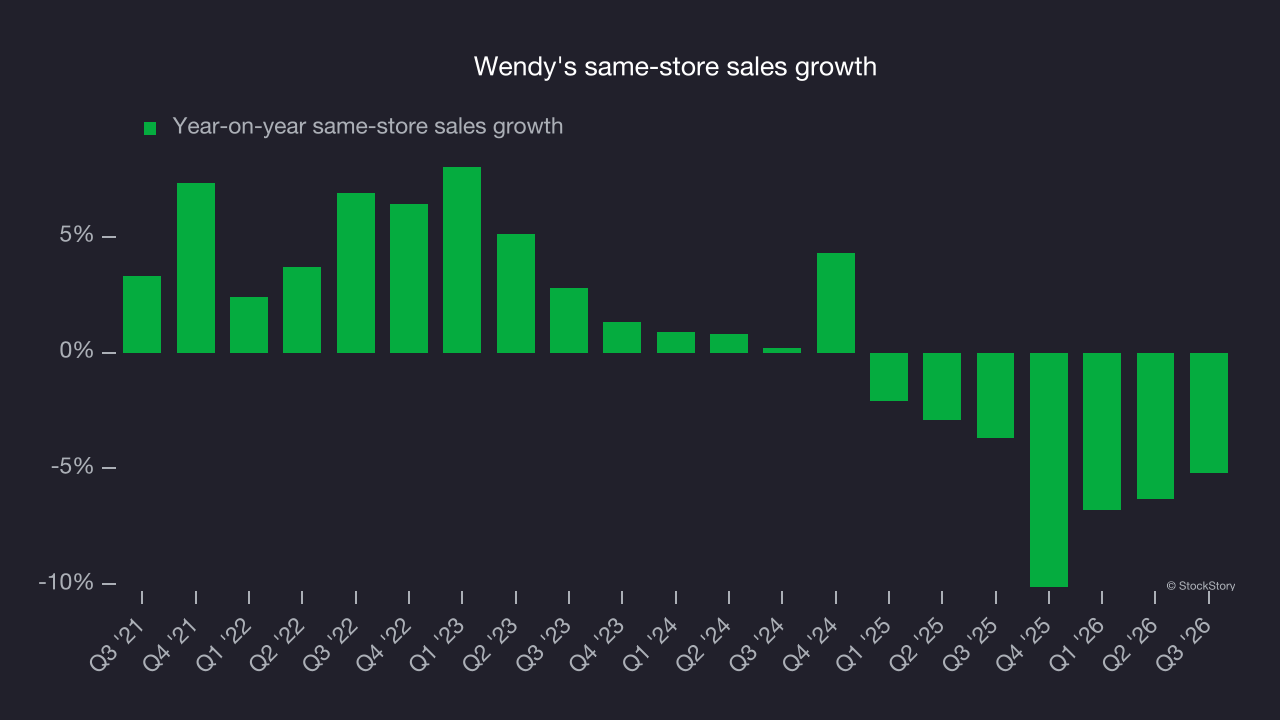
In the latest quarter, Wendy’s same-store sales fell by 5.2% year on year. This decrease represents a further deceleration from its historical levels. The business needs to reverse this decline.
Key takeaways from Wendy’s Q3 results
Wendy’s delivered a solid quarter, with EBITDA well above analysts’ consensus estimates and EPS also topping Wall Street’s expectations. Shares remained flat at $7.60 immediately after the results.
Wendy's latest quarter is only one piece of its longer-term business quality picture. Quality, combined with valuation, can help determine whether the stock is a buy. For more on Wendy's, read our full research report here (it’s free).