



Pharmaceutical company Collegium Pharmaceutical (NASDAQ:COLL) met Wall Street’s revenue expectations in Q3 2026, with revenue up 3.3% year on year to $216.3 million. The company’s full-year revenue guidance of $840 million at the midpoint came in 0.8% above analysts’ consensus estimates. Its non-GAAP profit of $1.96 per share was 5.6% above analysts’ consensus estimates.
For more on Collegium Pharmaceutical, read our free full research report.
Collegium Pharmaceutical (COLL) Q3 2026 highlights:
- Revenue $216.3 million vs S&P analysts’ consensus estimates of $216.8 million (3.3% year-on-year growth, in line)
- Adjusted EPS $1.96 vs S&P analysts’ consensus estimates of $1.86 (5.6% beat)
- Adjusted EBITDA $121.6 million vs analysts’ consensus estimates of $114.1 million (56.2% margin, 6.6% beat)
- Revenue guidance The company reconfirmed its revenue guidance for the full year of $840 million at the midpoint
- EBITDA guidance $457.5 million at the midpoint for the full year, above analysts’ consensus estimates of $447.9 million
- Operating margin 13.3%, down from 29.7% in the same quarter a year earlier
- Market capitalization $770.6 million
“We continued to see strong demand across our ADHD portfolio, supported by expanded commercial efforts heading into the back-to-school season. JORNAY PM reached record revenues, prescriptions and prescriber adoption, with quarterly net revenue growing 24% year-over-year,” said Vikram Karnani, President and Chief Executive Officer. “Additionally, in the first full quarter of Collegium’s ownership of AZSTARYS, revenues exceeded $26.5 million supported by nearly 2% prescription growth year-over-year. This represents a meaningful improvement from AZSTARYS’ annual prescription decline in 2025, prior to its acquisition by Collegium. These results demonstrate our ability to rapidly integrate differentiated medicines and execute targeted commercial investments to drive growth. Our pain portfolio also continues to provide a strong financial foundation as we expand our ADHD business and pursue additional opportunities to further grow and diversify Collegium.”
Revenue growth
A company’s long-term performance is an indicator of its overall quality. Any business can post a good quarter or two, but the best consistently grow over the long haul. Collegium Pharmaceutical’s 20.1% annualized revenue growth over the last five years was impressive. Its growth outpaced that of the average healthcare company and shows its offerings resonate with customers.
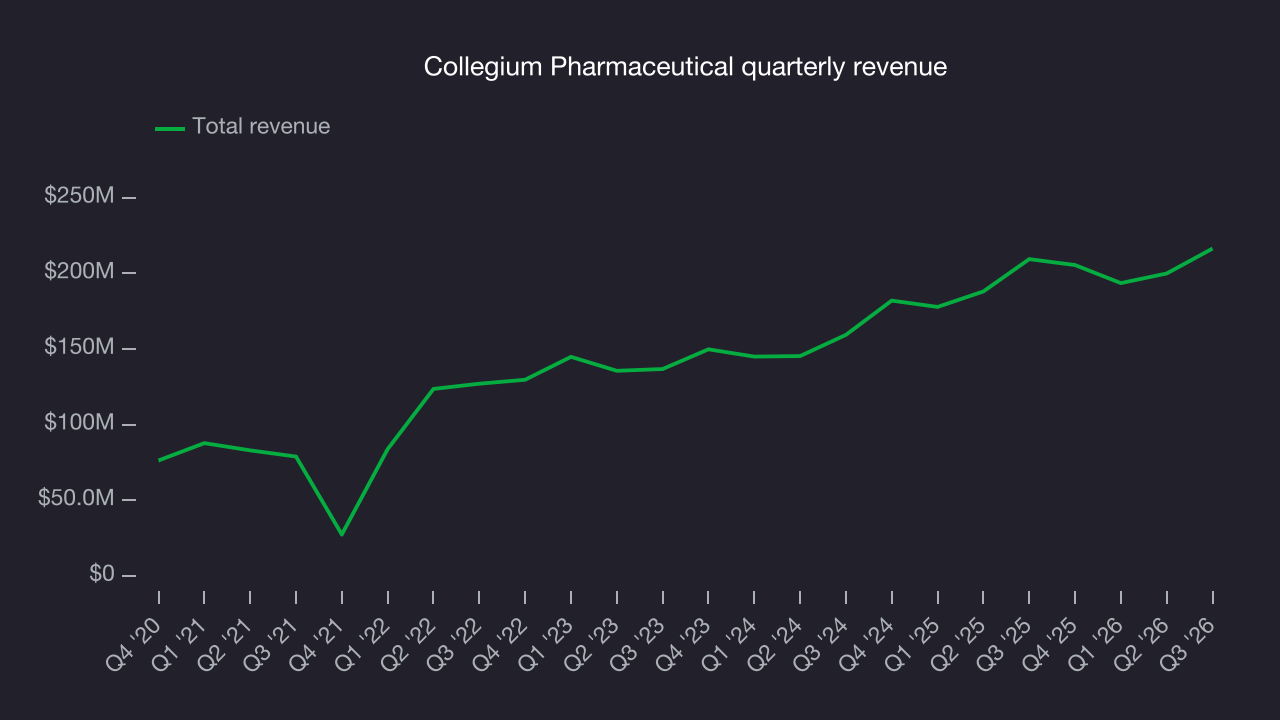
Long-term growth is the most important, but within healthcare, a half-decade historical view may miss new innovations or demand cycles. Collegium Pharmaceutical’s annualized revenue growth of 16.6% over the last two years is below its five-year trend, but the results still suggest healthy demand. 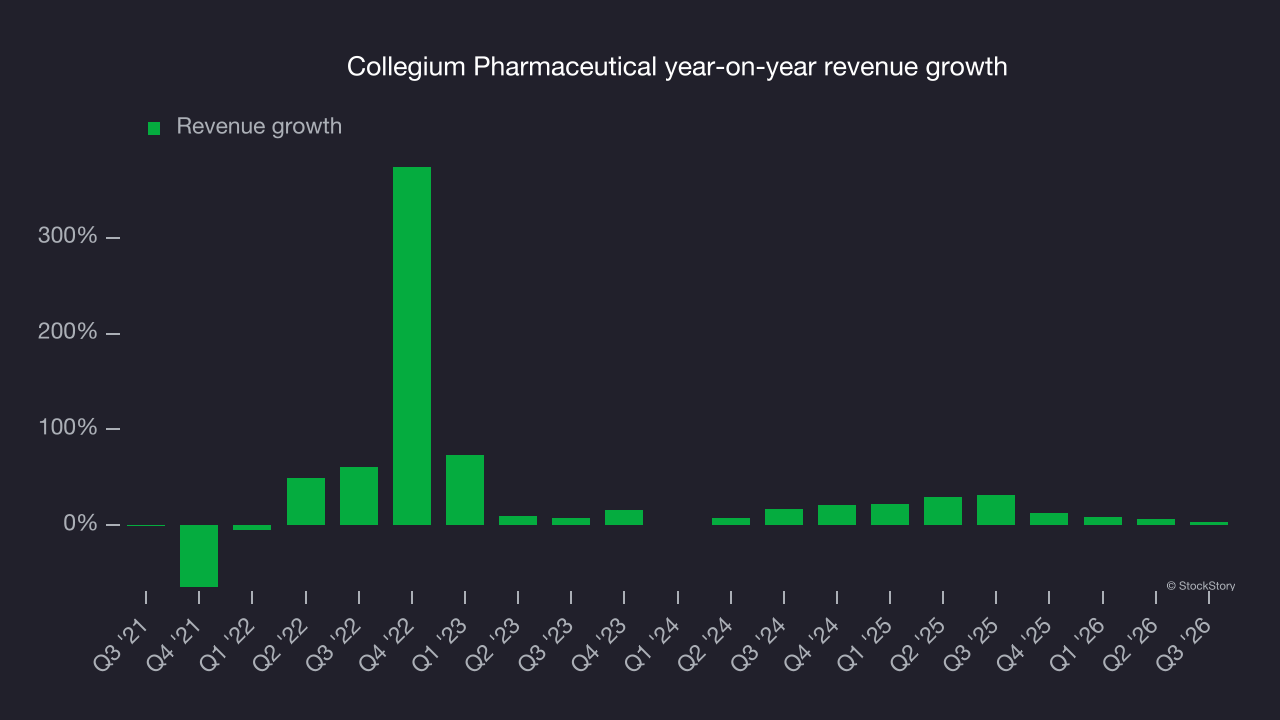
This quarter, Collegium Pharmaceutical grew its revenue by 3.3% year on year, and its $216.3 million of revenue was in line with Wall Street’s consensus estimates.
Looking ahead, sell-side analysts expect revenue to grow 1.4% over the next 12 months, according to S&P, a deceleration versus the last two years. This underwhelming projection indicates its products and services will face some demand headwinds.
Adjusted operating margin
Adjusted operating margin is a key measure of profitability. Think of it as net income (the bottom line) excluding the impact of non-recurring expenses, taxes and interest on debt – metrics less connected to business fundamentals.
Collegium Pharmaceutical has performed well over the last five years. It demonstrated high profitability for a healthcare business, with an average adjusted operating margin of 54.4%.
Looking at the trend in its profitability, Collegium Pharmaceutical’s adjusted operating margin rose by 3.5 percentage points over the last five years, as its revenue growth gave it operating leverage. More recently, however, the company’s margin has decreased by 19 percentage points on a two-year basis. Collegium Pharmaceutical still needs to prove it can expand its profitability consistently.
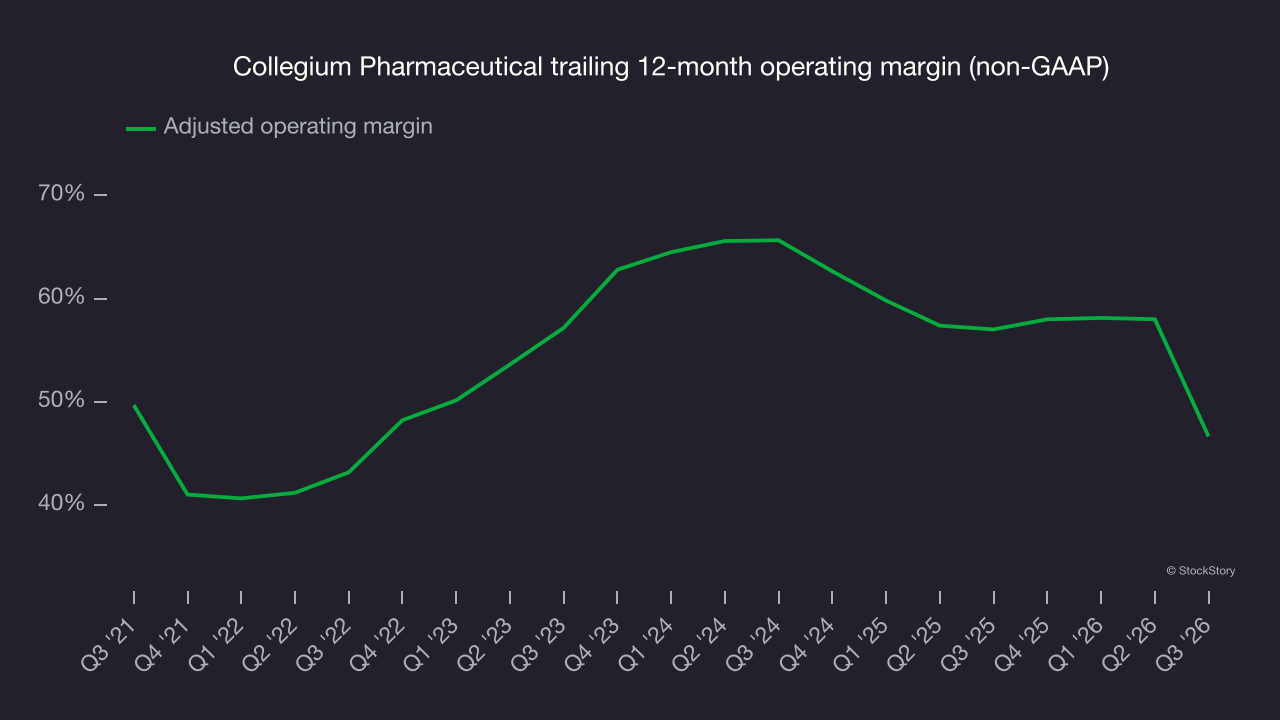
In Q3, Collegium Pharmaceutical generated an adjusted operating margin of 19%, down 42.9 percentage points year on year. This contraction shows it was less efficient because its expenses grew faster than its revenue.
Earnings per share
Long-term changes in earnings per share, or EPS, matter for the same reason as long-term revenue growth. Compared to revenue, however, EPS highlights whether a company’s growth is profitable.
Collegium Pharmaceutical’s EPS grew at a strong 17.2% compounded annual growth rate over the last five years. Despite its adjusted operating margin improvement during that time, this performance was lower than its 20.1% annualized revenue growth, indicating that non-fundamental factors such as interest and taxes affected its ultimate earnings.
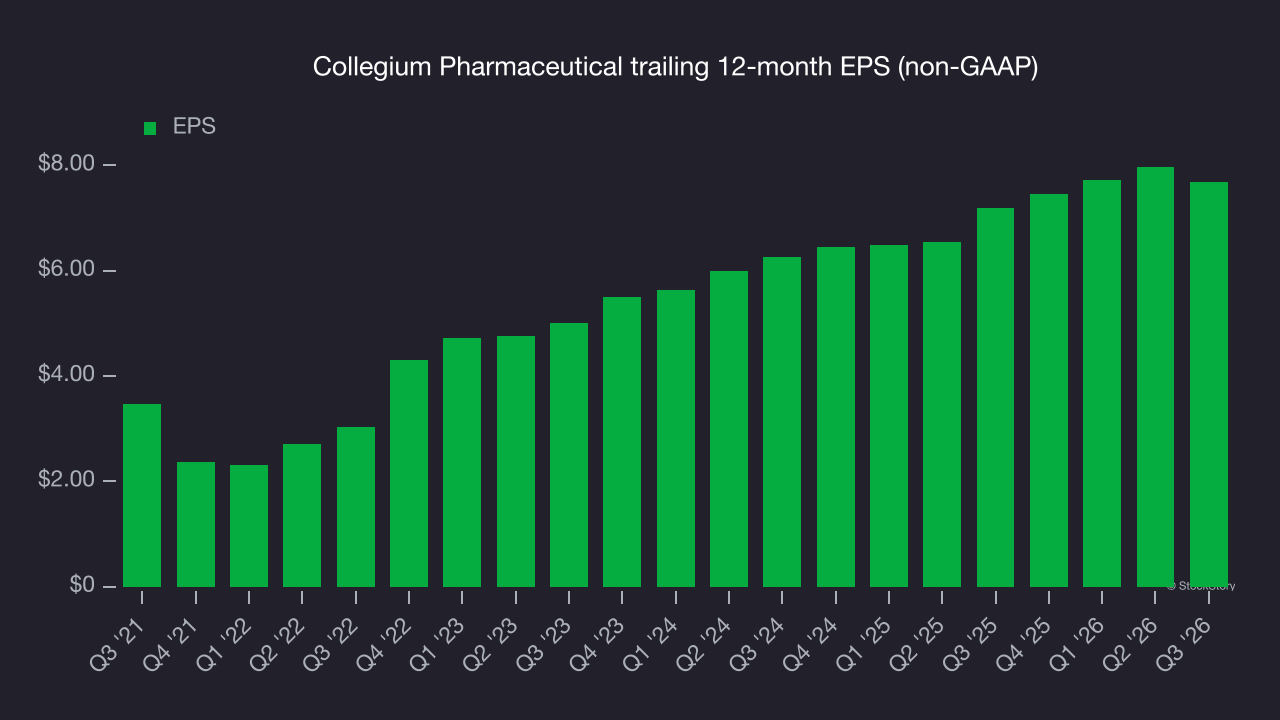
Examining Collegium Pharmaceutical’s quality of earnings can help explain its performance. A five-year view shows Collegium Pharmaceutical has diluted its shareholders, growing its share count by 7.9%. This dilution overshadowed its increased operational efficiency and has led to lower per share earnings. Taxes and interest expenses can also affect EPS but don’t tell us as much about a company’s fundamentals. 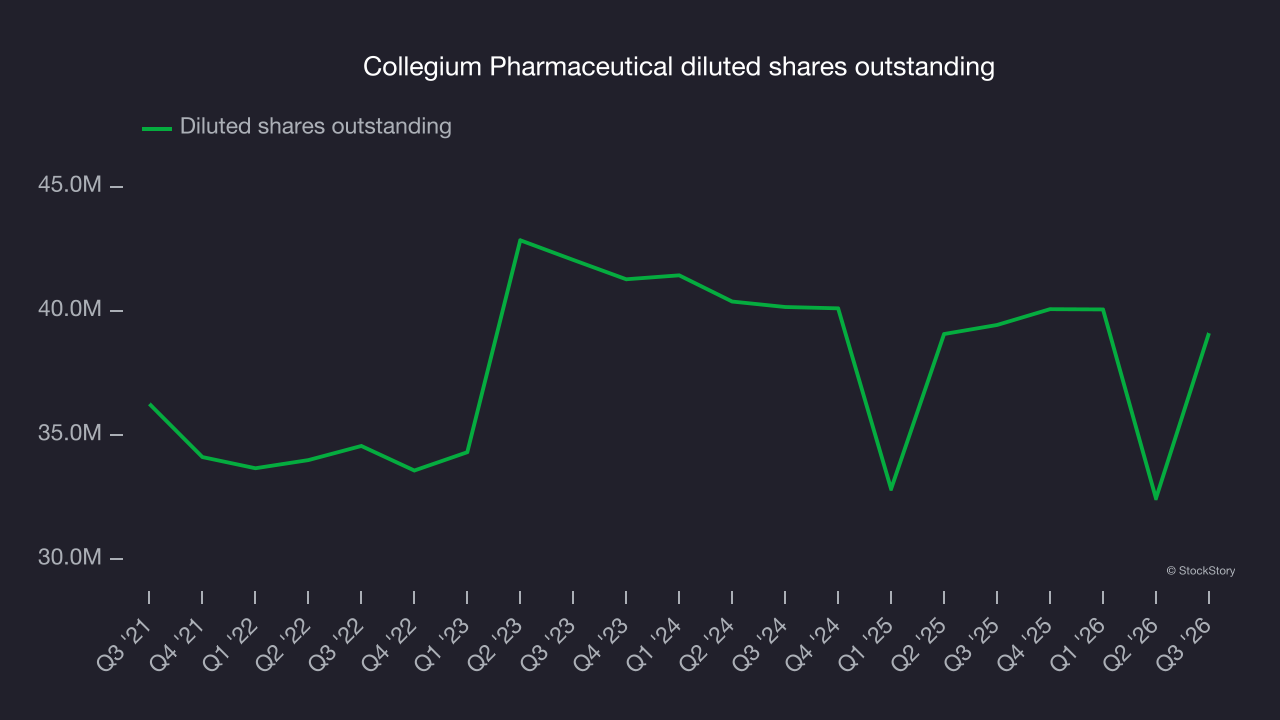
In Q3, Collegium Pharmaceutical reported adjusted EPS of $1.96, down from $2.25 in the same quarter last year. Despite falling year on year, this result beat analysts’ consensus estimates by 5.6%. Over the next 12 months, Wall Street expects Collegium Pharmaceutical’s full-year EPS to shrink by 9.6% from $7.68 to $6.95, according to S&P. This is unusual as its revenue and operating margin are anticipated to increase, signaling the fall likely stems from “below-the-line” items such as taxes.
Key takeaways from Collegium Pharmaceutical’s Q3 results
Collegium Pharmaceutical’s Q3 revenue came in as expected, but EPS topped Wall Street’s consensus estimates and full-year revenue guidance slightly exceeded analysts’ consensus estimates. Those were clear positives in a solid quarter. Shares surged 6.7% to $25.25 immediately after the results.
When deciding whether to invest in Collegium Pharmaceutical, the latest quarter matters, but not as much as longer-term business quality and valuation. For more on those factors, read our full research report here (it’s free).