


The Zhitong Finance App learned that as the Democratic Party won control of the US Senate and House of Representatives and won state elections in major data center towns such as Texas, Georgia, and Ohio, AI power investment faced two forces at the same time: long-term AI data center capacity requirements continued to rise significantly, but project connectivity, cost sharing, and regulatory returns faced stricter scrutiny.
A Goldman Sachs research report on November 2 drastically raised the global data center capacity forecast for 2030 from 217 GW to 273 GW, an increase of about 26%; among them, Goldman Sachs expects a sharp increase in US data center capacity from 49 GW in 2025 to 152 GW, reaching about 3.1 times the original, and the huge expansion space continues to support the long-term demand for the power chain. Two days later, the Goldman Sachs research team led by Carly Davenport pointed out that state-level political changes may delay the inflection point of load growth and affect the pace of Texas's wholesale electricity prices and utility investment, but they still regard Texas as an important long-term growth market, and retain the “buy” ratings of core companies in the data center power chain such as Vistra and NRG Energy.
Both Goldman Sachs studies point to the fact that the global AI computing infrastructure continues to accelerate and still provide huge demand for power resources, and the value of power assets depends on whether these demands can be quickly converted into cash flow from electricity sales on schedule and return on investment in officially approved data centers.
After the Democratic Party won control of Congress and key state elections, the market is re-evaluating the preconditions for turning these demands into profits — potential development restrictions in Texas affect new load access and forward electricity prices; changes in the regulatory landscape in Georgia are related to cost recovery and reasonable returns on electricity investments; Ohio's policy proposition increases uncertainty about project progress; and California wildfire liability reforms may ease valuation discounts for related companies.
In this latest power stock research report after the midterm elections, Goldman Sachs maintained a “buy” rating for NRG Energy, Vistra, PG&E, Sempra, Xcel Energy, FirstEnergy, and Duke Energy. The main line of investment behind this list is to find companies that can turn power supply resources, customer load, and approved investments into sustainable cash flow in the midst of growing AI electricity demand. According to Goldman Sachs, the future division of power stocks will depend more on when projects are introduced, how electricity prices are formed, who bears the investment costs, and ultimately how much growth can be realized as shareholder returns.
The market has begun to differentiate between the two logics of incremental and existing data center power supply. In October, the Nasdaq 100 and Philadelphia Semiconductor Index fell 6.6% and 15.4%, respectively, while Sempra, Xcel Energy, and American Electric Power rose by about 10.4%, 13.3%, and 9.8%, respectively. On November 4, after the election results were announced, Vistra, NRG Energy, and Constellation Energy fell sharply by 13.83%, 13.52%, and 6.71%, respectively, but Xcel Energy, Duke Energy, and Edison International still rose 2.21%, 2.43%, and 3.12%, respectively. This shows that the impact is focused on the market's expectations for new loads, electricity prices, and project delivery, but not all utilities can be viewed as the same type of AI transaction, and power chain leaders that have already received huge data center orders are still favored by the market.
The severe share price differentiation of this group of data center power chain companies echoes the differences in policy impact emphasized by Goldman Sachs: new load access is slowing down the forward electricity prices and profit expectations of some power generation companies; the value of regulated utilities depends more on whether the investment can be approved to be included in the rate, whether the cost can be recovered, and the regulatory environment in the region where it is located. As a result, AI electricity demand is still a long-term source of growth, but the market is increasing the requirements for growth fulfillment conditions — companies with reliable power supply resources, clear access arrangements, and sustainable return mechanisms are more in a position to maintain valuation support.
Texas Revalues Electricity Price Prospects, Georgia Revises Return on Investment: Votes Reshape the Path to Electricity Growth
The key variable in Texas is when the data center needs actually connect to the grid. Governor-elect Gina Hinojosa has advocated suspending development until 2027 legislation establishes more protections. Goldman Sachs believes that the main risk is a delay in construction and grid connection time rather than loss of long-term demand: delays in load growth will weaken expectations of tightening supply and demand in the Texas Electricity Market (ERCOT) and affect forward electricity prices and contract values for companies such as Vistra and NRG Energy; for Sempra, Xcel Energy, and American Electric Power, it may delay investment in transmission and distribution.
The Goldman Sachs research report listed the data center audit findings before December 10 as follow-up observation points. Meanwhile, KeyBanc analyst Sophie Karp downgraded Vistra from “gain” to “industry weight” due to policy uncertainty, showing that Wall Street investment institutions already have major differences over short-term risk tolerance.
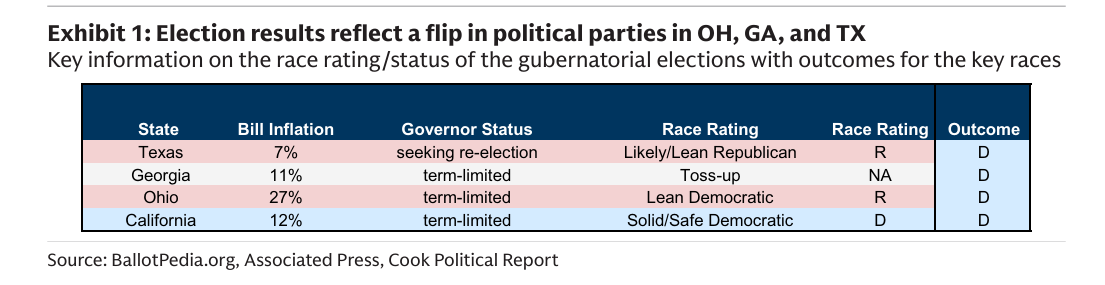
Georgia's influence goes deeper into regulating return mechanisms. In addition to the governor's position, the Democratic Party also obtained a majority of seats on the Public Utilities Commission, which means that large-scale load access, cost sharing, and rate approval may be subject to more strict scrutiny.
Approximately 56% of Southern Company's rate asset base is located in the state, and its reserves of over 75GW of potential large-scale load projects have therefore become the focus of Goldman Sachs's attention. The 75GW here belongs to the opportunity pool, and not all of them have been contracted or electrified. For regulated utilities, increased demand can only be converted into profit through investment approval, asset operation, and cost recovery; if regulations require developers to bear more infrastructure costs, the project economy and pace of operation will change, and it may also reduce disputes over ordinary users subsidizing major customers.
Ohio Data Center Expansion Faces Policy Test, California Seeks Wildfire Liability Reform: Electricity Stocks Revalue Key Variables
At the core of Ohio is the balance between large load growth and residents' ability to afford electricity bills. Goldman Sachs expects the local data center capacity to be put into operation by 2030, but after Amy Acton wins the election, stricter requirements for environmental protection, information disclosure, community benefits and cost sharing may increase development uncertainty, which is relatively unfavorable to FirstEnergy and American Electric Power, and Duke Energy's impact is limited.
According to the Goldman Sachs research report, American Electric Power's 84 GW contract load is more advanced than potential project reserves, but it still needs to be connected to the grid to contribute revenue; in addition, Goldman Sachs emphasizes that the acceleration of grid connection and the formation of additional investments in projects such as Bloom/Piketon are upward sources, financing requirements, the gap between actual and approved return on equity, and data center rate policies determine whether growth can fully fall into shareholders' profits.
The main line of California's valuation is the reform of the wildfire liability system. Governor-elect Xavier Becerra said that relevant policies still need to be improved, and Goldman Sachs therefore continues to pay attention to the special legislative session period and scope of reform. PG&E, Sempra, and Edison International may be supported by lower risk premiums if institutional adjustments reduce the uncertainty of major payouts and improve the recovery of investment costs. According to Goldman Sachs, PG&E, Sempra, and Edison International are expected to mitigate valuation discounts and create conditions for stock price restoration, especially if wildfire liability reforms reduce the risk of huge compensation and increase the certainty of reasonable cost recovery.
Investors are worried that the power company will bear huge compensation from the wildfires, or that the cost of the investment cannot be recovered through electricity prices, and that they will demand higher expected returns as risk compensation, as reflected in lower stock prices that they are willing to pay. The benefit of this additional requirement is the “risk premium” here.
If the system reform makes liability more clear and reasonable cost recovery more secure, the uncertainty that investors bear will decrease, and the required risk compensation will also be reduced. With future profit expectations unchanged, a decrease in the discount rate can support higher valuations. Thus, a “reduced risk premium” does not mean that a company's profit falls, but rather that the market may reduce the valuation discount of its shares.
Sempra is particularly reflective of geographical differentiation: while the Texas business faces delays in load fulfillment, the California business may benefit from liability reforms. The factors that determine a company's valuation are therefore also the combined results of each region's profit contributions, regulatory arrangements, and capital costs.
From “capacity planning” to “billable assets,” Goldman Sachs is optimistic about which power companies are associated with data centers
GPU training clusters, inference services, and intelligent workflows transform computational requirements into high-density, continuous power loads, and drive the construction of substations, transmission lines, power distribution equipment, cooling and backup power supplies. However, the profit mechanisms in different areas are not the same: market-based power generators mainly profit from power generation, electricity prices, capacity revenue, and long-term contracts; regulated utilities mainly form a rate asset base through approved investments, and then recover costs and earn returns according to the approval mechanism. Therefore, project delays first affect electricity sales and pricing expectations for the former, and the timing of capital investment and profit contributions for the latter; the extent also depends on hedging, contract guarantees, and regulatory approval.
Goldman Sachs's capacity update reveals the scale of this investment cycle: global data center capacity is expected to increase from 103 GW to 273 GW, a net increase of 170 GW in five years, with the US contributing 103 GW, accounting for about 61% of the global increase; by 2028, large-scale projects above 75 MW are expected to account for 75% of the new US capacity. These figures point to larger power supply and grid support requirements, but GW measures capacity and is not directly equal to actual annual electricity consumption. Assuming a full-stack cost of 50 billion US dollars per GW, 170 GW corresponds to a cumulative investment of about 8.5 trillion US dollars, but this also includes IT hardware and other expenses, and cannot all be considered utility electricity revenue.
New cloud vendors have expanded their potential sources of demand. Asia-Pacific construction is expected to improve, while European growth is more focused on the long term. At the same time, the eight US AI and cloud companies cited in the report have an average annual capital expenditure of about US$1.51 trillion from 2026 to 2030, covering the global investment of these companies, not all of which are invested in the mainland of the United States. According to Goldman Sachs, the most valuable electricity growth is growth that has targeted high-quality customers, clarified when to connect to the grid, implemented cost sharing, and can obtain a reasonable return on capital. Long-term expansion predictions and post-election policy pressure intersect in this implementation process.
Goldman Sachs's latest research report lists the ratings of seven “buy” and four “neutral” data center power chain companies; these ratings and target prices were not directly lowered as a result of this midterm election. The following increases are uniformly calculated based on the closing price on November 4. The target market value is estimated at an approximate estimate based on the disclosed share capital remaining unchanged. Dividends are not included, nor is it the target price that Goldman Sachs re-announced after the closing price plummeted.
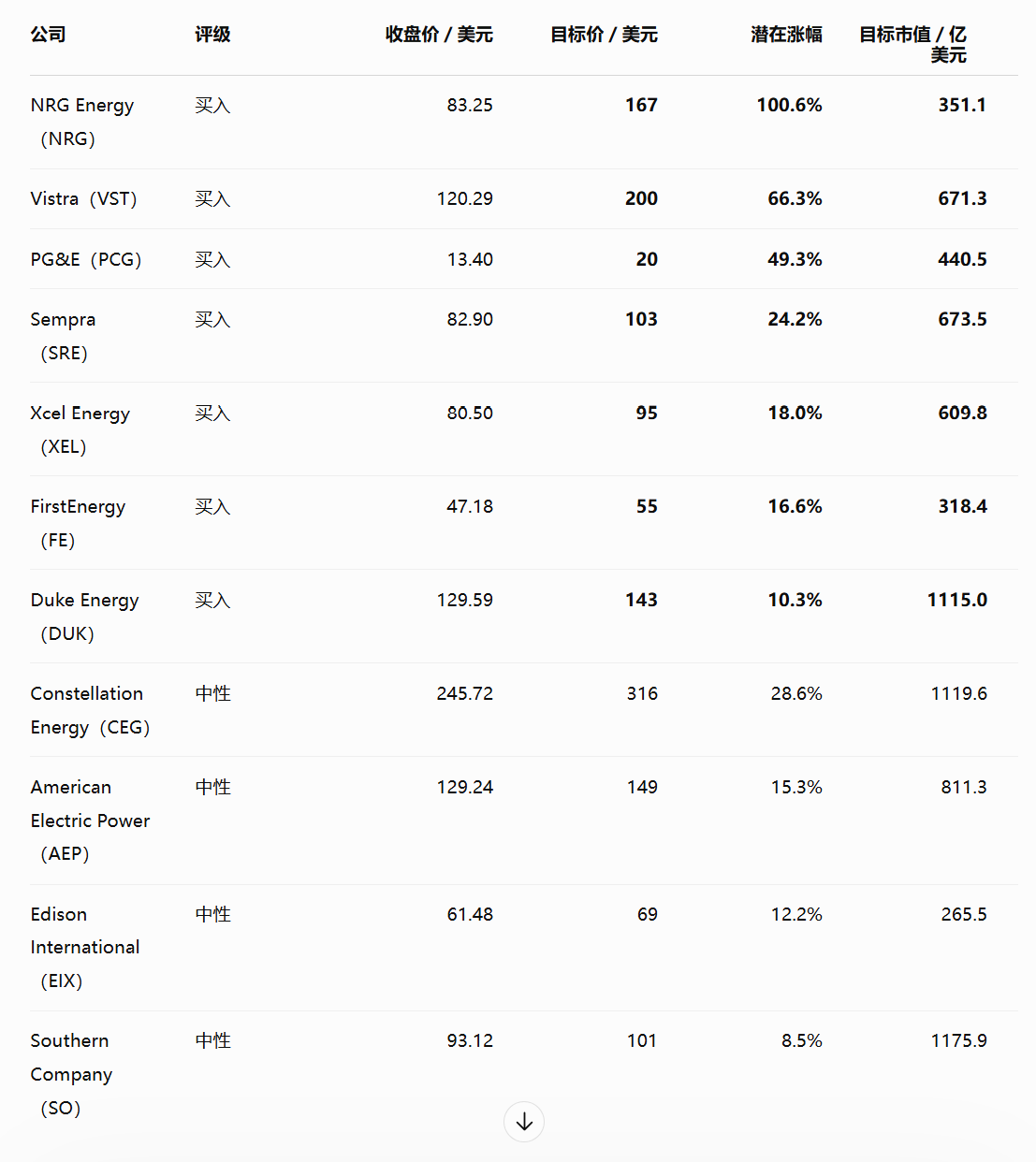
Valuation methods reflect business differences. Vistra uses a mixed estimate of 10 times EV/eBITDA and 7% free cash flow return, and NRG uses 8.5 times and 9%, so market changes in electricity prices, cash flow, and PJM capacity are particularly important; Constellation uses a price-earnings ratio of 21 times and a 5% return on free cash flow. Regulated companies are more likely to forecast profits for the 5th to 8th quarters: Xcel, FirstEnergy, Duke, and PG&E gave price-earnings ratios of 19.5, 17.5, 19, and 10.5 times, respectively; Southern and Edison were 19.5 and 10 times, respectively; Sempra and American Electric Power used segmented aggregate valuations. Goldman Sachs's premiums to Xcel and Duke reflect transmission and renewable energy growth, power generation investment, and regulatory improvement opportunities, respectively; PG&E's lower multiples highlight the restrictions on valuation of wildfire liability. The expansion of target price space after the election meant that the market increased the discount on implementation risks, and subsequent repairs still require evidence of grid connections, contracts, and regulatory returns.