


Markets are catching their breath after a post‑midterm relief surge, just as oil prices drop sharply and reshape the cost picture for fuel hungry airlines and cargo carriers. That mix can create pockets of opportunity and risk for investors who move before the story feels obvious. This article explains how the latest political and energy shifts relate to jet fuel costs and profiles 3 stocks exposed to those currents.
The stocks profiled below are just a starter pack, and the full screen surfaced 20 more U.S. airlines and airfreight carriers with equally compelling margin and fuel exposure stories that are not covered here. To identify and analyze the highest conviction plays from that broader universe, head straight to the U.S. Airlines and Airfreight Carriers Leveraged to Lower Jet Fuel Costs screener.
Werner Enterprises (WERN)
Werner Enterprises fits this fuel-sensitive screen as a large truckload carrier where diesel is a key expense. Shifting energy prices can ripple quickly through its extensive freight network and make small moves in fuel costs matter significantly for profitability.
Werner Enterprises operates a large truckload fleet and related logistics platform that moves retail goods, food, beverages and manufactured products across North America and internationally. It generates about US$2.5b from Truckload Transportation Services, roughly US$831 million from Werner Logistics, and has a market value near US$1.8b.
Continued investment in fleet modernization, digital platforms and automation, including the Werner EDGE TMS and AI-driven tools that are already improving functions such as road breakdown support, carrier payments and appointment scheduling, creates scope for further structural cost reduction and higher productivity that can support net margin expansion and earnings over time.
The key variable is how one less visible cost pressure ultimately interacts with those efficiency gains to reshape Werner Enterprises' margins.
Those shifting cost pressures are already in motion, and the full narrative for Werner Enterprises shows how Werner Enterprises could convert that fuel and tech mix into accelerating earnings power.

Covenant Logistics Group (CVLG)
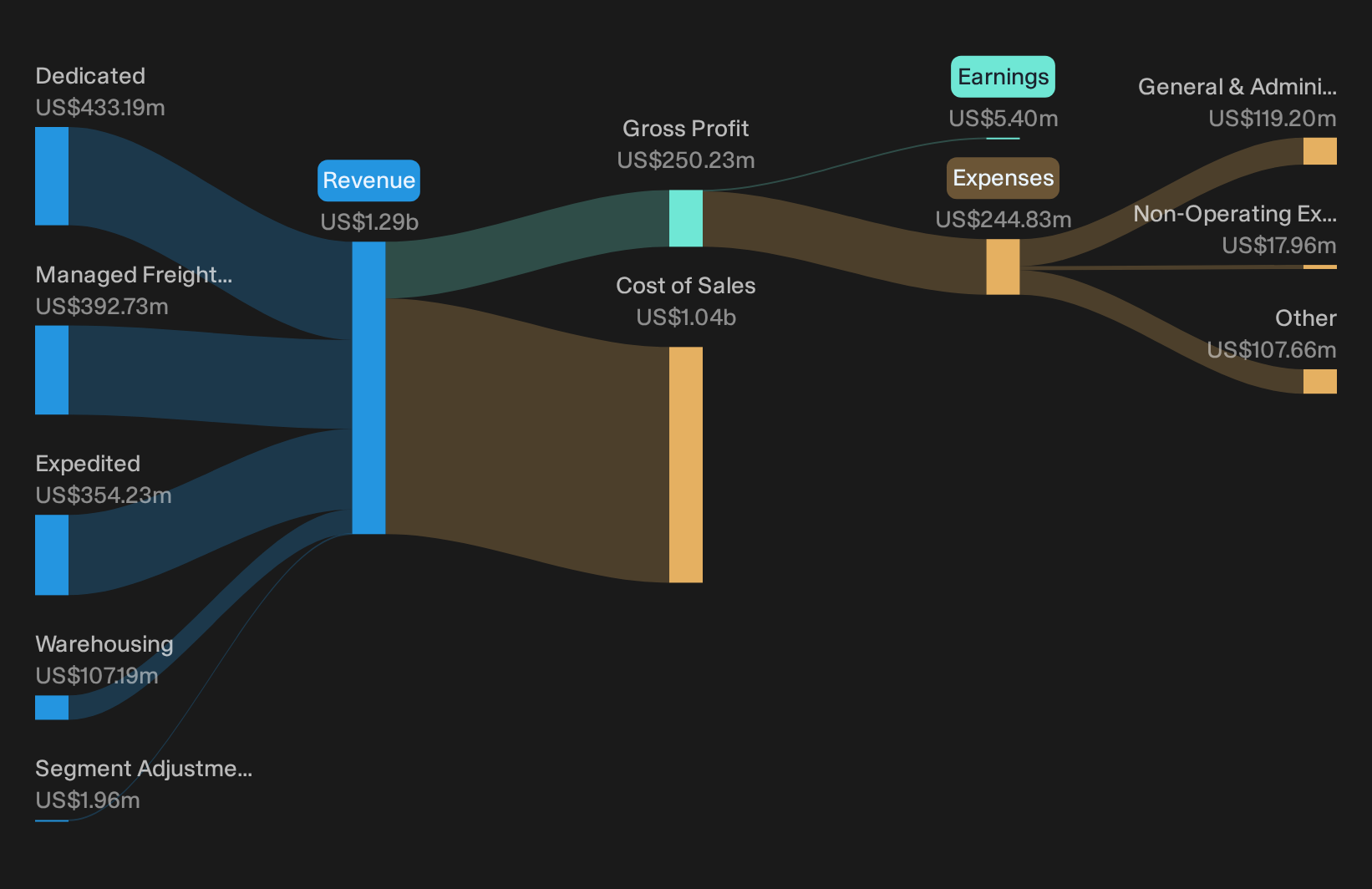
Covenant Logistics Group plugs neatly into this fuel-sensitive theme as an asset-heavy trucking and logistics player in which diesel costs help shape profitability. At the same time, its mix of Expedited, Dedicated, Managed Freight and Warehousing services gives the business several levers beyond fuel to influence earnings.
Covenant Logistics Group runs an integrated U.S. transport and logistics platform, generating about US$433 million from Dedicated, US$354 million from Expedited, US$393 million from Managed Freight and US$107 million from Warehousing, and carries a market value near US$850 million.
Industry wide constraints on driver availability and increased enforcement of ELD and safety rules are removing capacity from the market and are contributing to rising contract rates, which Covenant Logistics Group expects to capture over time in the form of higher revenue per mile and improved operating margin.
What happens to those emerging contract economics if a single key cost line moves faster than customers are willing to reprice?
When a single cost line can swing the whole equation, the full narrative for Covenant Logistics Group shows where Covenant Logistics Group could still see earnings power accelerate or stall.
J.B. Hunt Transport Services (JBHT)
J.B. Hunt Transport Services taps directly into the fuel cost theme of this screen, because its large truck and intermodal fleet lives and dies by diesel prices, and its rail partnerships can change how that fuel exposure flows through to margins.
J.B. Hunt Transport Services runs a large U.S. freight and logistics network built around Intermodal (about US$6.6b in revenue), Dedicated Contract Services excluding Final Mile (around US$3.6b), Integrated Capacity Solutions (roughly US$1.4b), Truckload (about US$900 million) and Final Mile Services (about US$800 million). This gives the US$20.9b firm broad exposure to surface transportation and fuel sensitive freight flows.
Record intermodal volume in Q2 2026, including over 578,000 loads and strong growth in the Eastern network, signals ongoing highway to rail conversion that could support revenue growth and intermodal operating margins as more of the identified conversion opportunity is captured.
What really matters for investors now is how one less visible shift in its cost and pricing balance ultimately feeds through to those margin outcomes.
That cost and pricing balance is where the real story starts, and the full narrative for J.B. Hunt Transport Services maps how fuel, contracts and intermodal mix could reshape JB Hunt's earnings path.

Seeking Fresh Alternatives Before They Fly
Markets can change quickly, and potential breakout ideas are often identified by early movers while the data is still fresh and less widely followed. Consider reviewing opportunities in a timely manner.
- Look for resilient momentum in companies that aim to balance return potential and risk by scanning a curated 31 resilient stocks with low risk scores before it becomes widely followed.
- Explore companies with strong cash generation trading at appealing levels by reviewing a hand picked 35 high quality undervalued stocks while valuations appear reasonable.
- Review opportunities related to the development of next generation energy infrastructure by considering a focused 16 nuclear energy infrastructure stocks before sentiment and prices potentially shift.
Have feedback on this article? Concerned about the content? Get in touch with us directly. Alternatively, email editorial-team@simplywallst.com