


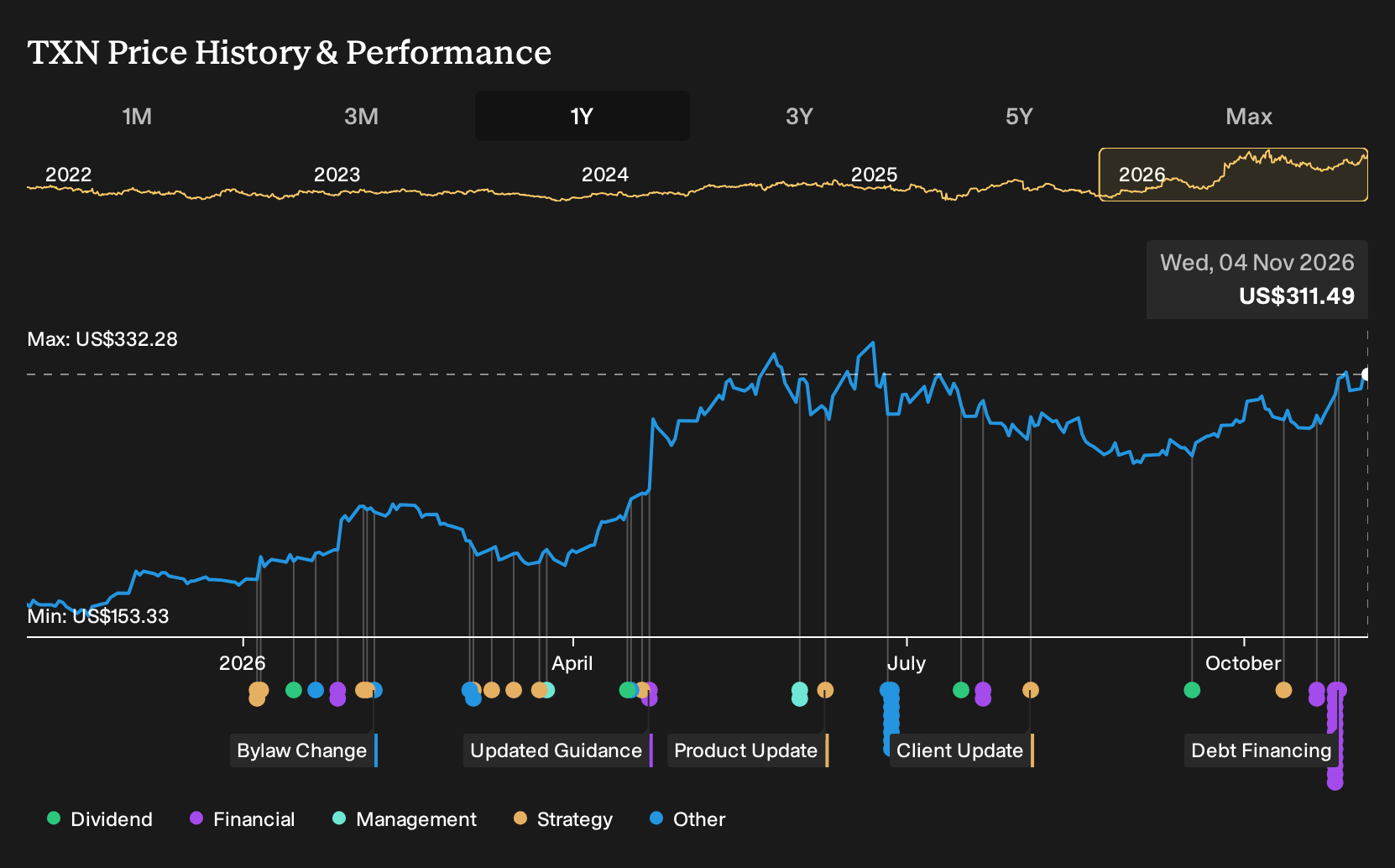
- Texas Instruments recently priced four series of senior unsecured notes totaling US$2.0b, with fixed coupons between 5.000% and 5.750% and maturities from 2028 to 2036, to help fund its planned acquisition of Silicon Laboratories and related costs.
- The fresh debt funding sits alongside reported earnings momentum and expanding industrial, automotive and data center demand. This tightens the link between Texas Instruments' balance sheet decisions, factory buildout and how effectively it fills those new fabs with long term orders.
- We will now look at how Texas Instruments' new US$2.0b bond issue to fund Silicon Labs could reshape its investment narrative.
Compare how Texas Instruments is reloading its balance sheet for growth with other chipmakers by scanning the hand picked 53 AI infrastructure stocks shaping the next leg of AI and data center buildouts.
Texas Instruments Investment Narrative Recap
To own Texas Instruments, you need to believe its heavy bet on in house 300 millimeter fabs and a broader analog and embedded portfolio converts into durable demand across industrial, automotive and data center customers. The Silicon Labs deal and fresh US$2.0b in bonds fit directly into that thesis by adding more embedded processing depth.
In the near term, the key swing factor is how quickly Texas Instruments fills new capacity with high value data center and industrial orders while absorbing higher depreciation and interest expense tied to the bond issue. The main risk is softer end markets leaving those fabs and the acquired Silicon Labs assets underused, which would pressure margins and free cash flow.
In this context, the most relevant recent move is the series of fixed rate senior unsecured notes that Texas Instruments issued and priced between 5.000% and 5.750% with maturities from 2028 to 2036. This financing directly supports the Silicon Labs acquisition, so it links balance sheet structure with how confidently the business is leaning into long duration demand.
For you as a shareholder, the central question is execution. Texas Instruments now needs to integrate Silicon Labs' embedded portfolio, keep factory loadings healthy and manage higher interest and depreciation at a time when expectations around AI driven data center and industrial automation demand are already high. Any stumble in those areas could quickly move from an abstract risk to a visible constraint on earnings quality.
Texas Instruments' current analyst narrative points to revenues of US$31.5b and earnings of US$13.5b by 2029, based on 15.0% yearly top line growth and an earnings increase of about 1.9x from US$7.1b today.
Uncover why Texas Instruments' fair value indicates an 8% potential upside to its current price, a discount that could close faster than many expect.
Exploring Other Perspectives
Another angle focuses on debt risk. The most cautious analysts worry that piling US$2.0b of new notes on top of heavy fab spending could strain returns if demand cools. Before this bond pricing, the most bullish group projected US$38.0b of revenue and US$15.3b of earnings by 2029, while more cautious voices sat nearer US$10.2b. You can treat this Silicon Labs funding step as a fresh data point that might pull those narratives closer together or push them further apart, so it pays to compare multiple scenarios rather than rely on a single forecast.
Explore 6 other Texas Instruments fair value estimates, including one that suggests as much as 40% upside from the current price!
Form Your Own Verdict
Don't just follow the ticker. Dig into the data and build a conviction that's truly your own.
- A great starting point for your Texas Instruments research is our analysis highlighting 3 key rewards and 1 important warning sign that could impact your investment decision.
- See our latest analysis for Texas Instruments. The report includes a comprehensive fundamental analysis summarized in a single visual, the Snowflake, making it easy to evaluate Texas Instruments' overall financial health at a glance.
Looking For More Investment Ideas Beyond Texas Instruments?
Once you have a view on Texas Instruments, it often helps to line it up against other potential opportunities using the Simply Wall St Screener. That way you can compare its risk, income and balance sheet profile with a broader watchlist rather than assessing it in isolation.
- If you want income that can complement a growth story like Texas Instruments, check out higher yielding candidates through the 5 dividend fortresses available in the screener.
- For investors who prefer to lean toward quality at a reasonable entry point, review the 35 high quality undervalued stocks to see which businesses currently screen as priced below their estimated worth.
- If capital preservation sits high on your priority list, narrow your options using the 31 resilient stocks with low risk scores and focus on companies with more resilient risk profiles.
Have feedback on this article? Concerned about the content? Get in touch with us directly. Alternatively, email editorial-team@simplywallst.com