


The Zhitong Finance App learned that the Democratic Party swept through Congress in the US midterm elections this week, triggering a sharp sell-off of large US technology stocks, and safe-haven demand heated up. The price of US bonds soared across the board on Thursday.
This wave of gains on Thursday drove US bond yields of various maturities down by up to 12 basis points, to the lowest level since the beginning of September. Treasury bond futures trading volume was about 40% higher than the 20-day average. As safe-haven funds poured into the treasury bond market, the Nasdaq 100 Index plummeted 6.4%, and the Philadelphia Semiconductor Index plummeted 12%.
In fact, the US bond market recorded its biggest increase in more than two years last month — investors lost confidence in the sustainability of AI infrastructure capital spending and began to switch from stocks to bonds.
“The decline in chip stocks is essentially a continuation of the judgment that the market is absorbing capital expenditure may slow down,” said Anmol Sinha, director of fixed income investment at Capital Group. “This is the driving factor behind the current market.”
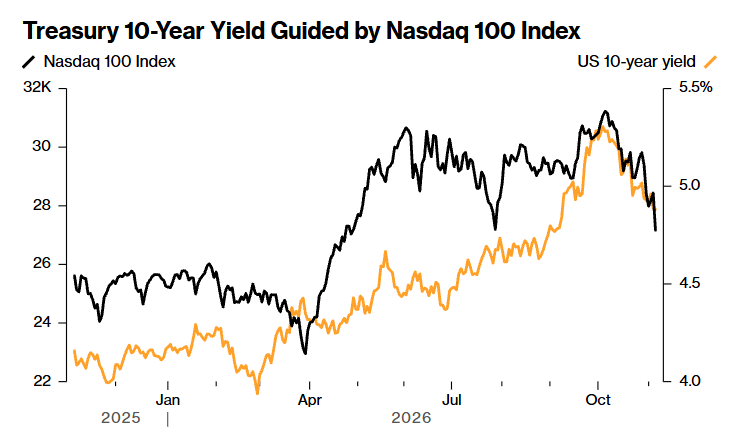
Interest rate expectations shift: deals that bet “on hold” have appeared
In addition to pure safe-haven purchases, the decline in AI infrastructure investment enthusiasm may slow down the prospects for the US economy to slow down, and also reduce market expectations for the Federal Reserve's interest rate hike in the next few months. Markets worry that after taking over Congress with an advantage beyond expectations, the Democratic Party will restrain the AI industry in January.
Although traders still prefer the Fed's policy makers to raise interest rates by 25 basis points during the last vote of the year on December 9, there were already “no changes” in the short-term interest rate options market on Thursday; bets on the Fed's further rate hike next year were also cut on Thursday.
The treasury bond options market, on the other hand, showed strong demand to hedge additional income. Notable transactions include a bet on the 10-year Treasury yield — currently around 4.82%, down about 6 basis points on the same day — to fall to 4.7% by the end of next week; another option due on November 20 targets the yield falling to around 4.35%.
“In our opinion, today is a standard safe-haven operation,” said Gregory Faranello, head of macro strategy at South Street Securities Holdings. “We will not continue to rise at this level for a long time, but for the time being, we will respect the trend of the bond market compared to risky assets.”
Tech giants are still “stealing money” with US debt
It is worth noting that the market's enthusiasm for investing in large technology companies has not disappeared, and the issuance of corporate bonds is competing with US bonds for capital. On Thursday, Apple is preparing to raise 7.5 billion US dollars in the corporate bond market through a seven-part issuance period of 2 to 10 years. This is its largest loan since 2021. Microsoft, Oracle, and Meta Platforms recently sold a total of 50 billion US dollars in bonds.
The strategist commented: “In the post-midterm election wave of AI, the winner will be treasury bonds — we have seen this today. Perhaps the best way to describe this market running too fast is: technology is rushing directly to the end of productivity, while the real economy is still waiting for electricians and electricity.”
Oil prices and the labor market are still variables
With Thursday's rise, US bond yields have returned to the level of late September to mid-October — when rising oil prices, strong US economic growth, and expectations of the Fed's interest rate hike combined with rising debt levels, propelled yields to multi-year highs.
Fluctuations in oil prices continue to impact the bond market. Oil prices have fallen by about 15% in the past three days, and the market believes that the election results may change the course of President Trump's war against Iran. Before the opening of the US stock market, US bond yields rebounded for a while as oil prices rebounded from a two-month low. Since the war broke out in February, supply shocks reignited US inflation, and prompted the Federal Reserve to raise interest rates in September, oil prices have largely indicated the direction of US bond yields.
The early weekly jobless claims data released on the same day showed the resilience of the US labor market, and the October employment data will be released on Friday and is expected to improve from September — the number of new jobs added in September fell short of expectations.
Cleveland Federal Reserve Chairman Beth Hammack and Richmond Federal Reserve Chairman Tom Barkin both publicly expressed support for higher interest rates. Last month, Hammack voted against the Federal Reserve's decision to keep interest rates unchanged and advocated raising interest rates.
“The sell-off in yield since September has left us a lot of room to make up,” said Ed Al-Hussainy, fund manager at Columbia Threadneedle Investments. He believes that if the October employment data weakens, the 10-year yield is expected to drop further to 4.7% or even lower — that is, the level in August.