


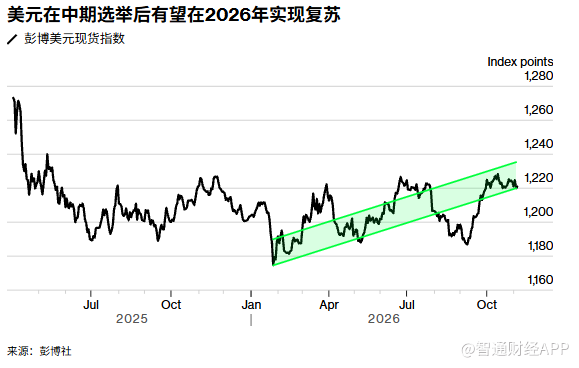
The Zhitong Finance App learned that foreign exchange strategists said that although the US midterm election results briefly dragged down the US dollar, the factors driving the US dollar's strength in recent months have basically remained unchanged. The Bloomberg dollar spot index fell on Wednesday, when traders were weighing the impact of Washington's policy impasse after the Democratic Party gained control of Congress. However, the index remained stable on Thursday, even as the US stock market fell; it is currently less than 1% below the nearly 18-month intraday high hit in October. Furthermore, the options market shows that traders expect the dollar to rise before the end of the year.
Expectations of growth and interest rate hikes form the core support
Institutions including Bank of America, Standard Chartered, and hedge consulting firm Chatham Financial believe that the key point is that this major global reserve currency will continue to be supported by at least two key sources — US economic resilience and market expectations for the Fed to raise interest rates over the next year.
Although large technology stocks plummeted after the US midterm elections, and the prospects for foreign demand for such stocks are becoming increasingly uncertain, some traders still believe that the US dollar is the leader among major currencies.
“I still think the dollar is king,” said Thomas Kikis, head of US and American markets at Standard Chartered Bank.
Kikis said that what supports this view is that the US economy may outperform Europe, and Europe will need to rely on the US for energy supply. However, he is concerned that Washington's political landscape may turn negative, changing the economic outlook.
The dollar did not change much this week. On Thursday, as tech stocks plummeted and the dollar rose slightly, markets feared that the Democrat-controlled Congress might propose stricter regulation of US data centers.
The US market is currently awaiting monthly non-farm payroll data to be released on Friday, as well as new inflation data to be released next week. The employment report is expected to show an acceleration in employment growth, while economists expect next week's data to show an easing of pressure on consumer prices.
After traders cut their bets on interest rate hikes as early as next month, these data are critical in setting the Fed's expectations. The market is currently pricing to raise interest rates at least once, and possibly twice, until mid-2027; earlier this week, the market expected to raise interest rates twice.
Technology stocks and oil prices are disrupted, and institutional views are divided
Dom Bunning, head of foreign exchange strategy at Nomura G-10, pointed out a potential feedback cycle that could drag down the US dollar: a decrease in capital inflows into US stocks and a decline in US bond yields will lead to a weakening of the US dollar.
“As the Nasdaq continues to fall, we are increasingly seeing that the dollar isn't exactly the kind of 'safe haven asset' in history.” Bunning display. Their position layout is to bet on the rise of the yen against the US dollar, which he called “the yen has always been the best foreign exchange trading option in an environment of falling stock markets/declining yields.”
The dollar did not change much in early Asian trading on Friday.
Sarah Ying, head of foreign exchange strategy at the Canadian Imperial Bank of Commerce, expects the US dollar to weaken. One reason is that AI transactions are facing increasing pressure. She is also closely monitoring whether factors such as falling oil prices will eliminate the so-called “Trump premium” after the election.
Brent crude oil plummeted this week as the market speculated that tension in the Middle East might ease, curtailing its gains since this year. The rise in energy prices during the war in Iran raised concerns about inflation and boosted bets on the Federal Reserve's interest rate hike.
Too many options signals, but upside is limited
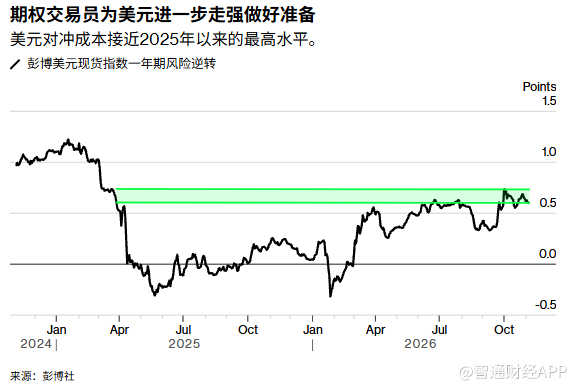
In the options market, traders are sending strong signals showing confidence in the future of the US dollar before the end of the year. The one-year risk reversal indicator, which is a barometer of market positions and sentiment, shows that investors are close to their most bullish level since early 2025.
Bank of America strategist Alex Cohen said this week that he expects the strong performance of the Democratic Party in the midterm elections to be slightly negative for the US dollar. Given the growth and inflation situation in the US, he expects the dollar to be weak for a short time.
According to the data, forecasting agencies expect US inflation-adjusted GDP to grow at an annualized rate of 2.3% this year, compared to 1% in the Eurozone and 0.8% in Japan. Chatham Financial Chairman Amol Dhargalkar said, “If you take a step back, the US economic picture is quite strong, which is not difficult to portray.” He said that when it comes to the US dollar, of course, it should be viewed in relation to other targets; if compared to other large economies, the US is the most attractive in this context.
However, as investors all wait and see the impact of the political impasse on policy and the economy, the dollar's upside seems limited at the moment. “As a result, the US dollar will probably stagnate,” he said.