


The Zhitong Finance App learned that for several weeks, major Wall Street trading institutions have been saying that stock market gains will resume after the US midterm elections are over. The trading departments of J.P. Morgan Chase, Castle Securities, and UBS Securities have all previously stated that the midterm elections will be a “clean-up of barriers” event in the market to help ease the unease of the market before the election. These trading departments believe investors will be tempted to re-establish stock positions since large amounts of capital are still on the market.
The bullish view before the election was mainly based on the judgment that investors were too defensive in their pre-election position allocation, so as election uncertainty is removed, they may re-increase their risk exposure. For example, according to data from Goldman Sachs's main broker service department, the rate at which hedge funds cut their exposure to stock risk in October set the fastest record since March.
Scott Rubner, head of stock and stock derivatives strategy at Castle Securities, said that this election may clear the way for the stock market to rise at the end of the year. “As the dust settles on the election, market volatility may gradually return to normal, and investors have plenty of room to re-establish risk exposure,” he wrote in a client report on Wednesday. As uncertainty gradually subsides and several major market buyers return one after another, we believe the US stock market is most likely to continue rising in the direction of least resistance at the end of the year.”
Davide Montoni of UBS Securities expressed similar views. He believes that after a period of sharp fluctuations in technology stocks, the results of this vote may become a catalyst for market growth. He said, “The financial reports of hyperscale cloud service providers clearly failed to give investors the clear positive signals they were looking forward to, but successfully getting through the election hurdle may be a catalyst triggering a bearish market at the end of the year.”
J.P. Morgan Chase's trading department also anticipates that technology stocks will rebound, and that the rising market will spread from a few very large market capitalization stocks to a wider range of markets. The bank's US market intelligence team said that its tactical view is bullish because the recent sell-off in technology stocks has created opportunities for a short-term rebound.
However, market performance on Thursday dramatically reversed this judgment. Anxiety surrounding artificial intelligence (AI) trading caused the S&P 500 index to plummet by 4.4%, the NASDAQ plummeted by more than 5% into the technical adjustment range, and the Nasdaq 100 market value evaporated by 2.3 trillion US dollars. The market is currently concerned that after Congress and several states gain an advantage, the Democratic Party will tighten its AI regulatory policies. Stricter AI regulations and restrictions on data center construction at the local level may slow down the investment process in the US AI infrastructure.
John Flood, head of Goldman Sachs Group's American Equities Executive Services, said that on Wednesday, the bank's stock trading department ushered in one of the busiest trading periods of the year. However, he wrote in a report to customers that the situation on Thursday was “just the opposite”. “Our phone calls were almost blown up, and customers asked us for market conditions and opinions. Unfortunately, we haven't seen much valuable information yet”.
In his report, he said that long-term holding investment institutions have once again fallen into a “freeze.” He pointed out that investors cut their exposure to stocks drastically before the midterm elections, so they were caught off guard by Wednesday's rebound. Hedge funds are now starting to sell off some shares of AI hyperscale cloud service providers they just bought the day before.
Although the performance of a single trading day does not determine stock market trends, and the trading department's previous bullish views are still likely to be realized, Thursday's sell-off highlights that predicting the direction of the stock market is no easy task even for Wall Street professionals.
It's worth mentioning that Alex Altmann, head of global equity tactical strategy at Barclays, is one of the few sceptics in Wall Street's major trading departments. He previously warned that the midterm elections are unlikely to be the event investors expect to clear market barriers, because the biggest pressure factors suppressing the stock market, such as whether AI investment can be rewarded and the financing costs required to build AI infrastructure, will not be resolved by the voting results.
Systematic capital flows further exacerbate selling pressure
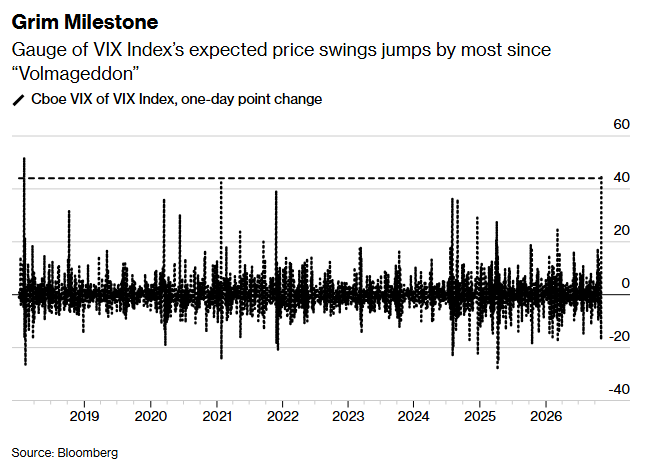
The reason for the sharp decline in the stock market on Thursday was also being amplified by so-called “systemic strategies.” Many of these strategies trade according to stock market trends rather than making decisions based on fundamental drivers.
Barclays stock tactical strategy model shows that volatility-controlled funds may cut stock exposure by about 30 percentage points. This is one of the largest single-day adjustments since market turmoil during the COVID-19 pandemic. The model also shows that within the next 24 to 48 hours, such funds may sell about $135 billion in US stock futures. Alex Altmann added: “As pressure to close positions spreads through real funding channels such as retail investors and long-term holding investors, we expect this situation to continue tomorrow.”
Exchange-traded fund (ETF) rebalancing operations have also increased market pressure. Barclays pointed out that Thursday is expected to be the largest leveraged ETF sell-out rebalancing day in history.
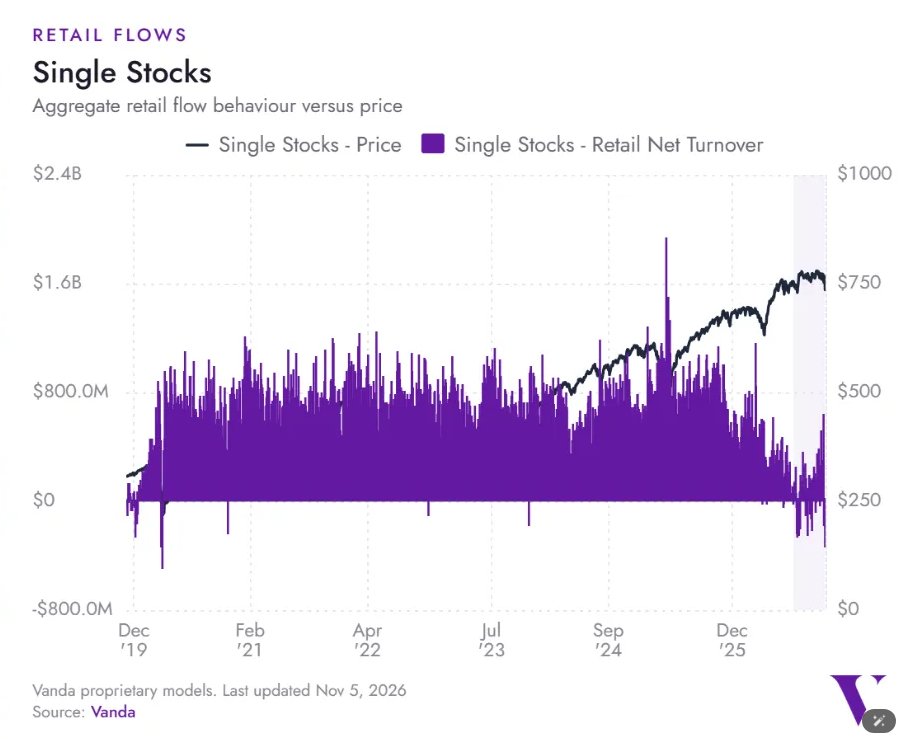
Retail investors — another major source of demand when the market previously pulled back — were also reluctant to rush into the market. According to data from Vanda Research, retail investors abandoned their iconic bargain buying strategy on Thursday and instead sold individual stocks. The sell-off speed set the fastest record since the worst period of the market collapse caused by the COVID-19 pandemic in March 2020.
Vanda Research pointed out that the scale of retail sell-off in the first 30 minutes of Thursday set the record for the largest single 30-minute sale in recent months, close to the peak when retail investors fled in panic at the end of July 2024. The agency added that shortly before closing, retail net capital outflows to individual stocks reached US$338 million. The sell-off set the record for the third-largest single-day clearance of individual stocks by retail investors, after March 12 and March 17, 2020.
As retail investors retreat, institutional investors are also reducing their risk exposure more widely, while systemic selling pressure continues to increase. Vanda analyst Viraj Patel pointed out that earlier this week, institutional investors' ability to buy call options had fallen to its lowest level in a year. Meanwhile, leveraged exchange-traded funds (ETFs) are under pressure to rebalance before closing, and are expected to reach 42 billion to 48 billion US dollars. Furthermore, funds that target volatility are simultaneously reducing their risk exposure.
Viraj Patel warned that institutional buyers chose to exit at a time when retail investors and systemic strategies are selling stocks in a big way. This pattern of capital flows is extremely rare and will rarely occur unless the market is under severe pressure.
UBS pointed out that retail-led sales triggered the futures market's risk control system and forced liquidation of leveraged ETFs. UBS further warned that the sales volume of systemic funds (especially risk control funds) is still expected to exceed 100 billion US dollars on Friday, and this round of adjustments may not have bottomed out.
Charlie McEligott, a cross-asset strategist at Nomura Securities, pointed out that the current negative gamma position in the market is “huge”, which means that price declines will continue to amplify the trend. The Goldman Sachs CTA model estimates that if the market falls further, the S&P 500 will face systemic selling pressure of about 164 billion US dollars. Jonathan Krinsky, BTIG's chief technical strategist, warned that rotation requires buyers on both sides. Healthcare is already 19% above the 200-day EMA, the highest in history, and defensive buying is weak. As a result, he believes that the next round of defensive buying lacks a source of funding.
Historical data also shows that the sell-off is likely to intensify in the short term, although the market usually eventually recovers after three months. Cappthesis founder Frank Cappelleri used the previous US midterm election cycle as a reference and found that historical experience also showed that the market may face more fluctuations in the short term. The chart analyst said that of the 13 midterm election cycles since 1974, the NASDAQ index rose 12 months after the election ended, except for one. “It is important to note that this process may be accompanied by sharp fluctuations,” he said.
Using 2018 as an example, Frank Cappelleri pointed out that the NASDAQ index rose the day after the Democratic Party won a seat in the House of Representatives that year. Subsequently, the market experienced a sharp sell-off in December, but in the end, the index rose by about 15% a year after the election.
Looking back at 10 technical pullbacks in the past decade, the NASDAQ experienced a further sharp decline in the following month after the sell-off wave in 2025, 2022, 2020, and 2018. However, with the exception of 2022, in all of the above cases, the NASDAQ re-entered an upward trend after six months — the technical correction in January 2022 brought more severe results. Within the next six months, the NASDAQ fell further by 18.3%, reaching 24.3% a year later. Overall, from the bottom of the technical correction, the NASDAQ rose by an average of 9.41% over the next three months and an average increase of 17.03% over the next six months.