


The Zhitong Finance App noticed that on Friday, as artificial intelligence stock sell-off intensified and spread to the credit market, SoftBank Group led the decline in Asian dollar bonds.
SoftBank's dollar bonds due in 2032 fell 0.9 cents on Friday, the biggest drop in 10 weeks, the data showed. Its bonds are one of the worst performing varieties in Asia. The stock price once fell 16%. Previously, credit default swaps (CDS) linked to some US companies involved in AI construction soared sharply. The yield premium on Asian dollar bonds has increased by at least 3 basis points, traders say.
Friday's decline continued the repricing already underway in global credit markets, after a borrowing frenzy fueled by the AI boom boosted yields. This round of sell-offs has intensified the headwinds facing the global economy. Although AI-related spending supported the world economy this year, rising fiscal deficits, rising oil prices, and rising inflation are worsening consumer sentiment.
On Thursday, the average spread on Asian investment-grade US dollar bonds reached 73 basis points, the widest since July 2025.
However, according to CreditSights analyst Zerlina Zeng, this round of sell-off was more moderate than the stock market, and the decline in US bond yields also cushioned its impact on investors concerned about overall yields.
Zeng said, “The sell-off in the US and Asian markets has always been restrained. “In view of the sharp sell-off in October, we have seen that investors are quite interested in bottoming out some high-yield Asian products, including Chinese real estate bonds that have performed well.”
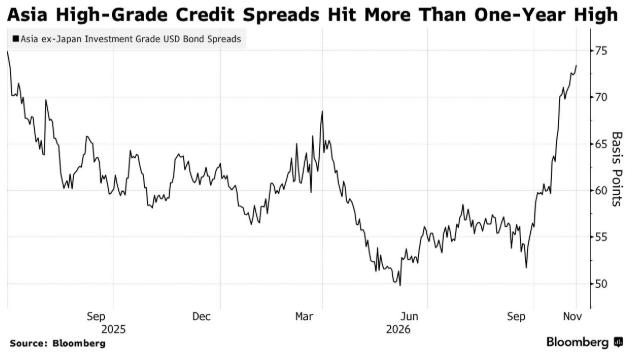
The question now is whether increasing pressure on companies linked to the AI investment boom will drive a more lasting repricing in the Asian credit market. The US stock sell-off on Thursday erased $2.3 trillion in market capitalization, while CoreWeave (CRWV.US), SpaceX, and Broadcom (AVGO.US) credit default swaps jumped to historic highs. ING is also selling a data center loan portfolio of around $500 million.
Investors are increasingly looking beyond the immediate sell-off to how these risks may shape the credit market in 2027. Zerlina Zeng said she has been taking calls from investors to assess the impact of the US midterm election results on tariffs, AI investment, the Iran war, and US debt supply.
Zerlina Zeng said, “The supply of bonds remains a core issue in the AI-related industry.” She said that the Democratic Party's big victory, massive debt issuance by hyperscale cloud vendors since last week, and negative news surrounding the Oracle (ORCL.US) New Mexico data center license are all putting pressure on interest spreads.
However, Brian Levitt, chief global market strategist at Invesco, believes that this round of sell-off is more like a repricing of crowded transactions than the collapse of the AI investment cycle. Levitt said, “From now on, AI construction may become slower and more disciplined. The long-term demand for AI and computing power remains intact. The price investors paid for this opportunity is simply being reset.”
Prior to the latest round of volatility, investors had already begun to withdraw from the bonds financing AI expansion.
Andrzej Schiba of RBC Global Asset Management said in an interview on Thursday that hedge funds have been selling such bonds in large numbers in recent weeks, increasing the risk that the prolonged repricing of AI-related bonds may spread more widely to global credit markets.