


The Zhitong Finance App learned that Wall Street financial giant Morgan Stanley (Morgan Stanley, Damo) believes that the policy uncertainty facing the construction of AI data centers in the US may instead create new investment opportunities for the Asian power industry chain. Dama analysts pointed out that progress on some US data center projects is blocked, which may push the demand for about 15 GW of computing power originally planned to be implemented in the US to Asia ahead of schedule, increase the utilization rate of local data centers, and further highlight the scarce value of reliable power supplies, power grid access, and energy storage facilities. As cloud computing giants such as Google's parent company Alphabet (GOOGL.US) and Amazon (AMZN.US) accelerate the deployment of data centers in the Asia-Pacific region, Asian power equipment and power supply solution providers are expected to usher in a new round of investment opportunities.
Damo's judgment came at a time when the US AI infrastructure sector was drastically sold off. In the US midterm elections, the Democratic Party won control of both houses of Congress and won key victories in major AI data center construction centers such as Texas and Georgia, causing the market to begin to re-evaluate the expansion prospects of AI computing power infrastructure and data center power chains. Investors are concerned that changes in the policy environment may lengthen the approval cycle for data center projects, increase the power supply costs for AI computing power clusters, and affect the progress of data center construction and the speed of implementation of investment returns on huge capital expenses.
By the close of the US stock market on Thursday, November 5, the Nasdaq 100 index had fallen sharply by 6.36%, and the Philadelphia Semiconductor Index fell 12.25%. Policy uncertainty compounded the performance prospects of semiconductor companies such as Qualcomm to fail to meet market expectations, causing selling pressure to spread from chip stocks to data center and related infrastructure supply chains, and even to a wider range of global technology stocks.
According to Damo, the blocking of progress of some US projects does not mean that global demand for AI computing power has disappeared, but may cause some computing power demand originally planned to be implemented in the US to shift to the Asia-Pacific region. Compared to some major data center construction centers in the US, some markets in the Asia-Pacific region may have more efficiency advantages in terms of project approval and actual construction. If cloud computing giants such as Google and Amazon speed up their data center layout in the Asia-Pacific region as a result, demand for reliable power supplies, grid access, and energy storage equipment is also expected to grow in the Asian market. In other words, Asian data center power chain companies may have new layout opportunities after being affected by the negative sentiment of US AI transactions and a short-term decline in stock prices.
Meanwhile, Goldman Sachs, another major Wall Street company, also believes that in the future, global demand for AI computing power and corresponding power equipment will continue to expand drastically. A recent research report released by Goldman Sachs drastically raised the global data center capacity forecast from 217 GW to 273 GW in 2030, an increase of about 26%. Among them, the US data center capacity is expected to increase sharply from 49 GW in 2025 to 152 GW in 2030, reaching about 3.1 times the original. Global data center capacity forecasts continue to rise, which means that even if short-term market sentiment is impacted by policy uncertainty, the long-term expansion of AI infrastructure will still provide important demand support for power equipment and related industry chains.
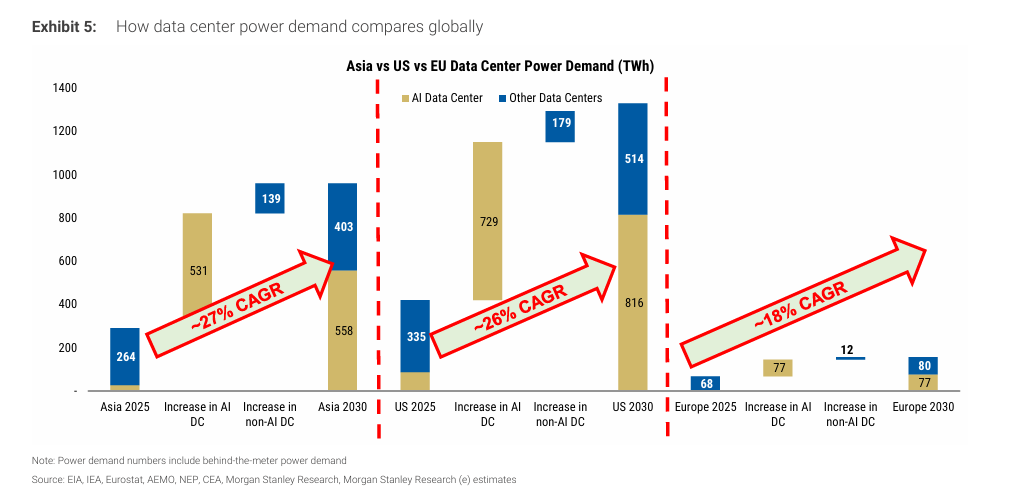
The above chart shows that AI is reshaping the global electricity consumption landscape, and potential demand from the US spills over to Asia about 15 GW. Damo estimates that the compound annual growth rate of electricity demand for data centers in Asia will be about 27% from 2025 to 2030, reaching about 960 terawatt-hours in 2030, of which AI data centers will contribute about 558 terawatt-hours.
Therefore, the list of power companies that are optimistic about future stock price trends clearly presented by the Dama analyst team in the research report includes — Thai power giant Gulf Development, Singaporean infrastructure and asset management giant Keppel, India's private thermal power faucet Adani Power, Chinese hydropower leader Changjiang Electric Power, South Korean battery and energy storage giant Samsung SDI, and Japan's regional power leader Hokkaido Electric Power. These Asian power companies are listed as potential beneficiaries of Asia's spillover from North American AI data center demand. Damo's core bullish judgment is that electricity tension in Asia and the Pacific may exceed expectations, and growth opportunities will fall more on companies that can turn additional load into electricity sales profits, infrastructure revenue, and energy storage demand.
US data center expansion faces Democratic Party policy variables, and Asia may accelerate acceptance of 15GW spillover demand
In the research report, the Dama analyst team emphasized that the new power supply and data center expansion in the US is facing policy uncertainty, which may push cloud giants to speed up their Asian layout and enable the approximately 15GW potential spillover demand previously expected to be absorbed by 2030 to be fulfilled sooner.
According to Morgan Stanley, the short-term global stock market, especially the technology stock theme, is still releasing risks, and the industrial logic associated with electricity and data center computing power systems is beginning to diverge in the medium term.
As of the close of Friday, November 6, the Nikkei 225 Index was down 5.96%, while Korea's KOSPI fell 6.02%. Hokkaido Electric Power, which Daima is optimistic about, fell 4.41%, less than the Japanese market; Samsung SDI fell 8.06%, continuing to withstand strong selling pressure. Korea Electric Power and Japanese power development company J-Power, which were included on the evasion list, fell by 3.03% and 4.27%, respectively. This set of performance means that Asia Power has yet to form a consistent safe-haven market; this market data also highlights that Damo is looking for potentially significant profit increases that may be brought about by US construction restrictions, rather than determining that the relevant stocks have escaped adjustments in global technology stocks.
The key to demand spillover is that power supply time changes the economy of site selection for computing power projects. Damo believes that the Texas election results will increase uncertainty about new power supply and data center development, which may prompt hyperscale cloud vendors to speed up investment in Asia. The potential acceptance volume is split by region: Malaysia about 4 GW, Japan 1.5 GW, the rest of ASEAN 4 GW, Australia 2 GW, India and other regions 3.6 GW, for a total of about 15.1 GW.
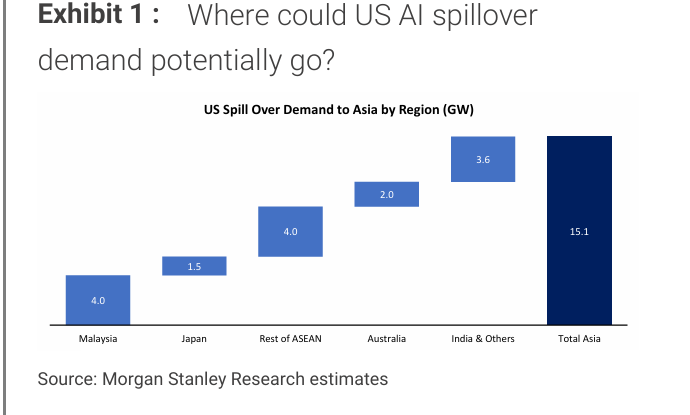
It is worth noting that the increase in Damo's judgment this time is mainly due to the possibility that the acceptance time may have been earlier, rather than the fact that these capacities have already been migrated. In terms of engineering and commercial arrangements, workloads such as training and batch processing are relatively easy to deploy across regions; low latency inference still needs to be combined with user location, network connectivity, and data compliance requirements. As a result, Asia needs to simultaneously provide reliable electricity, connectivity, and deliverable computer rooms in order to turn US project delays into its own orders.
This undertaking logic is already supported by project reserves. Damo's total investment commitment for cloud computing and AI infrastructure in Asia is approximately US$346.9 billion, of which ASEAN is about US$88.2 billion and India is US$66.7 billion; in addition, approximately 10.57 GW of contracts and project capacity announcements have been traced, covering India, ASEAN, Australia, New Zealand, Japan and South Korea. These figures include annual investments, cooperation plans, and some memorandums of understanding, and reflect construction reserves.
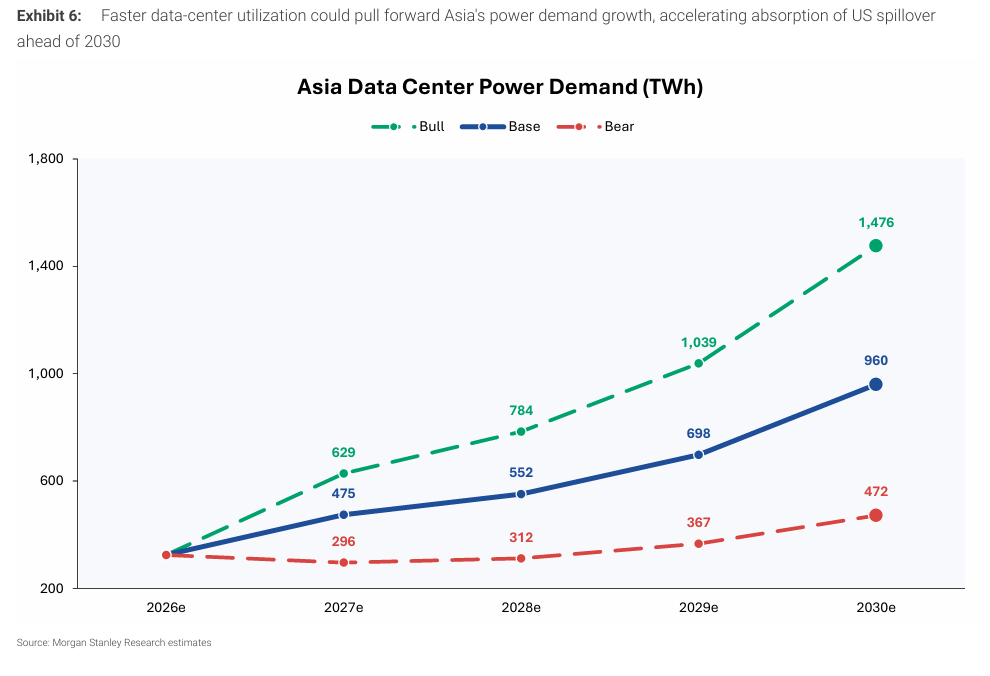
In addition, Damo's benchmark forecast for electricity consumption in Asian data centers in 2030 is about 960 TWh, or 960 billion kilowatt-hours, and the bull market scenario reached 1,476 TWh, which is about 54% higher than the benchmark. Specifically, the potential implication behind the investment in electricity themes in the Asian stock market is that if the utilization rate of existing computer rooms increases faster than the expansion of power supplies and power grids, the Asian power shortage may be reflected earlier in market-based electricity prices, long-term contract conditions, and changes in the value of power supply resources.
Pricing power is concentrated on reliable power supply: Why is Damo optimistic about these six Asian power companies
The Philadelphia Semiconductor Index fell sharply by 12.25% in a single day, bringing AI investment from imagining long-term demand back to the reality test of project delivery and profit fulfillment. At a time when the Democratic Party is taking back control of both houses of the US Congress and key state elections are changing policy expectations, the pace of approval of data center construction, power supply conditions, and cost sharing have become important variables in market repricing.
According to a Morgan Stanley research report, the new electricity supply in the US faces greater uncertainty, which may push hyperscale cloud vendors to speed up their deployment in Asia and enable the potential spillover demand of about 15 GW, which was originally expected to be absorbed by 2030, to be fulfilled sooner. As data center utilization increases, and power grid expansion and reliable power supply construction take longer, the level of power tension in some Asian markets may exceed expectations, bringing profit and valuation opportunities for core data center power supply links such as power generation, power grids, and energy storage.
Based on this logic, the Dama analyst team named six potential beneficiaries of Gulf Development, Keppel, Adani Power, Changjiang Electric Power, Samsung SDI, and Hokkaido Electric Power — the main business of these bullish targets, as well as investment leads shown by fundamentals and order prospects, which can be described as focusing on whether to further accelerate the transformation of power supply resources, infrastructure operation capacity, and energy storage technology into electricity services and continuous cash flow that can be delivered quickly and easily.
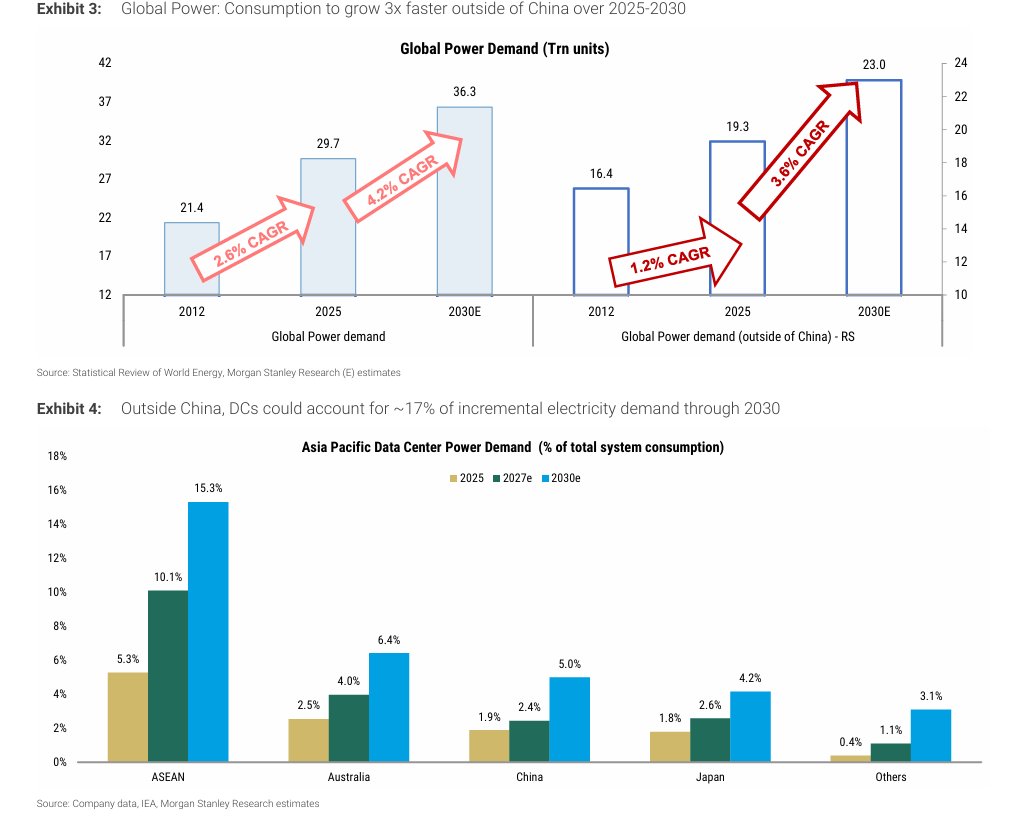
Damo places more emphasis on how much additional revenue generators and grid operators can keep. The report predicts that the electricity price spread may widen by about 15% by 2028; at the same time, equipment suppliers are facing resistance from customers and policy levels after two years of rising costs. Demand is not only based on AI: Damo expects a compound increase of about 5% in electricity consumption in Asia by 2030, reaching about 20 trillion kilowatt-hours, more than half of the world's total; electricity consumption in ASEAN data centers is likely to rise from 5.3% in 2025 to 15.3% in 2030.
Under the research framework of the global “AI intelligence frenzy, the multi-location layout of the data center-related power and AI computing infrastructure industry, and the construction requirements of high-efficiency liquid cooling systems,” Damo estimates that there is potential value creation space of about 500 billion US dollars and an opportunity to push the 2028 profit forecast by about 14%. However, these are all theme-level estimates; they are not the unified profit growth rate or stock price increase of the six companies.
The Dama Research Report shows that the six beneficiary companies on the homepage have different business locations: Gulf Development, Adani Power, Changjiang Electric Power, and Hokkaido Electric Power correspond to power generation and operation resources; Keppel (Keppel) supports energy, data centers, and infrastructure investment and operation platforms; and Samsung SDI supports batteries and energy storage, so all six companies cannot be classified as leading forces in traditional utilities.
The report specifically points out that Gulf, Adani Power, and Semco Industries are participating in data center meter power supply, and grid bottlenecks are driving customers to be more proactive in locking in on-site power and supporting facilities. According to this logic, the value of the investment depends on the availability of power supply, contract pricing, and cost absorption. Damo also recommended avoiding Korea Electric Power, Tata Electric Power, Global Power Synergy, and J-Power. To a certain extent, it can be described as indicating that an increase in demand for electricity will not automatically translate into an increase in profits for all power companies; among them, Tata Power's official investment rating is still “holding on and watching.”
In terms of ratings and valuations, Gulf Development, Keppel, Adani Power, Samsung SDI, and Hokkaido Electric Power all “gained”; Changjiang Electric Power was included in the core beneficiaries list, but the report did not list their official ratings separately. Of the six companies, only Samsung SDI clearly disclosed the target price: 670,000 won in the appendix. This is the existing target after the increase from 660,000 won on September 21. It is not a new increase in reviews for this election. Based on the closing price of 468,000 won on November 6, the potential room for growth is about 43.2%; keeping the share capital and exchange rate caliber used in the report unchanged, the corresponding target market value is about 35.95 billion US dollars.
From “data centers need more electricity” to “willing to pay for continuous and reliable power supply over the long term”
Demand for AI computing power continues to expand exponentially under the frenzy of AI agents, and the subsequent almost endless expansion of AI inference computing power clusters is driving the power chain, due to the simultaneous increase in demand for continuous operation and rapid fluctuation load. Large-scale training, inference, and multi-step agent calls will increase the intensity of use of computing facilities; switching between GPU clusters at different stages of work will also cause obvious power changes.
Therefore, data centers require not only sufficient power generation, but also substations, transmission and distribution networks, uninterruptible power supplies (UPS), and battery energy storage systems (BESS) to ensure that electricity can be delivered on time and load fluctuations are smooth. On-site power generation can relieve some waiting for connection to the grid, and energy storage can provide short-term buffers and backup, but it cannot replace continuous energy supply. Corresponding to the profit mechanism, power generators benefit from sales volume, utilization rate, and electricity sales price differences; power grid operators rely on approved investment and cost recovery to generate profits, while energy storage companies benefit from increased requirements for reliability and flexibility.
Another Wall Street financial giant Goldman Sachs's research report shows that the capacity forecast provides a long-term demand background for this AI data center power equipment industry chain: global data center capacity is expected to rise from 103 GW in 2025 to 273 GW in 2030, while the US will rise from about 49 GW to 152 GW, expanding to about 3.1 times in five years. The world added 170 GW, which is estimated at a full-stack investment of about 50 billion US dollars per GW, corresponding to a potential capital expenditure of about 8.5 trillion US dollars, but it is important to note that IT equipment such as servers is not all flowing into the power industry.
Damo further emphasizes geography and revenue distribution: when US projects face higher approval uncertainty, Asian regions that can provide more clear power supply times, reliable power, and enforceable commercial arrangements may speed up investment. However, according to the Goldman Sachs and Daimo research team, the overall assessment opportunities and capital allocation potential of the Asian power sector will eventually have to be gradually realized through additional load, profits from electricity sales, approved grid investments, and energy storage orders.