


The Zhitong Finance App learned that as global investors seek to reduce their artificial intelligence (AI) exposure, Europe's diversified stock market has suddenly become one of the most attractive transactions.
Not long ago, the European Stoxx 600 index was still lagging behind. The market feared that it was vulnerable to rising oil prices, and at the same time lacked leading technology stocks in the AI wave. Today, Europe's combination of robust industrial stocks, bank stocks, and defensive leaders, plus a host of commodity companies, is showing its value.
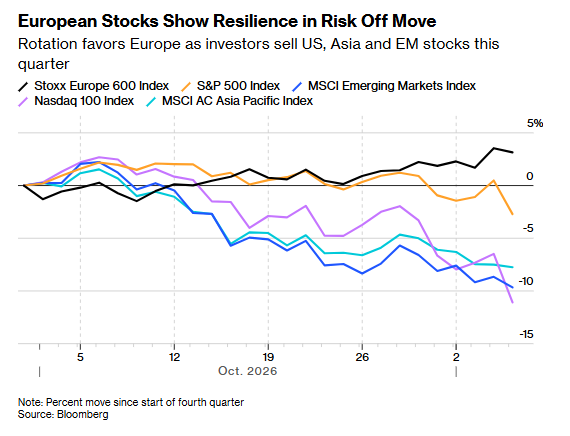
On Thursday, the Stoxx 600 index withstood the deepest round of correction in the S&P 500 index since April 2025, and is expected to record the strongest single-quarter excess earnings compared to global stock markets since the beginning of last year (when Germany first announced large-scale fiscal stimulus plans).
“Considering the impasse at the policy level, this indiscriminate market sell-off is already excessive, but it will take time for sentiment to stabilize. Europe is relatively likely to benefit, especially as the risk of oil prices recedes,” said Emmanuel Cau, head of European and Asia-Pacific equity strategy.
In fact, even before the US midterm elections, Europe's strong earnings growth was already benchmarking the performance of its peers on the other side of the Atlantic and making it more attractive. But as the Democratic Party swept through Congress to heighten concerns about the risks of AI transactions, investors urgently need to change course. Europe has become the preferred destination for funding.
The “blue wave” set off by American voters drove the rise in US Treasury bonds, as the market bets that the Democratic Party will restrain the Trump administration's tax and spending plans. It has also revived the prospects for many clean energy stocks listed in Europe.
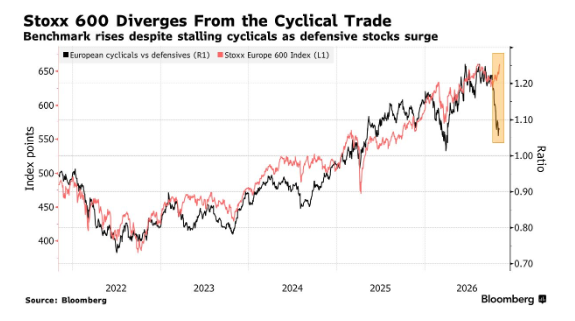
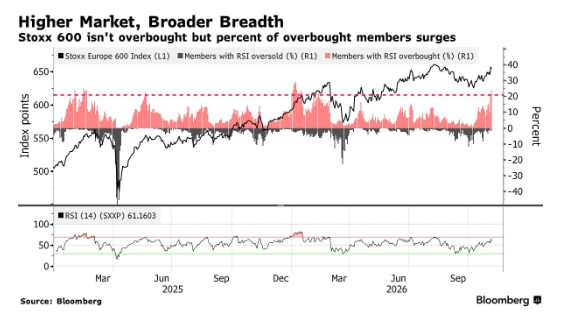
The shift to the defensive sector once gave the main impetus, but recently the entire market has been rising. This is in stark contrast to the market characteristics of the past five years, and also lays the foundation for the index to end higher in 2026.
“The October market is looking for alternative assets to low-volatility bonds, such as healthcare and food and beverage, but investors will now chase cyclical stocks that are more sensitive to falling interest rates,” said Kepler Cheuvreux, strategist led by Arnaud Girod. “This may help spur the year-end market.”
The midterm elections cleared barriers to the market. The sharp drop in oil prices this week shows that investors have begun to take into account the higher probability that the war in Iran will soon end. Sectors that have experienced the most profit recovery in recent months, such as banking and mining, and non-essential consumer goods stocks, which have underperformed this year, have all experienced some resurgence.
That being said, there are still risks in the region. Investors remember the recent spike in bond yields and credit spreads, while the political situation in France before the April presidential election is still worrying. At the same time, if oil prices fall, impressive profit growth may be questionable.
Furthermore, the region's economic growth rate is likely to remain sluggish next year, at 1.3%, compared to 2.2% in the US and 3.3% globally. But this may still be enough to support the strengthening of the market.
“We have found that the impact of global sentiment is more important than simply domestic growth,” said Goldman Sachs strategists, including Sharon Bell. “More than half of the Stoxx 600 Index's revenue comes from outside of Europe.”
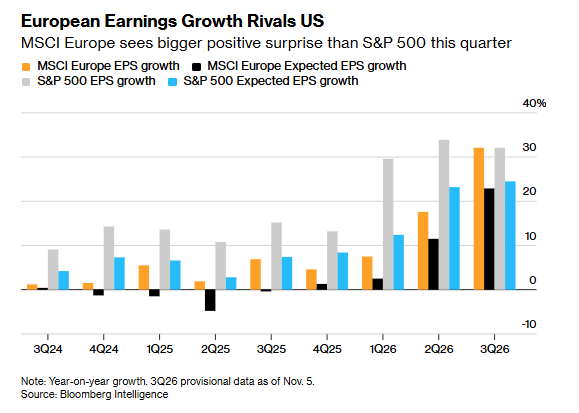
Profit growth was the biggest surprise. Previously, the market expected a steady acceleration in European profits to catch up with the gradual slowdown in US stock profit growth in 2027 or 2028. But Europe's repairs have far surpassed expectations. The three-quarter report shows that European companies' profits have rebounded sharply, and the momentum is comparable to that of US stocks. Earnings per share in both regions grew by about 32% year on year, but European earnings exceeded expectations by 9.2 percentage points, which is 7.6 percentage points higher than US stocks.
“European earnings have handed over another strong quarter, reinforcing our view that profit recovery in the region is still on track,” said Matthew Gilman, head of European equity strategy at UBS Global Wealth Management's Chief Investment Office. “Revenue growth continues to rise, profit margins continue to recover, and profit increases are higher than seasonal norms.”
Gilman said that while investment-related demand remains the main engine of growth, supported by AI, electrification and defense spending, profit improvements are spreading to other areas. “As a result, we believe the profit outlook structure is more balanced and no longer overly reliant on a few tracks.”
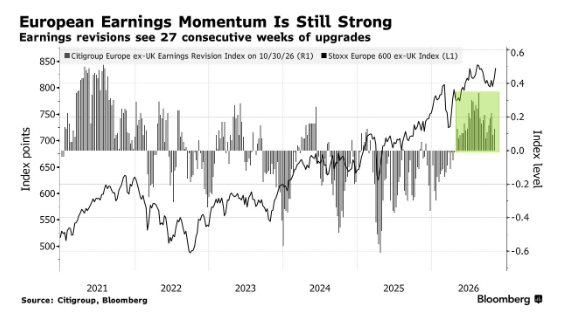
Admittedly, energy stocks accounted for a large portion of last quarter's growth, but profits in every sector are rising. Moreover, although falling oil prices will erode index-level earnings per share, its positive impact on market sentiment may continue to boost stock prices. Falling energy costs will also reduce the burden on consumers and may slow the pace of interest rate hikes by the ECB or the Bank of England.
In the short term, there are signs that the market is overheated, and nine industries have already entered the overbought range. However, the general market index has yet to show similar signals, and the overall allocation positions of foreign investors to Europe are still low. Bank of America's fund manager survey last month showed that global investors still maintain an 8% low allocation to Europe, which means there is room for continued capital rotation in the future.
“We have clearly moved to a risk-appetite model,” said Florian Roger, head of the BNP Paribas Corporate and Investment Bank Chief Investment Office. “We are oversuited to Europe and think there are several sectors that may drive further growth.”