


The Zhitong Finance App learned that at a time when global technology stocks are plummeting, traders in the US treasury bond market are betting ahead of time — continued weakness in agriculture, cooling AI investment expectations, falling oil prices, and inflows of safe-haven funds will jointly reduce the space for the Fed to raise interest rates further in the future.
Judging from the latest trends in the US bond market, US bonds are “further narrowing the room for interest rate hikes”. These senior fixed-income traders are betting that non-farm payrolls data may be weak, inflationary pressure relief brought about by falling oil prices, and safe-haven demand caused by the stock market crash to jointly drive up bond prices and the decline in the US bond yield curve for various maturities.
The October US non-farm payrolls report will be released at 21:30 Beijing time on November 6, thus becoming an important hurdle for testing this round of stock bond repricing. According to the median Bloomberg survey, economists expect 65,000 new jobs and maintain an unemployment rate of 4.2%; as of press release, the 10-year US Treasury yield had fallen to about 4.82%, and the interest rate swap market priced the December rate hike at about 68%. The market is cutting back on subsequent austerity, but the rate hike is still the most likely scenario for the December Federal Reserve FOMC meeting. A change that bond investors should pay more attention to is that some institutions are preparing to use price pullbacks triggered by strong employment data to continue to increase positions on US bond assets at a time when risk aversion in the market heats up and yields are high.
AI sell-off hits non-agricultural farmers, and the room for early trading of US bonds to raise interest rates narrows
The market environment faced by this US non-farm payrolls report has evolved from post-election industry fragmentation to widespread risk contraction. By the close of the US stock market on Thursday, the Nasdaq 100 Index, which has the title of “global technology stock weather vane,” fell 6.36%, the biggest one-day decline since March 2020. The S&P 500 index fell 4.36%, and the Philadelphia Semiconductor Index fell 12.25%.
The sell-off continued to spread to Asia on Friday: the Korea Composite Index fell below 5,000 points in the intraday period and triggered a meltdown, eventually falling 6.02% to close at 5059.69 points; the Nikkei 225 Index closed down 5.96%. Concerns that US data center construction may slow down are being transmitted to the Asian export chain through chip orders, equipment purchases, and capital expenditure expectations. In this context, technology stocks face not only adjustments in profit expectations, but also valuation pressure brought about by investors increasing risk compensation requirements.
Wall Street is in agreement on the direction of the rebound in US corporate recruitment, while there are clear differences on the strength of non-farm payrolls growth. Goldman Sachs, Bank of America, and J.P. Morgan Chase all expect 75,000 new people; Citibank, UBS, and Wells Fargo expect 65,000; Morgan Stanley expects 60,000 people; Deutsche Bank expects 55,000 people; Barclays expects 50,000 people; and TD Securities anticipates 40,000 people. Mitsubishi UFJ Financial Group's forecast is higher, at 90,000 people, mainly based on increased job vacancies in some industries and favorable seasonal factors. These major bank forecast data also mean that the results of slightly higher than 65,000 people are already within the expected range of many major banks.
What really determines the strength of interest rate shocks is whether new jobs, unemployment, wages, and previous month's revisions can all point to a further acceleration in demand. The market expects an average hourly wage increase of 0.3% month-on-month and a year-on-year growth rate of 2.9%; if recruitment resumes and wage pressure continues to ease, corporate revenue and profits may still be supported, while reducing the need for additional austerity.
The latest productivity data also provides this possibility: labor productivity in the non-agricultural commercial sector increased by 3.6% month-on-month in the third quarter, and unit labor costs fell 0.7% according to the same caliber, indicating that output expansion did not necessarily simultaneously drive up unit labor costs. The revised data is also important: the number of new jobs added in August has been revised down from 162,000 to 133,000, while 29,000 non-farm payrolls were at the beginning of September, and may face further adjustments on Friday.
US Treasury traders establish bullish positions ahead of employment report
As market expectations for further interest rate hikes by the Federal Reserve continue to weaken, bond traders are betting on a further rise in the US Treasury bond market before the October employment report is released on Friday.
Global stock markets were sold off after the US midterm elections, prompting investors to take safe haven from US Treasury bonds this week, pushing treasury yields to their lowest level since early September on Thursday. On Friday, the 10-year US Treasury yield was 4.82% as the stock market's decline intensified.
The recent rise has boosted the confidence of traders, and they have begun to target opportunities for further yield declines over the next few days. In the options market, one transaction is betting that the 10-year yield may drop to 4.7% by the end of next week, while the other transaction, which expires on November 20, targets a scenario where the yield falls to about 4.35%.
Although the October employment data is expected to improve compared to September, the rise in US Treasury bonds is likely to continue as long as investors prepare to buy during a sell-off.
Jamie Parton, co-head of TCW Group's global interest rate business, said that if the data is strong, “we are more likely to increase purchases than sales.”
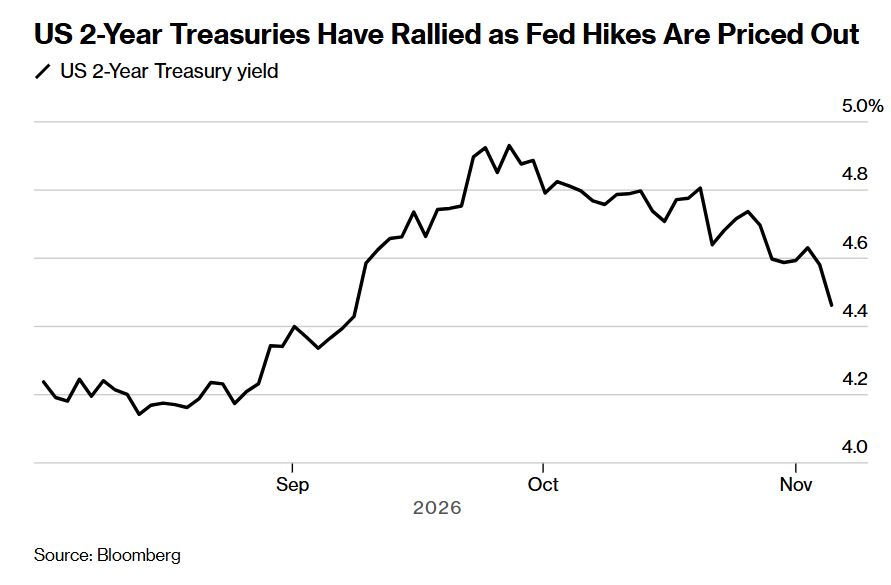
As shown in the above chart, as the US bond market tends to reduce expectations of the Fed's interest rate hike, the price of US two-year treasury bonds rises — rising US bond prices mean declining yields.
Patton's views are consistent with the findings of a survey by BMO capital markets strategists. A strategist led by Vail Hartman said in the report that although investors “cautiously tend to think that yields will rise,” they are “preparing to increase the length of time when US Treasury bonds are sold off after the release of the non-farm payrolls report.” BMO's monthly survey on how investors plan to respond to changes in US bond yields caused by employment data. The latest survey found that 48% of respondents will buy when prices fall, which is higher than the average of 43% over the past six months, and the highest ratio in four months.
The US war against Iran drove oil prices to soar, keeping inflation high, while the boom in AI investment boosted the US stock market. In this context, the Federal Reserve implemented the first rate hike since 2023 in September. However, market expectations for further interest rate hikes have gradually weakened since then, especially after the Federal Reserve kept interest rates unchanged in October. The Federal Reserve said at the time that economic conditions allow it to wait for more data to guide its next policy decision on December 9.
The interest rate swap market currently reflects that the probability of interest rate hikes in December is about 68%; for the policy path up to mid-2027, the market has yet to fully account for two interest rate increases of 25 basis points each time. And just last month, these contracts fully took into account the expectation that interest rates would be raised three times at that time.
Gennady Goldberg, head of US interest rate strategy at TD Securities, said: “We expect Friday's data to weaken slightly, but fundamentals are still critical to the market. The economy we are seeing is still quite strong, and the labor market is in a state of 'low recruitment and low layoffs', so the market has cut interest rate hikes quite a bit over the past few weeks.”
By the time Federal Reserve policymakers meet in December, they will also see November employment data due to be released on December 4. They will also grasp the inflation index announced later this month — the October Consumer Price Index announced on November 10, and the personal consumption expenditure price index in the October personal income and expenditure data released on November 25, the PCE price index.
Crude oil prices fell to a two-month low this week, partly due to market expectations that the election results might prompt an end to the war in Iran sooner. This drove the market's implied inflation expectations down sharply. The break-even inflation rate of 5-year US inflation-protected treasury bonds, or TIPS, fell to about 2.27% this week from 2.5% last weekend. This indicator represents the average increase in the consumer price index required to make the return of inflation-protected treasury bonds comparable to those of ordinary treasury bonds with higher yields.
The October employment report will be released Friday at 8:30 a.m. Washington time. According to the median forecast from the Bloomberg survey, non-farm payrolls are expected to increase by 65,000. 29,000 new jobs were added in September, lower than all predictions in the survey at the time, but this figure will be revised in the October report.
Oliver Chambers, head of the fixed income independent management account business at Clark Capital Management, said, “In the past two or three months, it seems like every time there has been a major revision in a certain direction, and then the next month it has been revised back. This slowing trend requires a return to normal to a certain extent.”