


The Zhitong Finance App learned that for several months, investors have been worried about a series of risks behind the “cash cow” of artificial intelligence (AI) capital expenditure. And this week, the market finally hit the panic sell-off button.
The dust settled in the US midterm elections on Tuesday. The Democratic Party won a majority of seats in both the Senate and the House of Representatives, and also won a landslide victory in the multi-state legislature and governor seats. The market immediately began worst-case pricing on AI transactions. Many of the winning candidates chose to limit the development of AI as their campaign platform, and the market is worried that data center construction in many places may come to a standstill.
This shift in expectations has caused traders to flee since Thursday, and all targets tied to hundreds of billions of dollars in expected AI capital expenses have been sold off. The Philadelphia Semiconductor Index plummeted 12%, and the Nasdaq 100 Index, which is dominated by technology stocks, fell 6.4%. Both indices recorded the biggest one-day decline since the COVID-19 pandemic hit in March 2020. AI benchmark Nvidia led the market decline, falling by more than 9%, and evaporating more than US$440 billion in market capitalization.
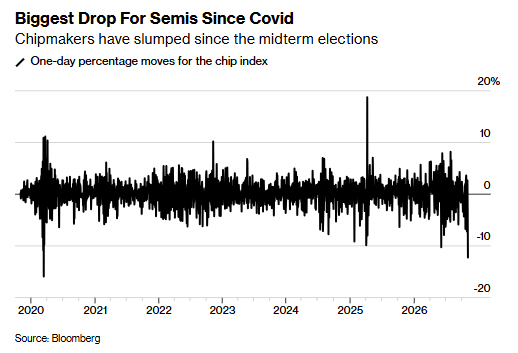
Despite subsequent reports, Texas governor-elect Gina Hinojosa has made it clear that all currently licensed Texas data centers will be allowed to complete construction. Hinojosa plans to pass legislation requiring data centers that are newly licensed and scheduled to be delivered from 2028 to 2029 to pay taxes, promise not to push up residents' electricity prices, not affect residents' water use, use union labor, and allow “Texans to have a place in decision-making.”
The news fueled a pre-market rebound in NASDAQ futures, but market doubts do not seem to have dissipated.
“The market is questioning data center supply chain companies' growth assumptions, and capital is being withdrawn on a large scale,” said Peter Tuz, president of Chase Investment Counsel. The fund holds shares in chipmakers Nvidia (NVDA.US) and AMD (AMD.US), as well as AlphaBet Inc. Major AI spenders such as (GOOGL.US) and Amazon (AMZN.US). “From the election results, it is easy to deduce that uncertainty in the regulatory environment is rising, which in turn is dragging down the growth prospects of these companies.”
Since this year, multiple pressures have continued to ferment, and market anxiety about AI capital expenditure has continued to accumulate: interest rates have risen, data center production expansion and the scale of loans has risen, and public opposition to data center construction is getting stronger and stronger. However, AI capital expenditure is the core engine of the current rise in the S&P 500 index, and once became a buffer for the market to withstand macroeconomic risks such as high oil prices, high inflation, and the situation in Iran.
Of course, given that government machines often run very slowly, it remains to be seen how efforts to curb data center development and regulation AI will evolve. However, this round of sell-off is enough to show that the core pillar of this bull market is already deeply panicked.
“Right now, the economy seems to be driven by only one engine, and not only is this engine slowing down, but the election results may also slow it down further,” said Barry Knapp, managing partner at Ironsides Macroeconomics. “I'm not buying any targets right now.”
According to estimates by UBS Group strategists, it is estimated that nearly one-third of the computing power launched in the US by 2028 is now at risk. Most of this comes from data centers planned to be built in Texas — in the state's gubernatorial campaign, Hinojosa, which promised to stop approval of new data centers, defeated current Republican Governor Greg Abbott to become the state's first Democratic governor since 1990.
These concerns are prompting people to re-examine the valuation of the AI sector, which is already under pressure. Nvidia, for example, has been the biggest beneficiary of AI investments. Its current price-earnings ratio is 13 times the expected profit for the next 12 months, down from more than 32 times a year ago. Broadcom (AVGO.US), the second-largest chip maker by market capitalization in the US, is expected to have a price-earnings ratio of 15 times, lower than the peak of 42 times in December last year.
“Previously, the market acquiesced that data center expansion is a long-term trend that can continue for many years,” Knapp said. “If computing power construction can only be maintained for a few more years and the long-term growth rate of the chip industry declines, then what valuation should we give?”
This round of sell-off is particularly severe in the riskiest corner of AI trading. AI computing service provider Coreweave (CRWV.US) plummeted 20% this week, down more than 75% from its peak in June 2025, and only a few dollars short of its March 2025 IPO price. Meanwhile, Nebius (NBIS.US), a heavily indebted new cloud service provider, fell 15% on Thursday, down 58% from its June high.
To make matters worse, supervisory uncertainty surrounding AI regulation and data center construction has made investors cautious about entering the market.
“It's hard to tell if the current decline is excessive because the regulatory outlook is uncertain,” said Luz of Chase Investment Counsel. “The market seems to have dropped over, but we will wait until the situation is clear before considering buying.”
One benefit of the slowdown in data center construction is that tech giants such as Amazon, Alphabet, Microsoft (MSFT.US), and Meta (META.US) will be forced to cut spending. As can be seen from the stock price performance after recent financial reports, investors can no longer tolerate capital expenditure support continuing to be higher than operating cash flow.
On Wednesday, the four giants combined Apple (AAPL.US) stock prices surged, and the total market value increased by more than 800 billion US dollars; however, the market generally fell on Thursday, and part of the previous increase was recovered.
“If they cut spending, maybe they won't have to borrow that much money, and maybe cash flow will rise,” Luz said, “but at the same time, growth could slow down. There are so many problems right now.”