


Eurozone regulators just reminded everyone that banking resilience and resolution rules still matter, and that opens a fresh window for investors who watch policy as closely as prices. Confidence in deposits, liquidity backstops and cross border capital flows can reshape how risk is priced without anyone ringing a bell for you. This article explores three eurozone banking and insurance stocks exposed to that policy story and why they might deserve a closer look now.
The three eurozone stocks covered next are just a sample set. The same screen surfaced 11 more banks and insurers with equally compelling policy hooks and balance sheet stories that are not unpacked in this article.
If you want to identify, compare, and analyze those additional high-capitalisation financial players through a single policy focused lens, head straight to the Eurozone Systemically Important Bank & Insurer Stocks screener.
Alpha Bank (ATSE:ALPHA)
Overview: Alpha Bank is a large Greek universal bank closely linked to eurozone banking union rules. It offers retail, corporate, wealth and insurance-related services across Greece and selected international markets.
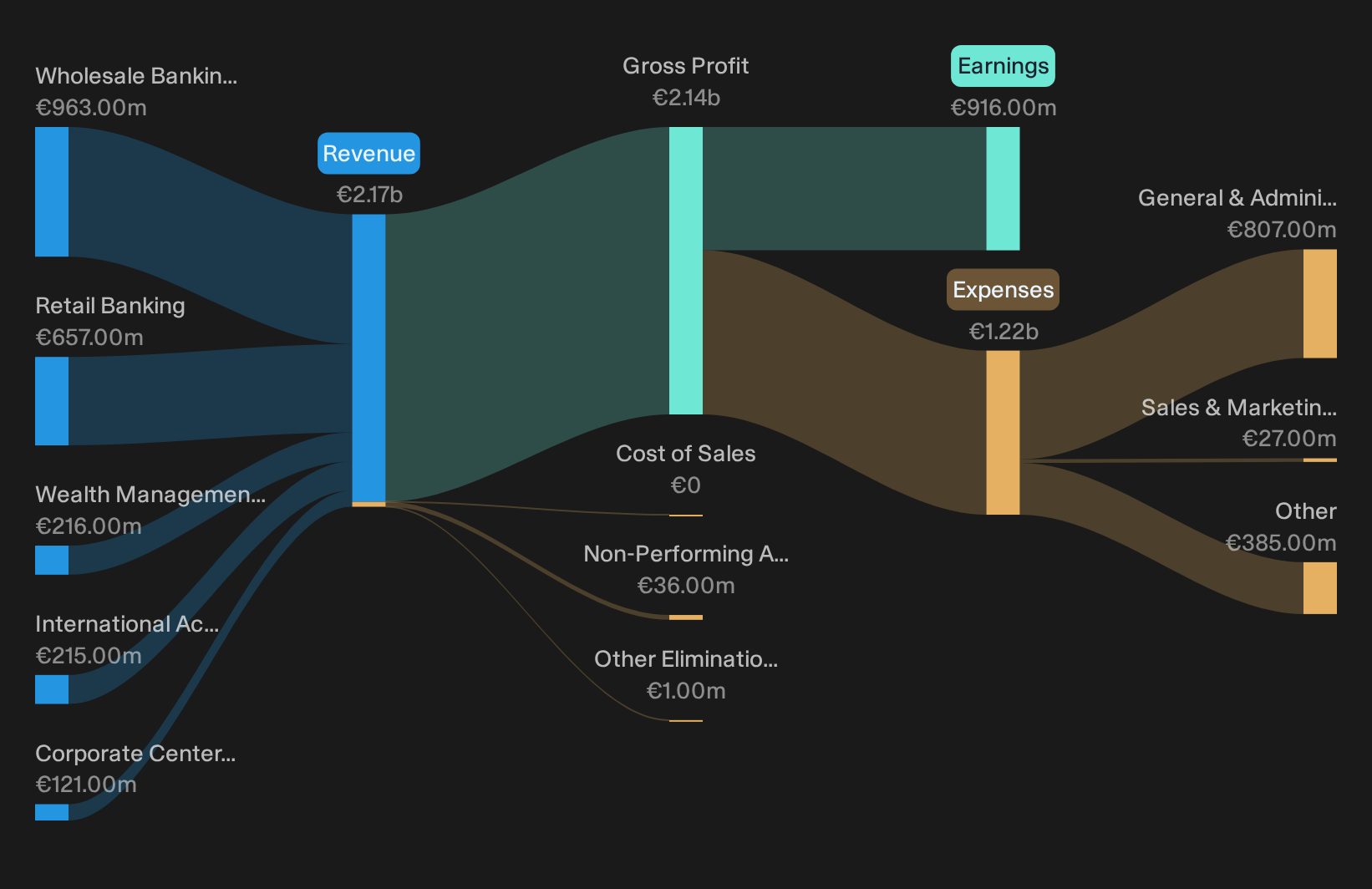
Operations: The group earns most of its €2.1b revenue from Wholesale Banking (€963 million) and Retail Banking (€657 million). It also generates smaller revenue streams from Wealth Management (€216 million), International Activities (€215 million) and other segments.
Market Cap: €10.6b
Alpha Bank matters for this eurozone systemic screener because it shows how a large Greek lender can plug directly into union-wide stability rules while seeking to shift more of its earnings away from pure lending and toward fee-based services.
"The build out of capital light transaction banking, including market share gains of around 10 percentage points in import letters of credit and over 11 percentage points in foreign guarantees, alongside a 38% rise in transaction banking revenues, positions Alpha Bank to grow non interest income and support margins."
What could influence the story from here is how one less visible constraint on Alpha Bank's balance sheet shapes the strength of those margins.
If that constraint on Alpha Bank's margins is what you care about, go straight to the full narrative for Alpha Bank to see how policy, capital and fees are really interacting.
National Bank of Greece (ATSE:ETE)
Overview: National Bank of Greece is a large, eurozone focused lender that provides retail, corporate, investment banking and fee based financial services across several EU markets.
Market Cap: €15b
National Bank of Greece is one of the clearest tests of how EU wide resilience rules and smoother cross border capital flows can reward a bank that has already rebuilt its balance sheet and is now leaning hard into digital delivery and fee income.
"The substantial progress in digital transformation, now including completion of the new cloud based core banking system that renewed about 80% of National Bank of Greece’s systems, positions the bank to roll out products more quickly, widen AI deployment such as the Sophia assistant and voice agent, and gradually lower licensing and branch costs, which directly supports revenue growth and net margin resilience."
The real swing factor is how one less visible cost and pricing pressure ultimately filters through to the return on equity story investors care about.
That pressure point is exactly what the full narrative for National Bank of Greece unpacks, separating temporary friction from where the National Bank of Greece story could be quietly accelerating in the period ahead.

Eurobank (ATSE:EUROB)
Overview: Eurobank is a large eurozone lender that links Greek, Cypriot, Bulgarian and Luxembourg clients into the ECB resolution and deposit frameworks through retail, corporate, wealth, insurance and real estate services.
Operations: Eurobank generates most of its €3.4b operating income from Retail (€820m), International Cyprus (€934m), Corporate (€646m) and International Bulgaria (€483m), with smaller contributions from Markets and Investment Property.
Market Cap: €16.8b
Eurobank matters in this systemic bank screen because it sits across several euro area markets where common deposit insurance, stronger resolution backstops and easier intragroup liquidity could meaningfully change how customers and bondholders judge resilience.
"Expansion of fee-based activities through wealth management and insurance, with assets under management already at €11b and targeted annual AUM growth above 20% plus fee growth of about 30% by 2028, is set to increase fee and commission income as a share of total revenue."
What investors really have to weigh now is how one unseen pressure on funding costs and risk pricing shapes the payoff from that shift toward fees.
When that hidden funding pressure really matters, the full narrative for Eurobank shows where Eurobank’s fee engine could be accelerating or where risk is quietly masking returns.

Seeking Alternatives Before The Crowd?
Fresh ideas move first. Breakout themes, early momentum and quality businesses can get caught quickly once the crowd notices. Scan what is still under the radar for now and act now.
- Spot stronger balance sheets before sentiment shifts by running your own curated shortlist using the list of solid balance sheet and fundamentals (192 results).
- Ride structural demand in electricity and grid upgrades by zeroing in on infrastructure players surfaced through the 40 power grid technology and infrastructure stocks.
- Capture early growth in medical data and diagnostics by screening for AI driven healthcare companies using the 124 healthcare AI stocks.
Have feedback on this article? Concerned about the content? Get in touch with us directly. Alternatively, email editorial-team@simplywallst.com