


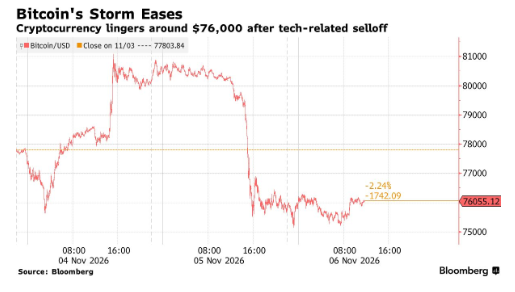
The Zhitong Finance App learned that the cryptocurrency market experienced a round of intense sell-off on Thursday due to chip companies' financial reports falling short of expectations and the Democratic Party taking control of Congress to suppress risky assets. However, on Friday, the sell-off was suspended, and Bitcoin followed the trend and picked up slightly.
According to the data, Bitcoin is currently trading around 76,000 US dollars. The day before, the cryptocurrency with the largest market capitalization was still above $80,000, with a single-day decline of nearly 6%. Smaller capitalization cryptocurrencies also generally picked up on Friday, with BNB, Zcash, and HPE all rising between 1% and 3%.
On Thursday, the S&P 500 recorded its biggest one-day decline in more than a year. The market expects that under the leadership of the Democratic Party, data center expansion may be limited, and chip stocks will be put under pressure. On Friday, the benchmark index and the technology-focused Nasdaq 100 futures rose slightly, boosting traders' sentiment, and optimism also spread to cryptocurrency assets.
“Bitcoin seems to be getting some breathing room after yesterday's sharp sell-off, but I'm not in a hurry to call it a reversal right now,” Dean Chen, an analyst at cryptocurrency exchange Bitunix, said in an email. “I'd rather describe the current trend as a decrease in selling pressure rather than a new round of opening positions.”
On October 29, the digital asset exchange Binance was hacked, involving an amount of 6.3 billion US dollars, which shocked the entire industry and dampened investors' enthusiasm for this asset class. Cryptocurrency is still unstable. Volatility in the wider market has further exacerbated the impact — in recent years, many cryptocurrency mining companies have transitioned into the artificial intelligence (AI) industry, causing the sharp decline in AI stocks to affect the cryptocurrency market.
“This round of sell-off reflects deepening market doubts about the return of huge AI expenses, concerns that stricter regulations may slow data center construction, and the wider withdrawal of high-valued growth assets,” said Axel Rudolph, IG's chief technical analyst. “However, as the stock market continues to decline, Bitcoin has held its position so far, indicating that buyers are entering the market to defend the current level. This relative strength may be an important test to determine whether Bitcoin is beginning to decouple from technology stock trading rather than just following its decline.”
The US spot Bitcoin ETF recorded an outflow of US$430 million on Thursday, according to compiled data. Among them, Fidelity's Wise Origin Bitcoin Fund led with an outflow of about $200 million, followed by BlackRock's IBIT outflows of about US$105 million.
“The sell-off does seem to be weakening, but the recent rebound is more like a brief resurgence than a continuous recovery,” said Samuel Leyne, co-head of cryptocurrency trading at Marex.
“You need a real catalyst to restore confidence, whether the geopolitical situation cools down, oil prices fall, or the macro situation improves,” he added. “Until then, we must focus on the stock market, ETF capital flow, and base level. Bitcoin needs to get back above $77,000 to gather upward momentum, and if the stock market continues to decline, $75,000 will be back in sight.”