


The Zhitong Finance App learned that CICC released a research report saying that in terms of computing power chips and complete servers, demand for domestic data center drivers continues to be strong, and the conflict is still on the supply side in the short term. Overseas short-term development slope adjustments have provided a time window to catch up with domestic computing power hardware, and related companies' performance is expected to continue to be released. In terms of production factors, the core medium- to long-term localization logic of sectors such as fabs, semiconductor equipment, and components has not changed. Affected by AI sentiment this year, there has been a sharp correction in stock prices in the large manufacturing sector in the short term, and valuations are already attractive. Continue to be optimistic about the booming development of the domestic computing power industry chain during the 15th Five-Year Plan period.
Overseas Strategy: How do you view the sharp decline in US stocks?
On November 5, EST, the three major US indices, the S&P 500, NASDAQ, and Dow Jones, fell 4.4%, 5.5%, and 3.4% respectively, all of which recorded the biggest one-day decline since the April 2025 tariff shock. The AI industry chain had the highest decline. The Nasdaq 100 fell by more than 6%, and the Philadelphia Semiconductor Index plummeted by about 12%, all of which recorded the biggest one-day decline since March 2020.
Chart: The three major US indices S&P 500, NASDAQ, and Dow Jones fell 4.4%, 5.5%, and 3.4%, respectively 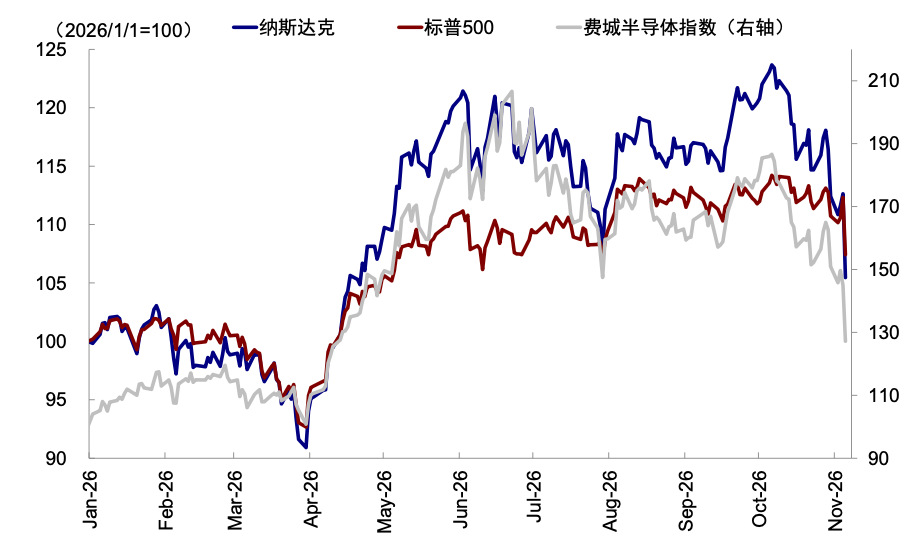
How do you view the sharp decline in US stocks and the subsequent trend. A brief review of CICC is as follows:
1. The characteristics of this sharp drop: significant decline, wide area of decline, panic and signs of being stepped on
1) Significant declines: Both the Fee and Nasdaq 100 Index recorded their biggest one-day declines since March 2020, falling 12% and 6%, respectively.
2) Wide range of decline: Unlike previous periods when AI cooled down, the safe-haven sector rose slightly. Yesterday, all 11 sectors of the US stock market fell, and even the essential safe-haven consumer and utilities fell, which is a sign of possible stepping on.
Chart: All 11 sectors of the US stock market fell yesterday
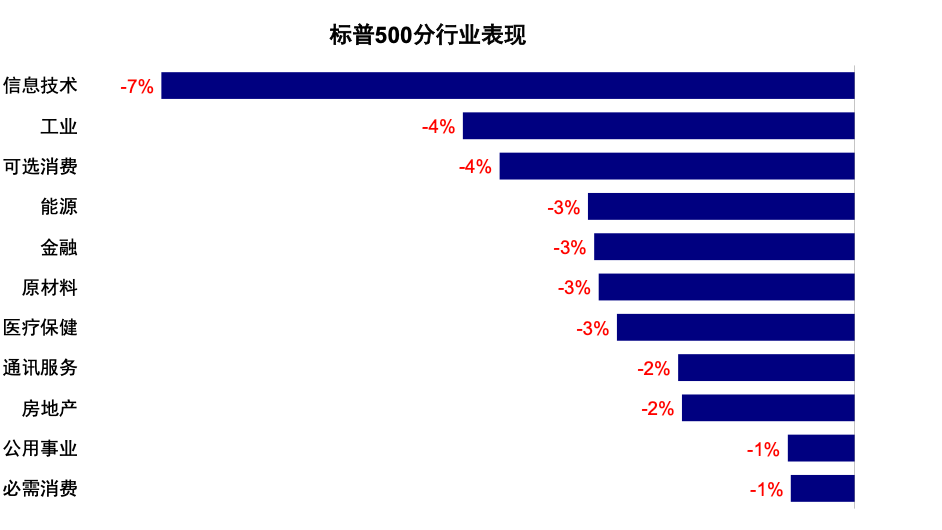
Source: FactSet, CICC Research Division
3) Increased volatility and fear: VIX rose to 28 (above 25 is a dangerous level, second only to the situation in Iran at the beginning of the year). The gap between VIX spot and three-month futures widened to the largest since April '25. This is often a direct reflection of market panic, and even a harbinger of further pressure.
Chart: VIX rose to 28, second only to the level of the situation in Iran at the beginning of the year 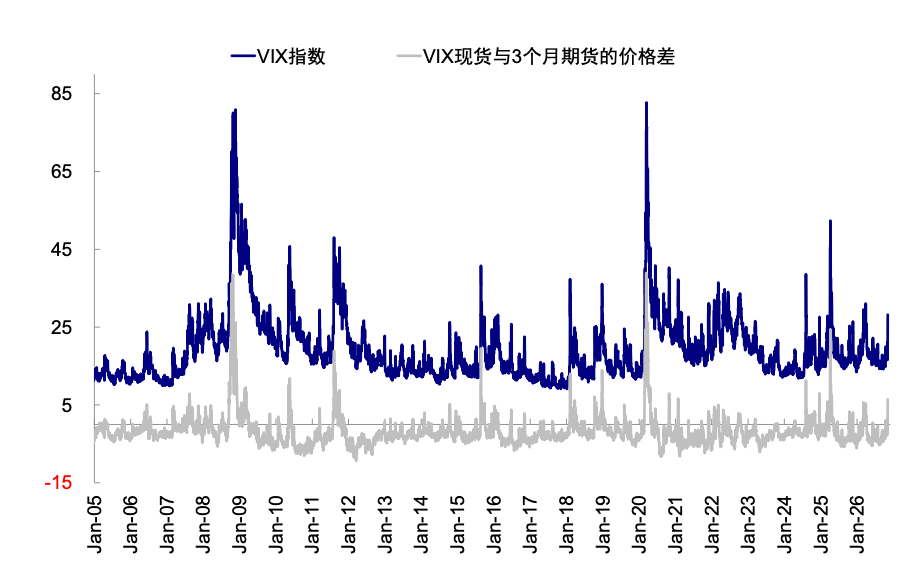
2. The reason for this sharp drop: AI regulation is being amplified by sentiment
The direct cause of this decline is still market fears that the Democratic Party may increase AI regulation and stop data center construction after winning the midterm elections. Democrat Gina Hinojosa, the newly elected governor of Texas, said in an interview with the media on Thursday that “Texas will introduce laws to protect citizens from data centers” [1]; at the federal level, Sanders also once again called for the suspension of construction of data centers across the country [https://www.cnbc.com/2026/11/05/democrats-data-center-restrictions-midterms.html]. Policy propositions at the state and federal levels are growing together, increasing market concerns about the progress of AI infrastructure and the sustainability of investment.
The market has fluctuated repeatedly in the past two days. Pre-market futures plummeted on the day of invoicing on the 3rd, then rebounded to repair the ground, surged globally, and then plummeted today. As CICC suggests in “The Asset Meaning of the Democratic Party's “Sweeping”, the influence of many issues of the Democratic Party on the same asset may be completely opposite. In situations where it is unclear which one can advance first and whether it can advance, the global market “chooses” one direction to trade. For example, a sharp rise or fall can actually find plenty of reasons to explain it.
Essentially, the central influence of the midterm elections on asset pricing is whether the dominant forces in the market are checks and balances aimed at “correcting” (inflation, the situation in Iran, the Federal Reserve, tariffs) or interference (AI, finance) directed at “opposing for the sake of opposition”. The day before yesterday was trading the former, and yesterday was trading the latter, but this does not mean that the market can determine in advance which direction it will develop first. For example, concerns about AI regulation. Pressure at the local level does require attention, but the Democratic Party's seat advantage in the Senate is still not enough to push for the passage of AI regulation laws at the federal level.
3. What do you think of falling to this position? Focus on liquidity in the short term. Stabilization requires clarification and catalysis. The market focuses on gold and Hengke
Combined with the downside characteristics analyzed above, regardless of the reason and catalyst, and whether subsequent concerns are fulfilled, the short-term trend is no longer dominated by fundamental logic.
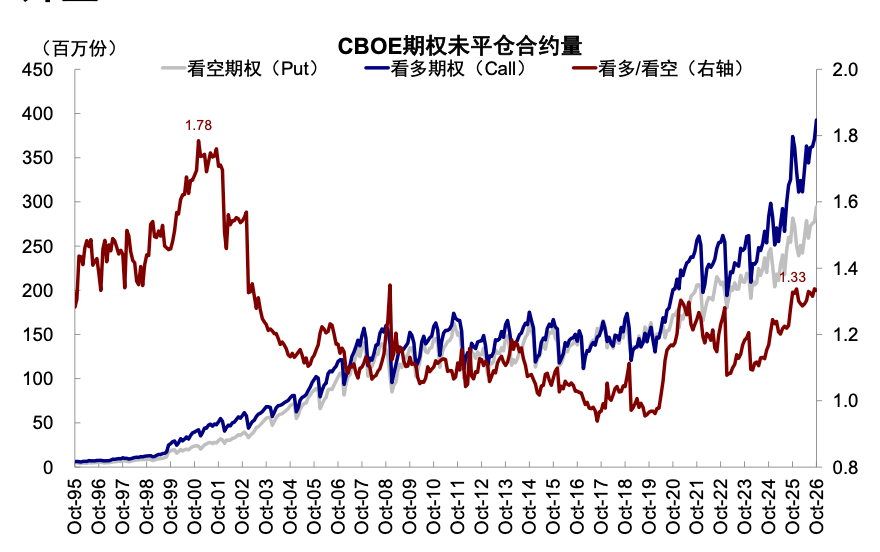
The emergence of panic and stampedness will reveal whether there will be further liquidation and liquidity risks. For example, CICC has already seen some hedge fund clearance announcements. The leverage level of US stocks previously rose to a record high. The implicit leverage level of the financing balance in FINRA statistics rose to the highest level in history of 3.4, and the bullish and bearish ratio of open positions on CBOE options also rose to 1.33, a new high since the end of 2018. This also means that the market is more sensitive to changes in price and volatility. Once a rapid decline triggers additional margin, passive position reduction, and derivatives hedging adjustments, selling pressure may spread from the AI sector to other positions, forming mutual reinforcement between price declines and deleveraging.
Chart: The implied leverage level of financing balances according to FINRA has risen to the highest level in history of 3.4 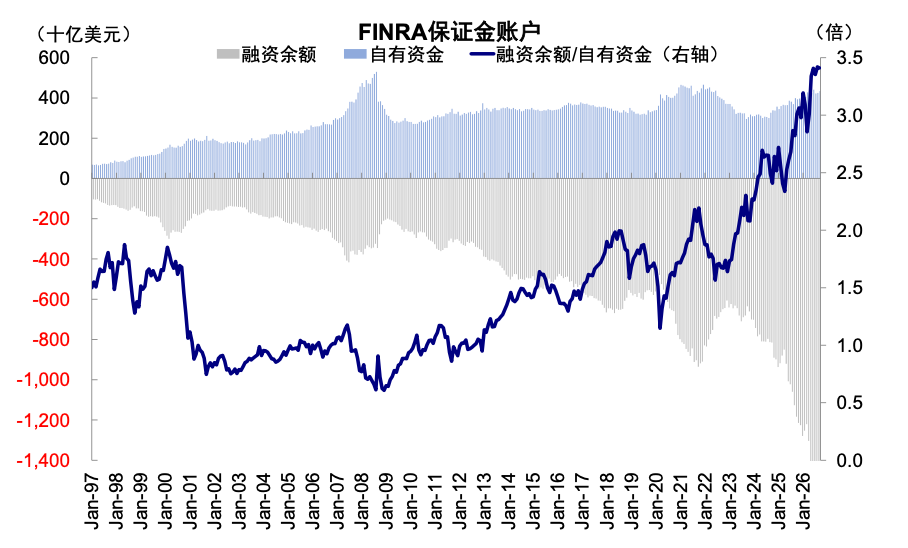
Chart: The bullish/bearish ratio of CBOE options open positions also rose to 1.33
Currently, it is still temporarily limited to the stock market. If we see that interest rates on US bonds and the US dollar are high, we need to be even more vigilant. This means that if the market sells safe assets, including US bonds, to meet the capital gap, the liquidity risk will increase dramatically.
Currently, AI is in a disconnected state. The key problem is that there are no new narratives and new catalysts for demand and models, so it will also amplify the risk of credit risk and regulatory pressure. Combined with high-intensity capital expenditure, cloud vendor free cash flow is constantly being squeezed, leading to growing concerns about the speed of realisation of AI revenue and return on investment. Market stabilization requires natural clarification or strong catalysts to reverse pessimistic expectations. No matter what angle you look at it, it requires some patience.
Chart: The overall valuation of US stocks is currently not extremely high 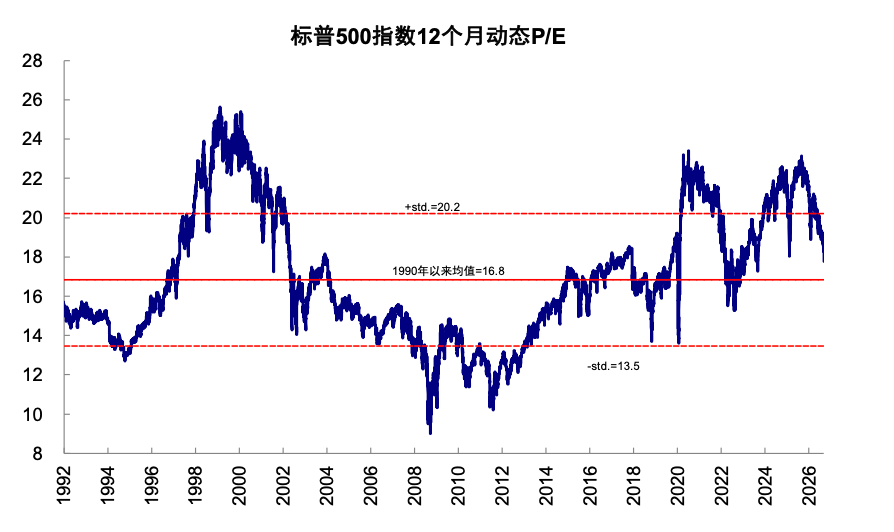
Source: Bloomberg, CICC Research Division
In terms of pace, the first half of next year is a critical verification period. The market needs to see Anthropic's performance in the first quarter of this year exceeding expectations and actual breakthroughs in the business to enhance confidence. Otherwise, as the market runs out of patience, the outlook for capital expenditure and returns in 2028 will be further bleak, and the main line of market trading may shift to recession trading.
Chart: The pullback was more obvious when previous growth expectations were fully taken into account, while cloud vendors were relatively resistant to falling 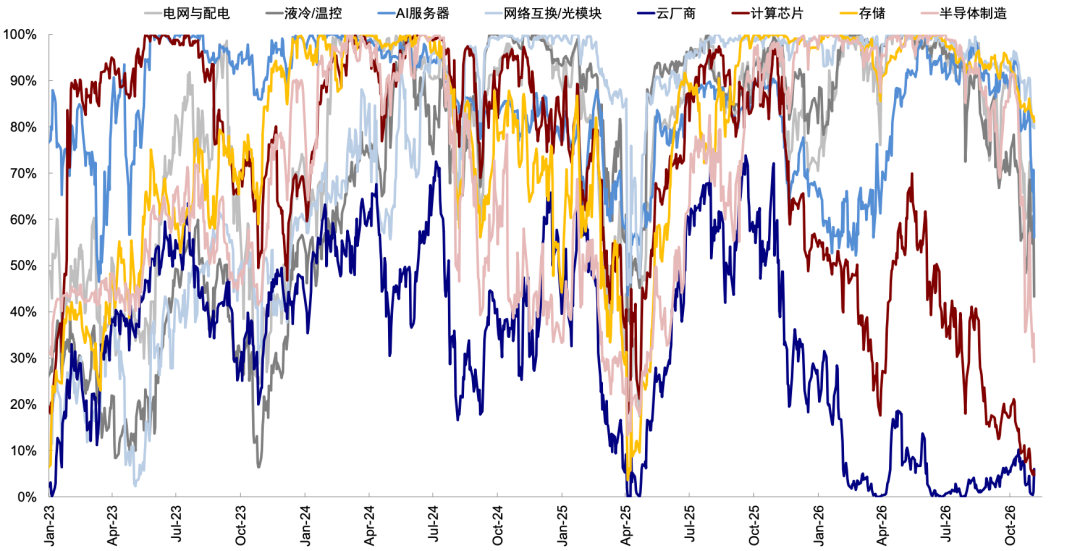
Source: FactSet, CICC Research Division
Structurally, AI may still be the main line, but internally, more emphasis should be placed on areas with higher profitability sustainability and certainty. The overall valuation of US stocks is currently not extremely high, but there are clear divisions within the AI industry chain. In this round of the AI market, hardware infrastructure links such as network interconnection/optical modules, semiconductor manufacturing, and liquid cooling/temperature control are included in higher profit growth expectations, and the pricing of cloud vendors is relatively reasonable. Recent market performance also reflects this difference. The correction was more obvious when previous growth expectations were fully factored in, while cloud vendors were relatively resistant to decline. This also means that the pricing of cloud vendors still leaves room for subsequent profit growth, but if profits from optical modules and other sectors cannot continue to increase, there is a risk that valuations will be lowered further.
Observing the performance of the two days of the midterm elections, the direction with the least resistance to market transactions gradually converged on Hengke and Gold. 1) Because Hengke has little exposure to AI, there is no need to worry too much about AI risks. It is expected that falling oil prices and inflation will also reduce the pressure to raise interest rates due to declining geographical risk. 2) Gold benefits from rising political game risks; it can also benefit from falling oil price inflation, reducing pressure to raise interest rates, and weakening interest rates on US dollars and US bonds.
However, Hengke's original problem was not external but internal, but the “advantage” was low enough and AI exposure was small, but the rebound from external environment improvements and capital reallocation alone came from further escalation of fundamental pressure and geographical risk. In the course of the rebound in the past two days, sharp net sales to the south and a rise in shorting in Hong Kong stocks all indicate increased market differences (“How did the market bottom out?”). In contrast, gold has less resistance, and various factors still provide support.
Technology hardware: Short-term headwinds in overseas AI infrastructure, continuing to be optimistic about the development of domestic computing power during the “15th Five-Year Plan” period
Recently, driven by the fact that the growth rate of leading AI Lab ARR is slowing down, investors in overseas markets have begun to continue to worry that the current high return on investment in AI infrastructure is unsustainable, and they are also pessimistic about the growth expectations of CSP Capex in North America in '28. After the US midterm elections ended on November 5, US stocks further fed back market concerns last night about the US government increasing AI regulations and slowing down investment in AI infrastructure. On the same day, the Fee Half Index fell by more than 10%, and the NASDAQ index fell by more than 5%. Looking back at A-shares, most of China's AI hardware industry chain standards (including overseas chains and domestic chains) have pulled back by more than 50% since July. CICC believes that short-term data center construction in North America will change the slope of hardware demand, but will not change the long-term trend; demand for domestic computing power is likely to increase.
Looking at overseas chains, CICC believes that the current valuation premiums of related companies have clearly been digested, AI is still booming in the medium to long term, and that the sharp decline in the market reflects concerns about the pace of overseas AI data center construction. According to Wind data, the current PE (TTM) of the CICC Statistics Shenwan Communications Equipment Index is 28.92 times higher, below the 10% quartile for the past three years. CICC believes that the recent sharp drop in AI stock prices in overseas chains has sufficiently squeezed the valuation bubble. What has yet to be clarified is the potential change in the pace of overseas AI data center construction and its impact on the degree of implementation of core supplier performance; however, after short-term capital shocks amplified fluctuations, market concerns about the pace of construction and profit delivery have clearly been released. According to factual figures, the total capital expenditure of the four leading US cloud vendors increased by 84.2% year on year in 3Q26. Microsoft Azure/AWS revenue increased high year on year during the same period, indicating that demand continues to shift to revenue. Looking ahead to the future, CICC believes that '27 will still be a year of active investment by cloud vendors.