


The Zhitong Finance App learned that the US non-farm payrolls data for October was unexpectedly strong, driving the price of US bonds down on Friday and the overall rise in yields. As the number of new jobs far exceeded market expectations and the unemployment rate declined, traders further increased their bets on the Federal Reserve's interest rate hike in December, and expectations that monetary policy would continue to be tightened heated up.
According to the data, the number of people employed in non-farm payrolls in the US increased by 165,000 in October, far exceeding market expectations of 65,000. The actual increase reached about 2.5 times the expected increase. Meanwhile, the unemployment rate fell to 4.1%, and employment data for the previous few months were revised upward, further highlighting the resilience of the US labor market. In terms of wages, the year-on-year wage growth rate in the US has accelerated to 3.1% over the past 12 months, indicating that the job market has not only maintained strong recruitment demand, but wage growth has also rebounded.
After the release of strong employment data, US Treasury bonds were sold off, and yields on treasury bonds of various maturities generally rose. Among them, the two-year US Treasury yield, which is most sensitive to the prospects of the Federal Reserve's interest rate policy, once rose 7 basis points to 4.54%; the yield on the benchmark 10-year US Treasury rose 4 basis points to 4.87%.
Due to the inverse relationship between bond prices and yields, the increase in yield reflects that investors are readjusting their expectations for future interest rate paths.
After the employment data was released, the market continued to bet that the Federal Reserve would further tighten monetary policy. According to interest rate market pricing, traders currently expect the probability that the Federal Reserve will raise interest rates by 25 basis points at the December policy meeting is about 70%. Meanwhile, the market expects that by September 2027, the Federal Reserve will increase interest rates by a total of at least 40 basis points.
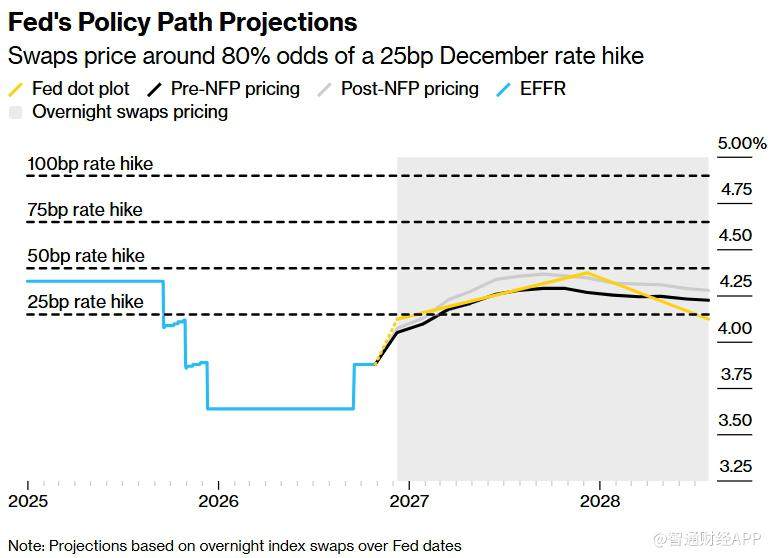
This non-farm payrolls report reinforces the market's judgment that the US economy is still resilient. The number of new jobs has significantly exceeded expectations, and the unemployment rate has declined. Coupled with a recovery in wage growth, this means that the labor market has not shown any obvious signs of weakness, and may also cause the Federal Reserve to remain alert in controlling inflation.
For the Federal Reserve, although strong employment growth is beneficial to economic expansion, it may also support consumer demand and make it more difficult for inflationary pressure to subside quickly. Especially in a context where rising energy prices are already putting pressure on inflation, a continued strong labor market may further strengthen the reasons for policymakers to maintain austerity.
The reaction of the US bond market also shows that investors are incorporating higher policy interest rate expectations into bond prices. The increase in short-term treasury bond yields surpassed that of long-term treasury bonds, highlighting how sensitive the market is to recent policy adjustments by the Federal Reserve.
Next, investors will continue to pay attention to US inflation data and the policy statements of Federal Reserve officials to determine whether expectations of interest rate hikes in December will heat up further and how long the current monetary tightening cycle may last.