


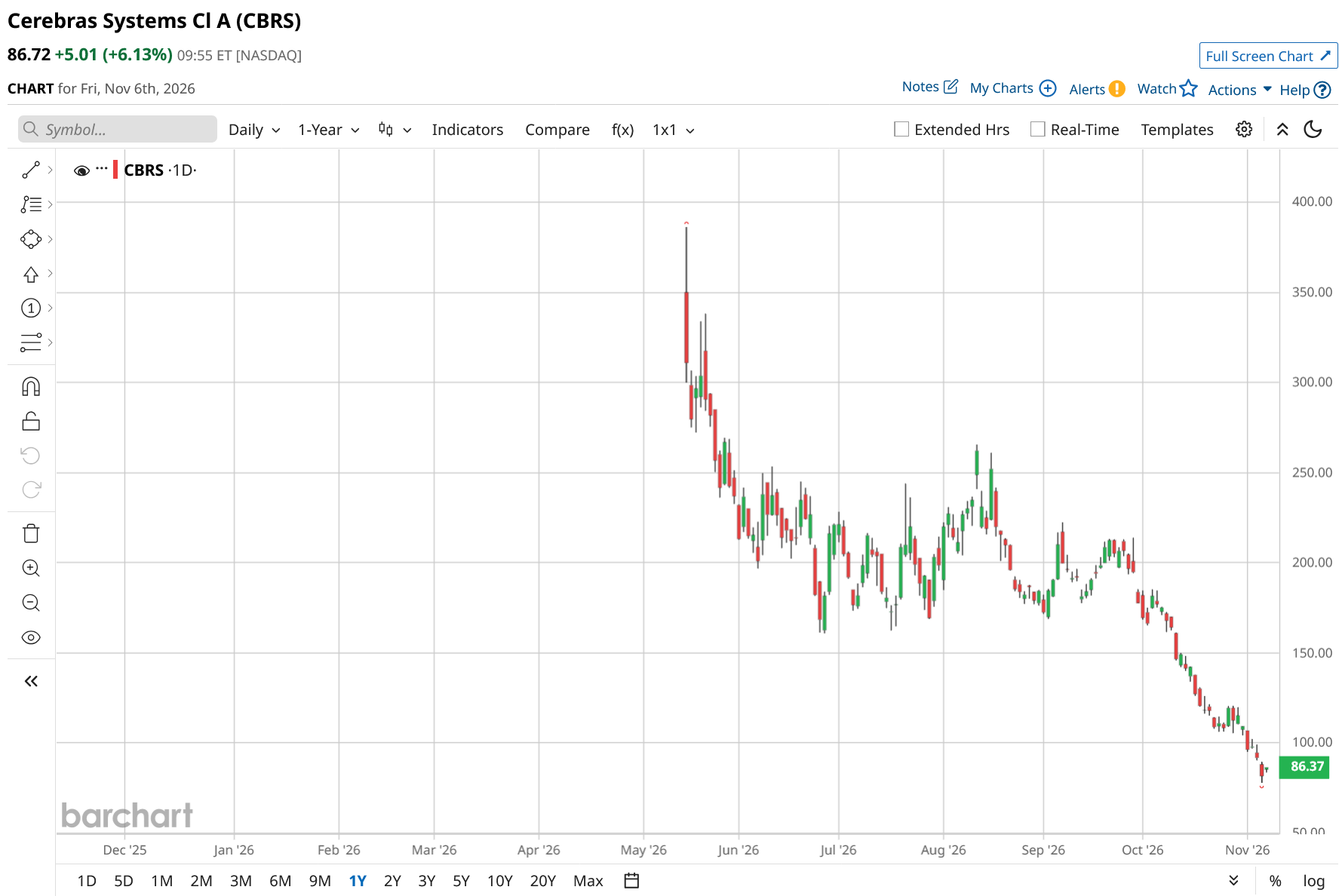
AI infrastructure stocks had a rough October. Cerebras Systems (CBRS) fell 36%, while CoreWeave (CRWV) lost 38%. Yet Gartner's October forecast put worldwide data center systems spending at $879 billion in 2026, up 73.8%. Spending is growing fast, but that hasn’t kept these stocks from falling.
Cerebras Systems is still expanding its business. On Oct. 27, it announced plans with Oracle Corporation (ORCL) to offer its AI inference technology through Oracle Cloud Infrastructure. Second-quarter core revenue grew 103% year-over-year (YoY), and management raised its full-year core revenue forecast to $880 million-$890 million.
But Nov. 9 brings a more immediate test. Cerebras’ final IPO lock-up period ends, making more shares eligible for sale going into Nov. 10. That doesn’t mean holders will sell. Still, could the unlock push shares lower, or will cloud growth give investors a reason to hold on ahead of third-quarter earnings on Nov. 12? Let’s take a closer look.
Can Earnings Support the Stock?
Cerebras Systems sells AI computing systems and cloud services built around its wafer-scale chips. But its shares have dropped 60% over three months and 52% over the past month.
The second-quarter results tell a stronger story. GAAP revenue rose 74% YoY to $180.1 million, while core revenue grew 103% to $209.9 million. Cloud and other services drove much of that growth, with record GAAP revenue of $126 million, up 281%. On a core basis, that revenue reached $127.7 million, up 287%.
Those core figures leave out stock-based compensation, noncash customer-warrant amortization, data-center pass-through revenue and costs, and certain other items. Core gross margin improved about 940 basis points to 41%, while core operating margin improved roughly 2,600 basis points to negative 16%. But GAAP gross margin was 14%, and GAAP operating margin was negative 265%. The business is growing, but it is still losing money.
Cerebras has funds to support its expansion. After raising $6.4 billion in gross IPO proceeds, it reported $8.6 billion in cash, cash equivalents, restricted cash, and short-term investments. It also has an $850 million revolving credit facility to help fund data-center acquisitions. Another $25.4 billion in remaining performance obligations represents contracted business, not revenue already earned.
For the third quarter, management expects core revenue of $214 million-$216 million, a gross margin of 38%-40%, and an operating margin between negative 25% and negative 23%. Raised full-year core targets call for revenue of $880 million-$890 million, a gross margin of 41%-43%, and an operating margin between negative 19% and negative 17%.
What Could Sustain Cerebras’ Growth?
Cerebras Systems and Oracle Corporation plan to offer the former’s fast AI inference through Oracle Cloud Infrastructure to AI labs, businesses, and developers. The service will build on Oracle’s existing AI tools, including Dedicated AI Clusters in OCI Enterprise AI. Cerebras’ Wafer-Scale Engine puts computing and memory on one processor, reducing the need to move data between chips. That helps AI models generate responses faster, especially when AI agents need several steps to complete a task.
To add more computing capacity, Cerebras is building a data center in Mikkeli, Finland, with Compute Nordic Finland. The site will expand in phases to 165 megawatts of contracted IT capacity. Construction is already underway on the first 50-megawatt phase, and the service orders carry seven-year terms.
Cerebras is also working with London-based AI and computing software company Callosum to speed up inference, the process AI models use to generate responses. The partnership follows Cerebras’ announcement of 200 megawatts of European AI computing capacity. It focuses on systems where multiple AI agents work over long periods and adapt as tasks change. Different stages require different computing resources, so the companies plan to combine different types of computing infrastructure to handle that work.
Wall Street Weighs the Road Ahead for CBRS Stock
Cerebras Systems will report earnings on Nov. 12, 2026, after the market closes. Analysts expect a loss of $0.13 per share for the September 2026 quarter and $0.52 per share for the full-year ending December 2026.
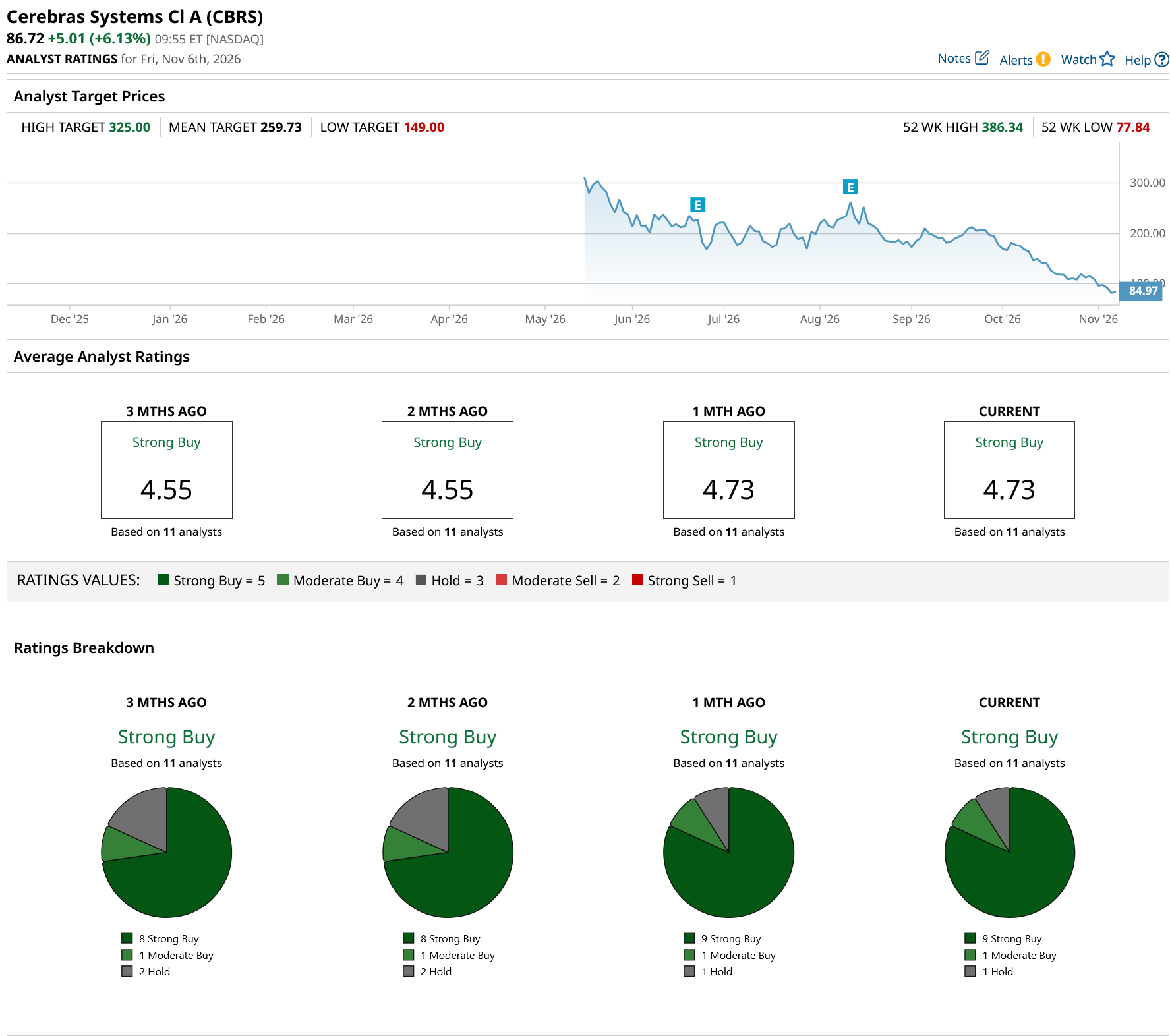
Despite those expected losses, analysts have been positive about CBRS stock. Earlier this year, Mizuho analyst Vijay Rakesh started coverage with an “Outperform” rating and a $300 price target. He pointed to Cerebras Systems’ ability to deliver fast AI responses with simpler networking and chip packaging. That rating came before Culper Research’s report, so it should not be taken as a response to the allegations.
Morgan Stanley, Rosenblatt, and Needham also gave the stock positive ratings earlier this year, with targets ranging from $279 to $300 across those three firms.
Overall, all 11 analysts surveyed rate CBRS stock a consensus “Strong Buy.” Their average price target of $259.73 suggests 199% upside from current price levels.
Conclusion
Nov. 9 looks more like a near-term risk than a reason to buy CBRS stock. Earlier share unlocks have already added pressure, while rapid revenue growth has not settled investors’ concerns. My bias is toward further weakness around the final unlock, although shares becoming eligible for sale does not mean holders will sell. The Nov. 12 earnings report could change that direction if results and guidance strengthen confidence in growth and narrowing losses. For now, the partnerships and bullish analyst targets support the longer-term case, but they do not make a quick rebound the most likely outcome.
On the date of publication, Ebube Jones did not directly have a position in any of the securities mentioned in this article. All information and data in this article is solely for informational purposes. For more information please view the Barchart Disclosure Policy here.