


Duolingo (DUOL) is back in focus after third quarter results topped revenue expectations, daily active users climbed 29%, and management lifted guidance for both the fourth quarter and full year 2026.
Recent price action shows that Duolingo’s share price has been volatile, with a 7 day share price return of 19.33% and a 90 day move of 19.95%. Yet year to date the share price is down 11.03% and the 1 year total shareholder return has declined 21.96%, so recent momentum is improving against a weaker longer term record as investors reassess growth potential and risk after the earnings beat and raised guidance.
Spot fresh momentum stories similar to Duolingo’s post-earnings move by scanning our curated list of 21 high quality undiscovered gems, which pairs strong fundamentals with under-the-radar profiles.After Duolingo’s sharp post earnings jump and a longer spell of weak returns, the real test now is simple. Does the current price still leave enough upside to compensate for the risks?
Most Popular Narrative: 18.5% Undervalued
On the narrative view, Duolingo’s fair value of $192.64 sits well above the latest close at $157.02. This puts the recent rebound into context and raises a clear question around how much of the long term story is already in the price.
The surge in Duolingo’s content production using generative AI, with roughly 20,500 course units shipped in a recent quarter and professional level coverage across major languages, creates room for higher value tiers and new premium features that could support ARPU and gross margin over time as more of this content is monetized.
See why 20 investors see Duolingo as 18% undervalued.
Result: Fair Value of $192.64 (UNDERVALUED)
Still, the bullish Duolingo story faces pressure if strong daily active user growth keeps outpacing revenue, or if longer free trials and eased paywalls dilute monetization.
Find out about the key risks to this Duolingo narrative.
Another View: Duolingo Through The P/E Lens
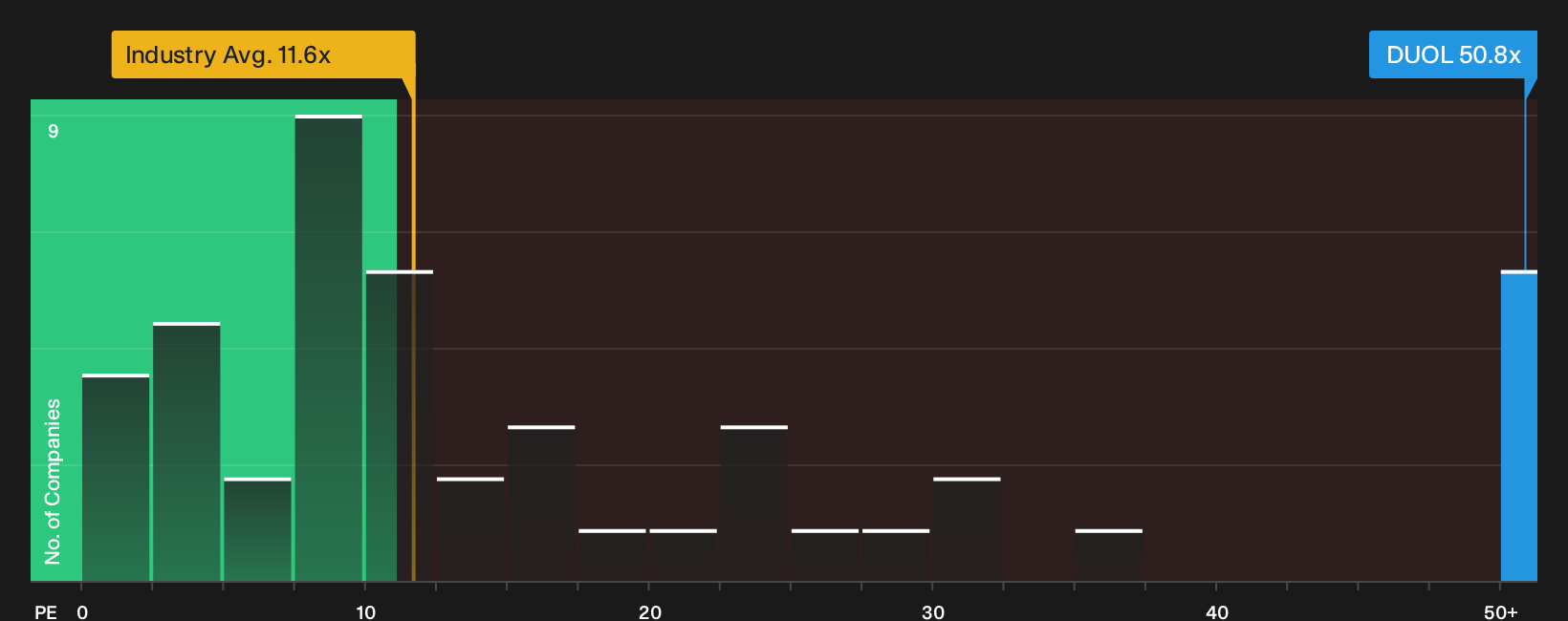
There is a very different story when Duolingo is viewed through its P/E ratio rather than narrative fair value. The stock trades on 50.8x earnings compared with a peer average of 11.5x and a fair ratio of 27.8x. That gap points to valuation risk if sentiment cools.
For investors who prefer to anchor on earnings multiples instead of narratives, this spread between the current P/E, peers and the fair ratio raises a simple question: Is the premium a price for Duolingo’s potential or a margin of safety running in reverse?
See what the numbers say about this price — find out in our valuation breakdown.
Next Steps
If this mix of optimism and concern around Duolingo feels familiar, use it as a prompt to move quickly. Pull up the numbers and stress test your own thesis against the 2 key rewards and 3 important warning signs.
Looking for more investment ideas beyond Duolingo?
If Duolingo has sharpened your focus, do not stop here. Broaden your watchlist and pressure test your thinking against other clear, data backed opportunities.
- Target potential mispricing by scanning a curated spread of quality opportunities through 42 high quality undervalued stocks.
- Strengthen your downside protection by focusing on financially resilient businesses using the 32 resilient stocks with low risk scores.
- Rebuild your watchlist with durable balance sheets and steady fundamentals sourced from our list of solid balance sheet and fundamentals (24 results).
Have feedback on this article? Concerned about the content? Get in touch with us directly. Alternatively, email editorial-team@simplywallst.com