


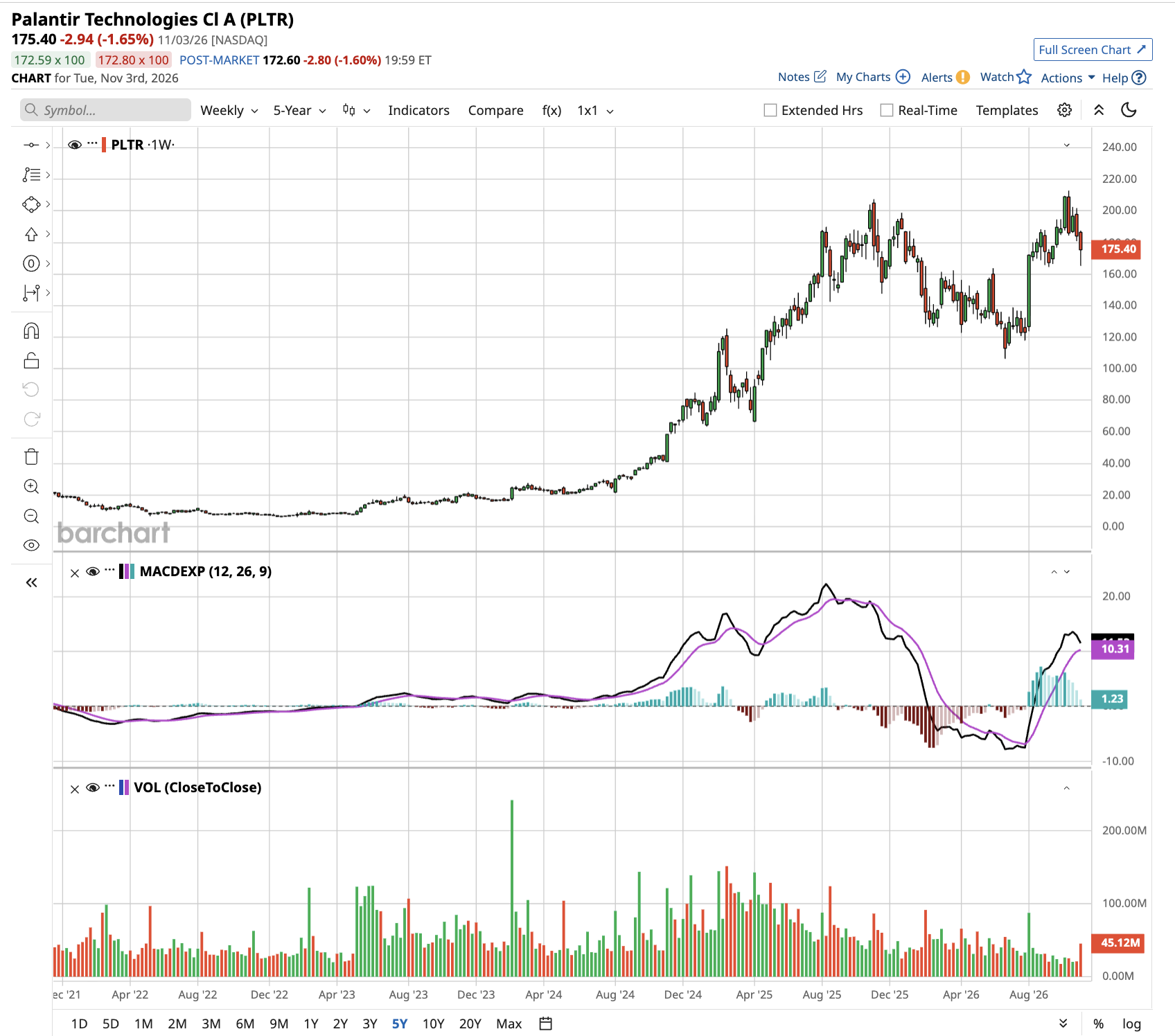
Palantir Technologies (PLTR) recently reported strong quarterly numbers and beat consensus estimates comfortably. However, the tech stock still moved lower after earnings even as management raised the company's outlook for the year.
Valued at a market capitalization of $372 billion, PLTR stock is up a staggering 1,500% since its initial public offering (IPO) in 2020. Let’s take a closer look at whether it remains a top stock to own in November 2026.
Palantir's Earnings Beat Wall Street Estimates
Palantir cleared both bars Wall Street set for the third quarter. The company reported adjusted EPS of $0.44 versus analysts' estimate of $0.41, while revenue of $2.31 billion beat the consensus estimate of $2.18 billion.
Palantir grew revenue 96% year-over-year (YOY) and surpassed $2 billion in quarterly revenue for the first time. On the Q3 earnings call, the company called it the highest growth it has ever posted as a public company. Palantir also reported net income of $1.13 billion, up from $476 million during the same period last year.
On the Q3 call, CFO David Glazer noted that adjusted operating margin stood at 62%, allowing Palantir to report an operating cash flow of $1.2 billion. The company ended the quarter with $10.4 billion in cash.
Glazer also cited the company's Rule of 40 score, which is a quick health check for software companies. The figure calculates whether a company is growing fast while making money by adding together its revenue growth rate and adjusted operating margin. Using Palantir's 96% YOY revenue growth and adjusted operating margin of 62%, the company earned a Rule of 40 score of 158% in Q3.
The usual benchmark for the score is 40%, and a score above that level is generally seen as healthy. Palantir’s score of 158% is nearly four times that mark, which is why CEO Alex Karp called the number “jaw dropping” on the earnings call. Glazer also noted that the score rose three points from the prior quarter and confirmed that Q3 marked the 13th-straight quarter of improvement.
U.S. Commercial Revenue Passes Government Sales
Palantir built its name on government work, including support for U.S. warfighters. Commercial customers were once a side business. In Q3, however, U.S. commercial revenue accounted for the majority of sales.
U.S. commercial revenue more than doubled YOY to $984 million, while U.S. government revenue rose 96% YOY to $953 million. A year ago, U.S. commercial revenue was $397 million. CNBC recently noted that Palantir's U.S. commercial business has more than quintupled over two years.
Palantir ended Q3 with 686 U.S. commercial customers, up 29% from a year ago. The company's top 20 customers now bring in average trailing 12-month revenue of $146 million, up 76% YOY.
International commercial revenue also rose 21% to $184 million, while international government revenue rose 31% to $192 million. Evidently, U.S. customers did most of the heavy lifting in Q3, accounting for 84% of total sales.
Palantir lifted its full-year forecast as well. The company now estimates fiscal 2026 revenue to grow 91% YOY to roughly $8.53 billion. U.S. commercial revenue is forecast at $3.56 billion, while adjusted free cash flow is expected between $4.8 billion and $5 billion. For Q4, management also estimates $2.65 billion in revenue.
Why Customers Are Signing Bigger Deals
On the Q3 earnings call, Palantir shared some examples of higher customer spending. One industrial materials company started with a pilot of nearly $3 million in Q2 before signing a $29 million annual deal in Q3, while a global athletic company "converted a $1.6 million pilot that began in Q1 2026 into an approximately $21 million ACV deal last quarter.” Palantir calls its pitch "sovereign AI," where companies tune artificial intelligence (AI) models on their own data and control the results. According to Palantir, L3Harris (LHX) noted that a model tuned on its own data quickly beat the leading model it had used prior.
Karp said that first projects once started near $250,000 and can now start around $25 million. The CEO also told CNBC that the business is growing without salespeople. On the call, he compared Palantir's customer events to "a rock concert."
Still, measured by total contract value, U.S. commercial bookings rose only 11% YOY to $1.463 billion. That’s far slower than U.S. commercial revenue growth of 148%. Total contract value counts the full value of a deal over its whole term. A shorter contract has a smaller total even if the customer spends the same per year, which is likely why bookings grew more slowly than revenue.
Glazer said several deals worth $10 million or more ran for shorter terms than usual, because customers are just starting with sovereign AI. He expects contracts to get bigger and longer over time.
What Should Palantir Investors Watch Next?
A 3% stock dip after a beat-and-raise quarter is a reminder that extended trading is only a first reaction. The next test is Q4, when Palantir expects about $2.65 billion in revenue. Investors should watch whether bigger U.S. commercial deals keep coming, and whether shorter contracts grow longer as Glazer forecast.
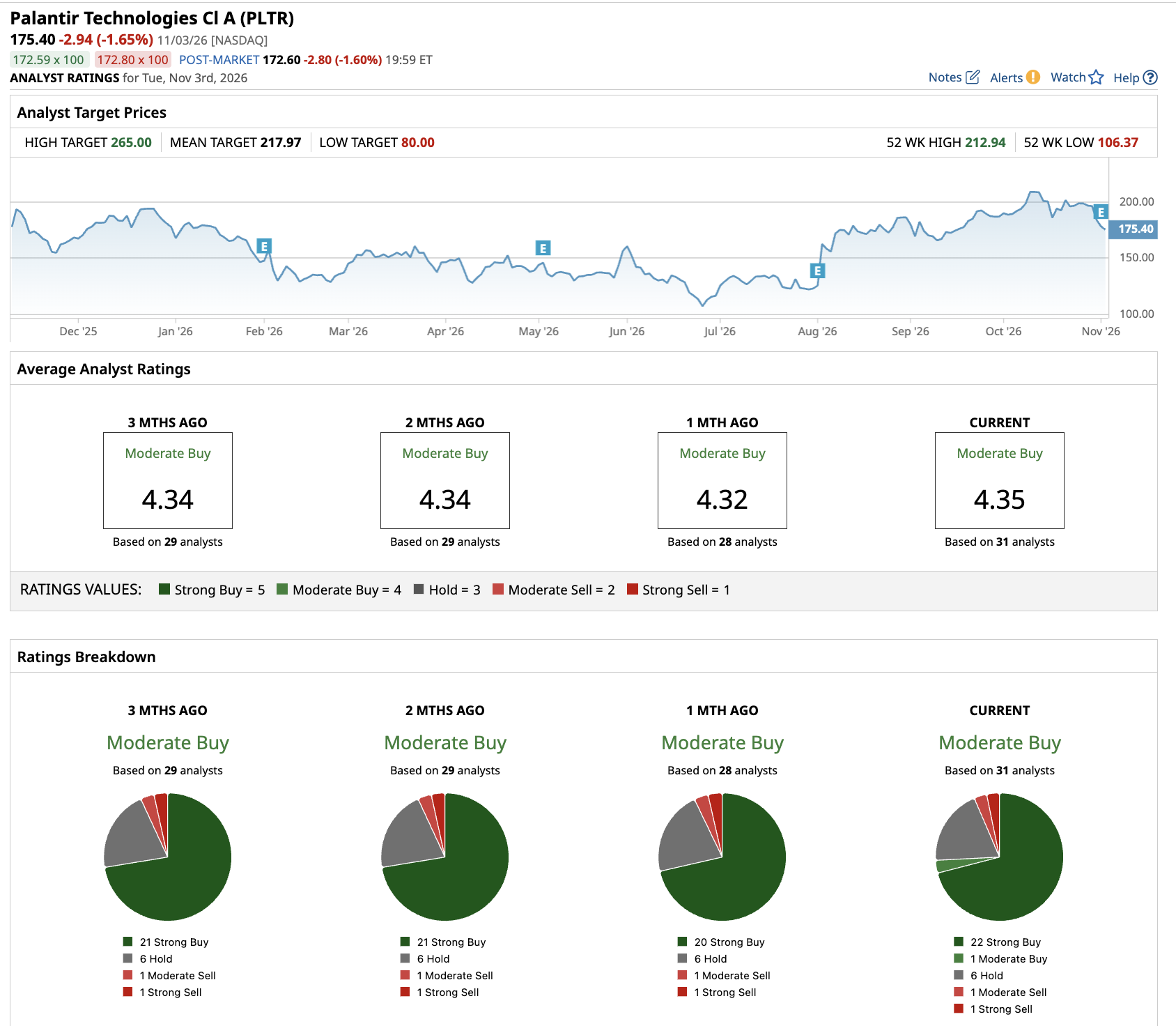
Overall, Palantir stock has a consensus “Moderate Buy” rating on Wall Street. Out of the 31 analysts covering PLTR stock, 22 recommend a “Strong Buy” rating, seven recommend a “Hold,” one recommends a “Moderate Sell,” and one analyst recommends a “Strong Sell” rating. The average price target of $223.86 suggests potential upside of 39% from current levels.
On the date of publication, Aditya Raghunath did not directly have a position in any of the securities mentioned in this article. All information and data in this article is solely for informational purposes. For more information please view the Barchart Disclosure Policy here.