


- Forestar Group reported fourth quarter sales of US$580.8 million and net income of US$59.2 million, with full year sales of US$1,635.1 million and net income of US$142.6 million, alongside leadership changes including the retirement of Executive Chairman Don Tomnitz and the upcoming board transition involving Samuel Fuller and Stacey Dwyer.
- The combination of softer earnings and a refreshed board, which includes a former D.R. Horton executive with land development and financing experience, places Forestar Group’s capital allocation discipline and lot conversion execution under closer scrutiny.
- This raises the question of how Forestar Group’s softer earnings and Executive Chairman transition could reshape the existing investment narrative around lot conversion.
Forestar Group Investment Narrative Recap
To own Forestar Group, you need to be comfortable with a land developer whose story is all about converting a large contracted lot pipeline into steady lot sales, despite choppy housing demand and tighter buyer affordability. The latest quarter showed softer sales and earnings, which keeps attention on how quickly those contracted lots turn into cash and how efficiently new land spending is deployed.
The short term swing factor still looks like lot conversion timing against that record contracted backlog and planned US$1.4b of 2026 land and development spend. The key risk remains that weaker new home demand and margin pressure persist, so returns on invested capital and free cash flow stay under strain rather than improving.
The most relevant recent update is the leadership shift around Executive Chairman Don Tomnitz, with CEO Andy Oxley taking on the Executive Chairman title and Stacey Dwyer joining the board. For a land heavy model like Forestar Group, board level oversight of capital allocation, leverage and lot banking structures directly connects to those backlog conversion and margin catalysts.
Dwyer’s background across homebuilding finance, lot banking and a D.R. Horton tenure adds operational and funding experience to the audit and compensation committees. That should keep focus on balancing Forestar Group’s liquidity and revolver capacity against the risk that ongoing lot volume declines, gross margin compression and negative free cash flow reduce the payoff from that US$1.4b development program.
Forestar Group’s current analyst narrative points to revenues of about US$1.7b and earnings of roughly US$133.1 million by 2029. This outlook is based on an assumed 1.1% yearly revenue decline and a move from US$170.4 million of earnings today to the 2029 consensus, which would mean an earnings decrease of about US$37.3 million from current levels.
Uncover how Forestar Group's fair value indicates a 39% potential upside to its current price before sentiment on Forestar Group closes that gap.
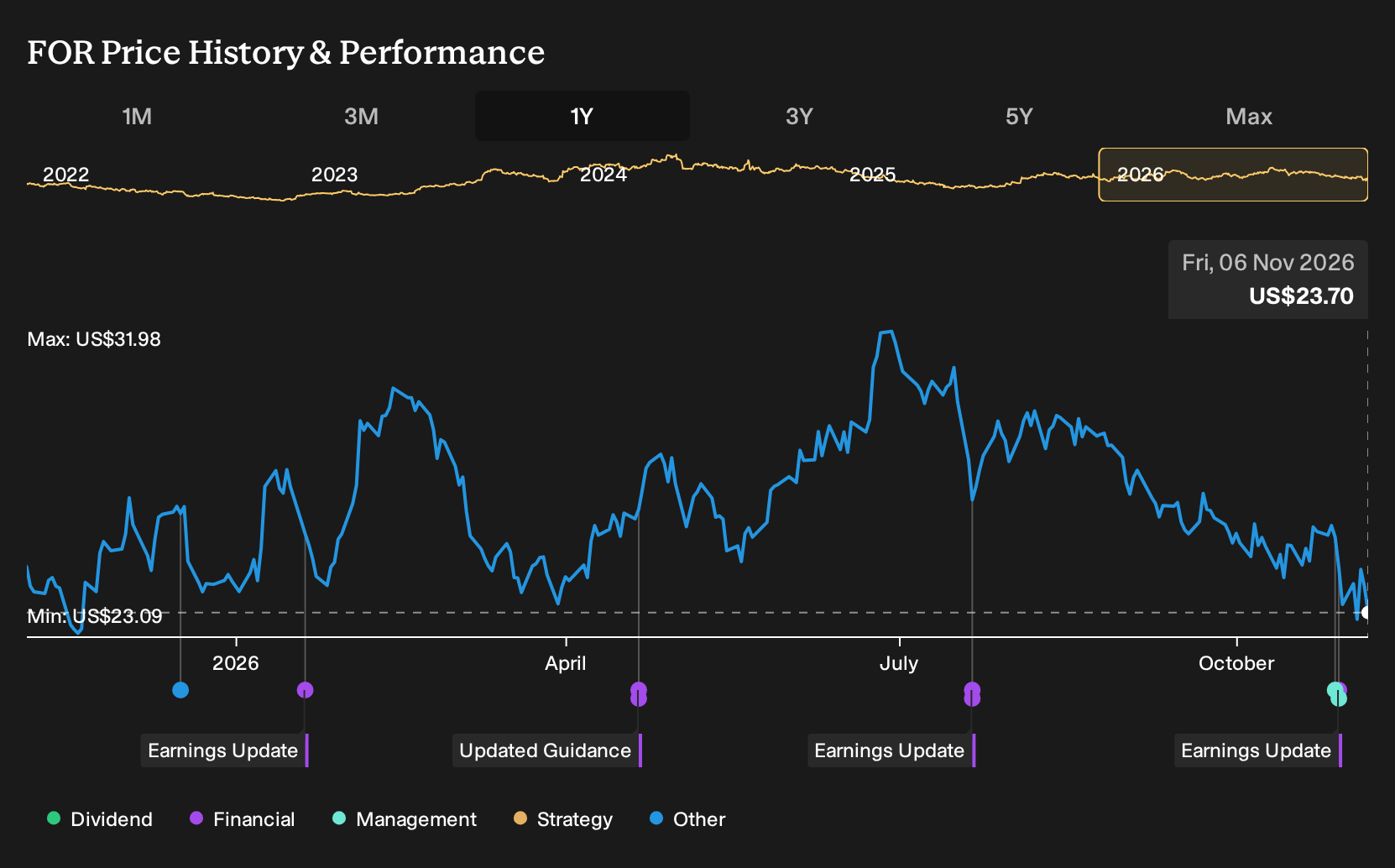
Exploring Other Perspectives
One alternate view puts customer concentration in the spotlight. The most bearish analysts worry that Forestar Group’s tight link to D.R. Horton could cap lot growth, and before this earnings release they were pencilling in roughly US$1.7b of 2029 revenue and only about US$132.1 million of earnings. That is a noticeably harsher lens. You can use this as a prompt to compare several narratives and decide which assumptions feel more realistic now that earnings and board changes are on the table.
Explore another Forestar Group fair value estimate, including one that suggests it could be worth just $34.00!
Reach Your Own Conclusion
Disagree with existing narratives? Extraordinary investment returns rarely come from following the herd, so consider trusting your own analysis.
- A great starting point for your Forestar Group research is our analysis highlighting 2 key rewards and 1 important warning sign that could impact your investment decision.
- See our latest analysis for Forestar Group. The report includes a comprehensive fundamental analysis summarized in a single visual, the Snowflake, making it easy to evaluate Forestar Group's overall financial health at a glance.
Looking for more investment ideas beyond Forestar Group?
If the Forestar Group story has sharpened your thinking about risk, balance sheets and future cash flows, it can be useful to test that framework across a wider watchlist using the Simply Wall St Screener.
- If you care most about financial resilience, start with companies that pair healthy cash positions with controlled leverage by scanning a list of solid balance sheet and fundamentals (24 results).
- For investors who focus on quality at a reasonable entry point, look through a carefully filtered pool of potentially mispriced opportunities with the 42 high quality undervalued stocks.
- If steadier income streams appeal to you, filter for potential payers with stronger yields and balance sheet support using the 6 dividend fortresses.
Have feedback on this article? Concerned about the content? Get in touch with us directly. Alternatively, email editorial-team@simplywallst.com