


- QBE Insurance Group anchored IA Capital’s Inter-Atlantic Opportunity Fund I through QBE Ventures and completed about US$1.6b of loss portfolio transfer deals with RiverStone International covering North American and European books.
- The fintech and insurtech fund commitment, paired with transferring legacy liabilities to RiverStone, highlights QBE’s focus on both technology partnerships and active balance sheet reshaping.
- We will now see how QBE Insurance Group’s late stage fintech and insurtech fund backing could influence its broader investment narrative.
QBE Insurance Group Investment Narrative Recap
To own QBE Insurance Group, you need to be comfortable with a global commercial insurer that depends on keeping underwriting discipline tight while investing in technology and modernization that can take time to pay off. The key short term swing factor remains how well pricing holds up against claims inflation and catastrophe activity in core regions like Australia Pacific and North America.
The latest fund backing and loss portfolio transfer activity do not significantly change that near term equation. The bigger risk still sits in premium rate pressure and large loss volatility, plus the drag from a slower expense ratio improvement. Those are the levers that can move the combined ratio and earnings most meaningfully.
The most relevant recent development is QBE Insurance Group anchoring IA Capital’s Inter Atlantic Opportunity Fund I through QBE Ventures. The fund targets late stage fintech and insurtech companies, which ties directly to QBE’s push into AI, automation and data led underwriting tools such as Aurora and cyber solutions like QCyber Rapid Pay.
For you as a shareholder, the question is execution. If QBE can convert this external fund exposure into practical improvements in claims handling speed, pricing accuracy and cyber product capability, that can support the catalyst of more stable margins over time. If integration is slow or costs stay elevated, the risk of a stubbornly high expense ratio remains.
QBE Insurance Group Consensus Expectations In Focus
Analysts sketch a relatively steady path for QBE Insurance Group, with forecasts built more around holding earnings firm than delivering a sharp profit reset. The story they are telling hinges on measured revenue expansion, a slight squeeze on margins and a valuation that already incorporates much of that view.
On the top line, the current consensus assumes revenue grows by 4.2% a year over the next three years. That tempo points to gradual expansion rather than a step change, which fits a mature global insurer that leans on pricing discipline, selective growth and productivity gains instead of chasing volume for its own sake.
Profitability assumptions are more cautious. Margins are projected to move from 11.1% today to 10.0% by 2029, so estimates already factor in some pressure from claims trends, catastrophe exposure and ongoing investment in technology and modernization. For you as an investor, that matters because even with revenue moving higher, a lower margin means less of each premium dollar is expected to drop through to the bottom line.
Earnings sit at the center of this view. Consensus points to QBE Insurance Group generating about $2.2b of profit today and still around $2.2b in 2029, which implies flat earnings over that period. The analyst range is wide though, with the more cautious end of the spectrum at $1.6b. You are therefore looking at a band rather than a single clean number, and your own comfort with that spread should guide how much weight you put on the headline forecast.
QBE Insurance Group's narrative projects $22.0b revenue and $2.2b earnings by 2029. This rests on 4.2% yearly revenue growth and essentially flat earnings from $2.2b today, with analysts expecting no material earnings change over that horizon.
Those same earnings estimates then get plugged into valuation work. To line up with the consensus price target, the stock would need to trade on a P/E of 14.3x by 2029, compared with about 12.8x today. That multiple is still below the stated 21.0x for the broader Australian insurance sector, so the current framework does not rely on QBE trading at a premium to domestic peers.
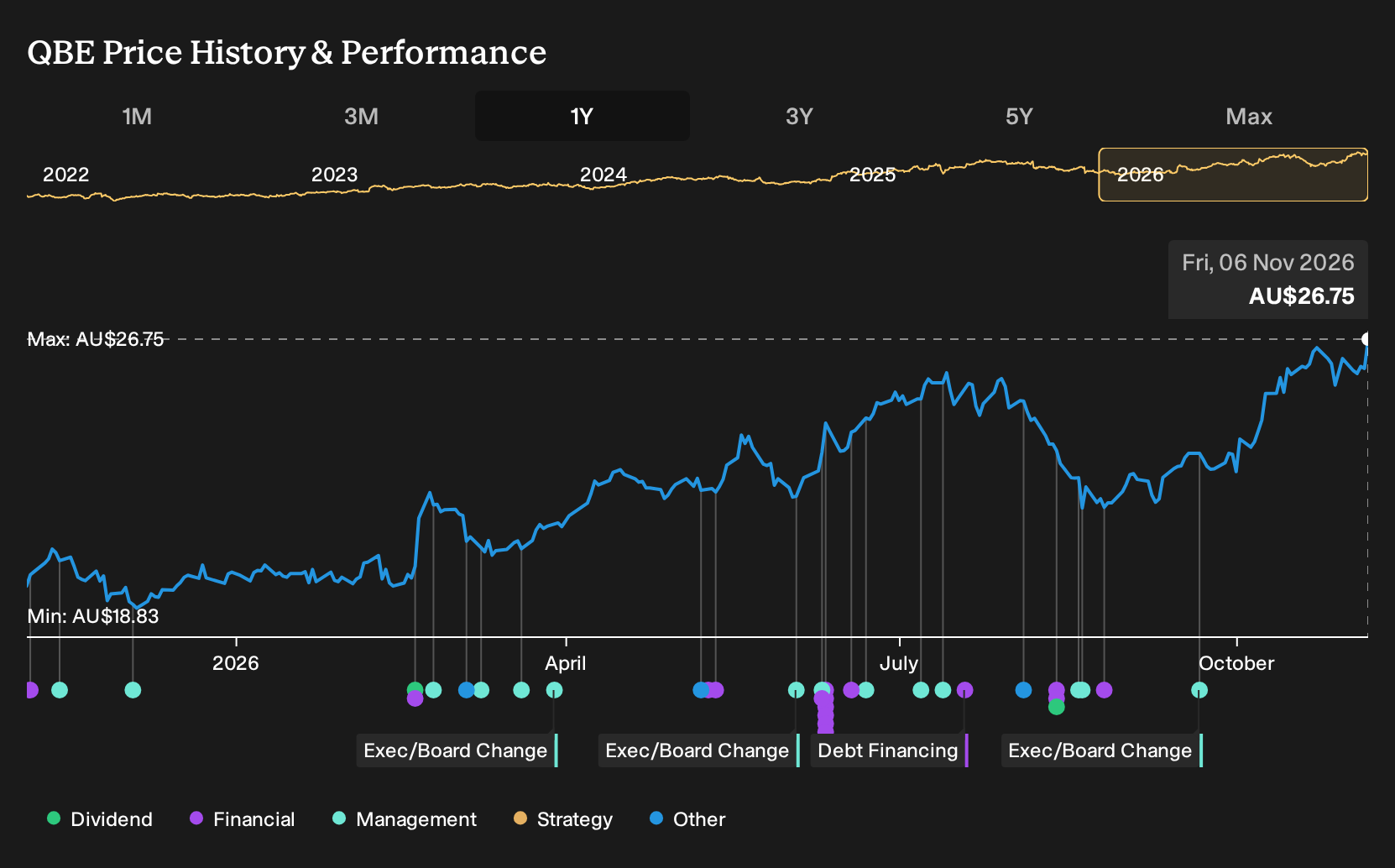
Price targets themselves are far from uniform. The average sits at A$24.94, with the most optimistic analyst at A$28.00 and the most cautious at A$17.00. With the shares at A$26.50 as of early November 2026, the midpoint target is 6.3% lower. This indicates that many analysts view QBE Insurance Group as roughly fairly priced on their set of assumptions rather than obviously cheap or expensive.
For your own decision making, the key is how those inputs line up with your expectations. If you think revenue can compound faster than 4.2% a year, margins hold firmer than 10.0%, or the market is willing to pay more than 14.3x earnings by 2029, then the consensus framework may prove conservative. If you are more concerned about claims inflation, catastrophe volatility or slower cost improvement, the lower end of the earnings range and price targets becomes more relevant.
Uncover why QBE Insurance Group's fair value indicates a 7% potential downside to its current price that leaves little room for error.
Exploring Other Perspectives
One alternate view leans hard into QBE Insurance Group’s push into newer premium pools like clean energy and cyber. That more optimistic camp was already assuming revenue of about $23.1b and earnings of $2.3b by 2029 before this fund commitment and leadership shuffle. You can now ask whether those expectations move even higher, while more cautious analysts may question execution risk and prefer the earlier $22.0b and $2.2b consensus path. Both sets of views were formed before this news, so it is worth exploring how your own thesis might shift as these developments play out.
Explore 5 other QBE Insurance Group fair value estimates, including one that suggests as much as 94% upside from the current price!
Decide For Yourself
Disagree with existing narratives? Extraordinary investment returns rarely come from following the herd, so go with your instincts.
- A great starting point for your QBE Insurance Group research is our analysis highlighting 2 key rewards and 1 important warning sign that could impact your investment decision.
- See our latest analysis for QBE Insurance Group. The report includes a comprehensive fundamental analysis summarized in a single visual, the Snowflake, making it easy to evaluate QBE Insurance Group's overall financial health at a glance.
Looking For More Investment Ideas Beyond QBE Insurance Group?
Once you have a view on QBE Insurance Group, it can help to widen the lens and line it up against other companies with different risk and return profiles. The Simply Wall St Screener can surface groups of stocks that match the type of portfolio role you want filled, whether that is resilience, income, or undervaluation.
- If capital preservation and steadier business profiles matter most to you, start with a basket of companies flagged as 6 resilient stocks with low risk scores that may better align with a more cautious approach.
- For investors hunting for mispriced quality, look through our curated set of 4 high quality undervalued stocks that pair stronger fundamentals with valuations that do not look stretched on current metrics.
- If you want to cast the net wider for potential future compounders, filter for 14 high quality undiscovered gems that combine solid financial footing with relatively limited market attention.
Have feedback on this article? Concerned about the content? Get in touch with us directly. Alternatively, email editorial-team@simplywallst.com