


Lemonade (LMND) is back in focus after third quarter results topped revenue and earnings expectations, while renters insurance reached nationwide coverage across all 50 states and Washington, D.C., giving investors fresh numbers to reassess the stock.
Even with the Q3 beat and renters insurance now live nationwide, Lemonade’s share price has slipped. The 30-day share price return is down 15.55% and the year-to-date share price return is down 47.93%, while the three-year total shareholder return of about 178% still points to a very different long-run journey than the past year’s 47.28% total shareholder decline.
Scan how Lemonade stacks up against other fast-moving insurers by reviewing a curated set of 29 resilient stocks with low risk scores.The Q3 beat, nationwide renters rollout and sharp share price slide pull in opposite directions. For Lemonade, does that combination still tilt the risk reward toward buyers or signal caution at today’s valuation?
Most Popular Narrative: 19% Undervalued
Lemonade closed at $39.55, while the most followed valuation storyline on Simply Wall St pegs fair value closer to $48.95. This frames the recent selloff against a higher long term anchor.
Ignore the 79%. In-force premium, the measure of how much insurance Lemonade actually has on the books, grew 32.4% to $1.43 billion. Revenue grew 79% because ceded premiums fell roughly 49% as the company retained a larger share of its own risk. The company says as much in its letter.
See why 4 investors see Lemonade as 19% undervalued.
According to rcb9, the gap between the share price and this fair value hinges on a few moving parts that investors can monitor directly. The narrative uses a 12% discount rate, a 10% profit margin and a 28% revenue growth rate, and it treats the recent move to retain more risk as a key swing factor.
The author argues that headline revenue growth is being flattered by this reinsurance shift. The more important signal comes from underwriting metrics such as the gross loss ratio and loss adjustment expense ratio. That focus ties the valuation back to Lemonade’s core insurance engine rather than to accounting optics.
The same framework flags clear downside triggers that could challenge the $48.95 fair value, including any quarter where the gross loss ratio moves above 70% or where in force premium growth tracks below 25%. Those checkpoints give readers concrete data points to watch as they decide whether the current discount compensates for execution risk.
Result: Fair Value of $48.95 (UNDERVALUED)
Still, Lemonade’s thesis leans heavily on its gross loss ratio staying near 60% and on in force premium growth holding above 25%. Either slipping could reset expectations fast.
Find out about the key risks to this Lemonade narrative.
Another View On Lemonade’s Valuation
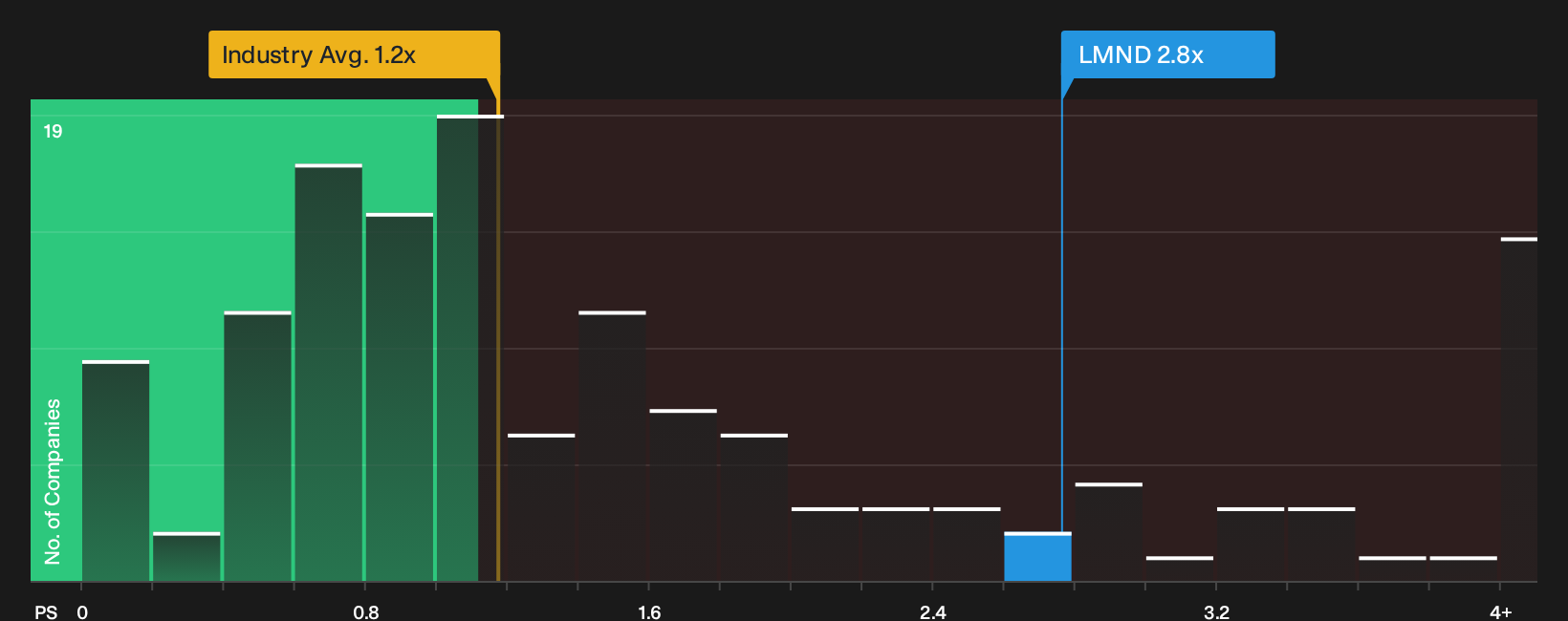
The crowd-sourced fair value of $48.95 paints Lemonade as 19% undervalued on long term assumptions. The market’s current P/S of 2.8x tells a different story, because it is higher than the US Insurance industry at 1.2x, peers at 2x and a fair ratio of 1.6x.
That gap suggests investors are already paying up for future growth and profitability that are not yet in the income statement. The key question is whether you are comfortable paying a richer multiple while the business is still loss making.
See what the numbers say about this price — find out in our valuation breakdown.
Next Steps
Mixed signals or real opportunity? With both concerns and upside potential highlighted in the latest data, consider acting promptly and weighing both sides for yourself by reviewing 2 key rewards and 1 important warning sign
Looking for more ideas beyond Lemonade?
If Lemonade has your attention, do not stop here. Broaden your watchlist with fresh companies filtered by quality, value and resilience using targeted screeners.
- Target potential mispricings by scanning a focused set of 39 high quality undervalued stocks that combine solid fundamentals with room for sentiment to catch up.
- Prioritize strength and staying power by filtering for companies on our list of solid balance sheet and fundamentals (24 results) so you are not relying only on optimistic narratives.
- Get ahead of the crowd by tracking 19 high quality undiscovered gems before wider attention and liquidity potentially reshape how these businesses are viewed.
Have feedback on this article? Concerned about the content? Get in touch with us directly. Alternatively, email editorial-team@simplywallst.com