


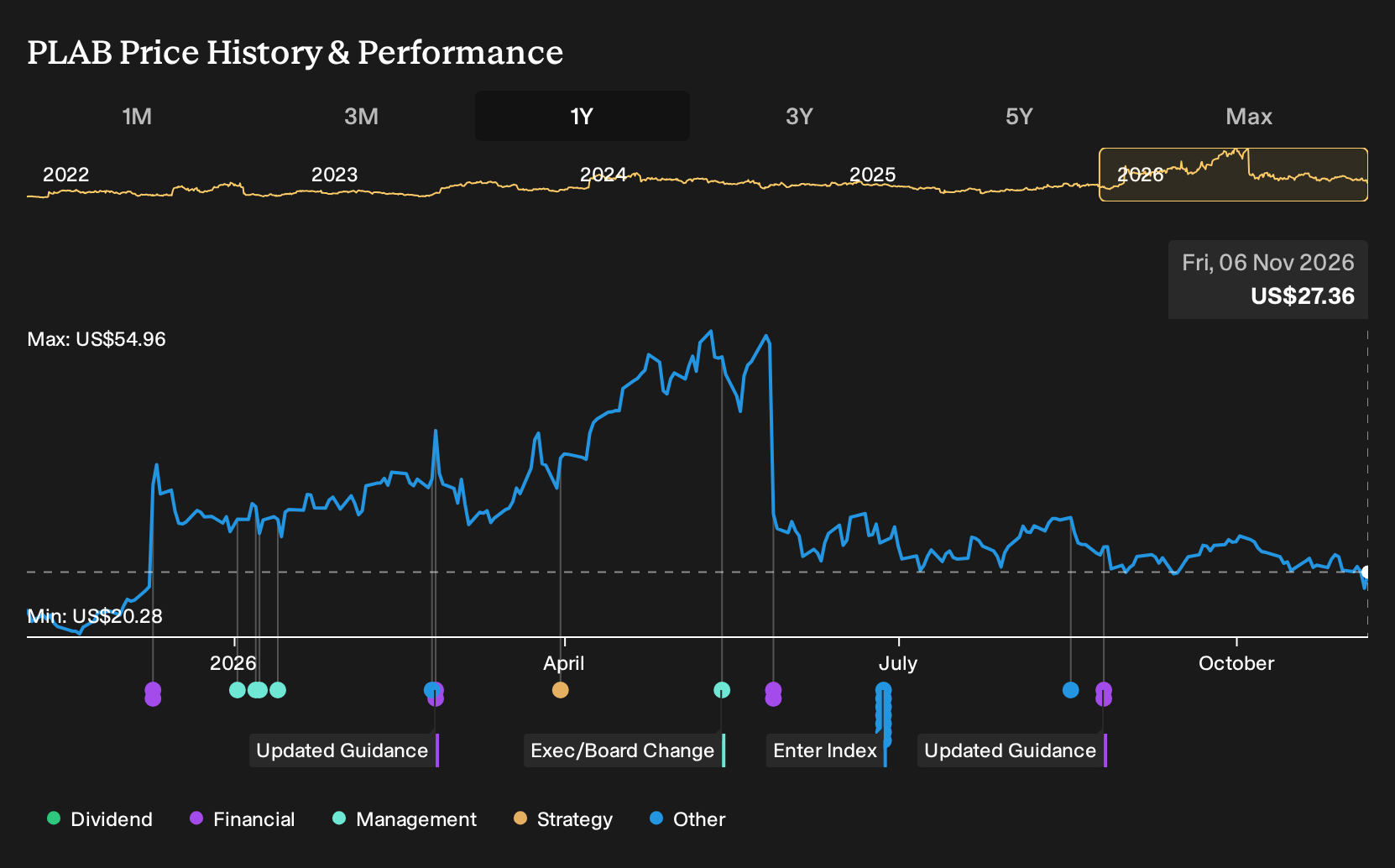
- Photronics recently faced sector driven pressure after political calls to halt AI data center development raised questions about future demand for high performance semiconductor related components.
- The reaction highlights how closely Photronics's photomask demand is linked to broader AI infrastructure spending, even though the company does not build data centers itself.
- We will look at how Photronics's investment narrative holds up as political scrutiny of AI data center build outs intensifies.
Photronics Investment Narrative Recap
To own Photronics, you need to be comfortable with a photomask specialist that is spending heavily into future capacity while forecasts point to slower revenue growth of 3.8% a year and declining earnings over the next three years. The near term story is about whether that capex actually gets filled with high end IC and display work.
The AI data center headlines question part of that demand, but the core risk already on the table is a mismatch between this heavy spending and realized orders, especially after past IC revenue softness and guidance related volatility. If political pressure delays some AI projects, it mainly reinforces that execution and timing remain the key swing factors.
With no fresh company announcements directly tied to the AI data center debate, the most relevant milestones are still the previously flagged capacity projects. Management is pushing ahead with the Allen, Texas expansion and a Korea build out that are intended to support advanced nodes and regionalized manufacturing over fiscal 2026 to 2028.
For you, the link to today’s news is simple. Any slower AI related mask demand would put more pressure on those future tools to earn their keep through outsourced logic, DRAM and high value FPD work. The thesis now leans even more on execution at these new sites, capital discipline and how quickly customers shift complex masks to merchant suppliers like Photronics.
What The Photronics Forecasts Assume
Analysts sketch a future for Photronics that leans on measured growth rather than explosive expansion, which matters when you are weighing AI infrastructure exposure that could prove lumpy. Their models build in revenue rising by 3.8% each year over the next three years, alongside profit margins that are expected to move from 19.0% today to 10.8% by around 2029 as new fabs and tools are absorbed.
On current estimates, earnings today are about US$165.1 million and the consensus points to US$104.4 million of profit by the 2029 financial year. That is a decline of roughly US$60.7 million, so the scenario being priced into some models is one where Photronics runs a larger, more advanced footprint at a lower profit pool than it generates now.
Photronics' narrative projects US$968.4 million of revenue and US$104.4 million of earnings by 2029. This requires 3.8% yearly revenue growth and an earnings decrease of about US$60.7 million from current earnings of US$165.1 million.
Those same reports anchor a consensus price target of US$41.33 per share on a 2029 earnings base of US$104.4 million. This would equate to a P/E ratio of 32.1x using the analysts' discount rates. The implied multiple is well below the 52.4x level cited for the broader US semiconductor group, yet well above the 11.3x P/E applied to Photronics today, so you are being asked to accept both lower earnings and a richer earnings multiple in the years ahead.
For AI focused investors, the key link back to the current data center debate is clear. If AI related mask demand slows or proves choppier than hoped, this kind of earnings path leaves less room for error on those big capacity projects in Allen and Korea, since the valuation case already assumes Photronics can hold investor confidence while earnings trend below today's level.
Uncover why Photronics' fair value indicates a 51% potential upside to its current price, which could narrow quickly.
Exploring Other Perspectives
Two fair value estimates from the Simply Wall St Community cluster between US$33.50 and US$41.33, so you are seeing a fairly tight band rather than outlier calls. Those views pre date the recent AI data center driven sell off. The gap between heavy capex plans and sector wide volatility means you benefit from checking several alternative opinions before deciding how Photronics fits into your portfolio.
Explore another Photronics fair value estimate, including one that suggests it could be worth just $33.50!
The Verdict Is Yours
Disagree with existing narratives? Extraordinary investment returns rarely come from following the herd, so go with your instincts.
- A great starting point for your Photronics research is our analysis highlighting 4 key rewards and 2 important warning signs that could impact your investment decision.
- See our latest analysis for Photronics. The report includes a comprehensive fundamental analysis summarized in a single visual, the Snowflake, making it easy to evaluate Photronics' overall financial health at a glance.
Looking For More Ideas Beyond Photronics?
Once you have formed a view on Photronics, it can help to line it up against other opportunities that suit different risk levels, income needs, or balance sheet profiles. The Simply Wall St Screener lets you quickly filter for stocks that match what you care about most, instead of scrolling through tickers one by one.
- If you want potential value with stronger fundamentals behind it, take a look at our 39 high quality undervalued stocks that combine quality metrics with discounted pricing.
- For readers who care about resilience first and returns second, you can filter for a 29 resilient stocks with low risk scores that may better match a capital preservation mindset.
- Those hunting for opportunities with healthier finances can focus on companies from the list of solid balance sheet and fundamentals (24 results) to compare Photronics with peers that have robust balance sheets.
Have feedback on this article? Concerned about the content? Get in touch with us directly. Alternatively, email editorial-team@simplywallst.com