


Netflix (NFLX) just posted quarterly results that combined higher membership, pricing moves, and growing advertising activity, alongside a 34.6% operating margin, and it set plans to broaden its ad-supported tier and live sports offerings.
Netflix shares have been volatile around these results, with the 1-day share price return down 3.28% and the 30-day share price return down 9.02%. The 3-year total shareholder return of 41.78% still points to longer term momentum that has cooled recently as investors reassess growth potential and risk after a 30.31% year to date share price decline.
Scan beyond Netflix and see how other large media and tech players are priced by filtering for 39 high quality undervalued stocks with resilient balance sheets and solid cash generation profiles.
After a 30% year to date slide in Netflix, the tension now is simple: Is the stronger margin profile and new ad and live sports push still underappreciated, or has most of the rerating already happened in the past three years?
Most Popular Narrative: 22.7% Undervalued
The most followed narrative on Simply Wall St places Netflix's fair value at $82 per share, compared with the latest close at $63.41. That gap anchors a view that the current share price does not fully reflect the cash generation investors see in the model.
Netflix is no longer being debated as a broken streaming story. The real debate now is subtler: has it already done enough to justify the valuation, or is the market still underestimating how durable the cash flow model has become?
See why 146 investors see Netflix as 23% undervalued.
According to Ivoed, the narrative hinges on Netflix evolving from a pure scale play into a cash machine, with buybacks and monetisation doing more of the heavy lifting than raw subscriber additions. The thesis leans on revenue of $49.7b, net income of $14.8b, and a profit margin above 28% as evidence that the current business profile already supports a premium, while still leaving room if advertising and pricing deepen free cash flow over time.
That same narrative is not blindly bullish. It describes Netflix as a "high-quality, cash-generative business" but closer to fair value than a clear bargain, with the upside case depending on whether ads, live content and broader monetisation truly shift the free cash flow curve rather than just keeping the story exciting. In other words, the gap between $63.41 and the $82 fair value reflects confidence in durability, with some caution about how much extra free cash flow the next initiatives will actually deliver.
Result: Fair Value of $82 (UNDERVALUED)
Still, the narrative can crack if Netflix struggles to turn advertising into meaningful cash flow, or if live content spending pressures that 34.6% operating margin.
Find out about the key risks to this Netflix narrative.
Another View: Netflix Through The P/E Lens
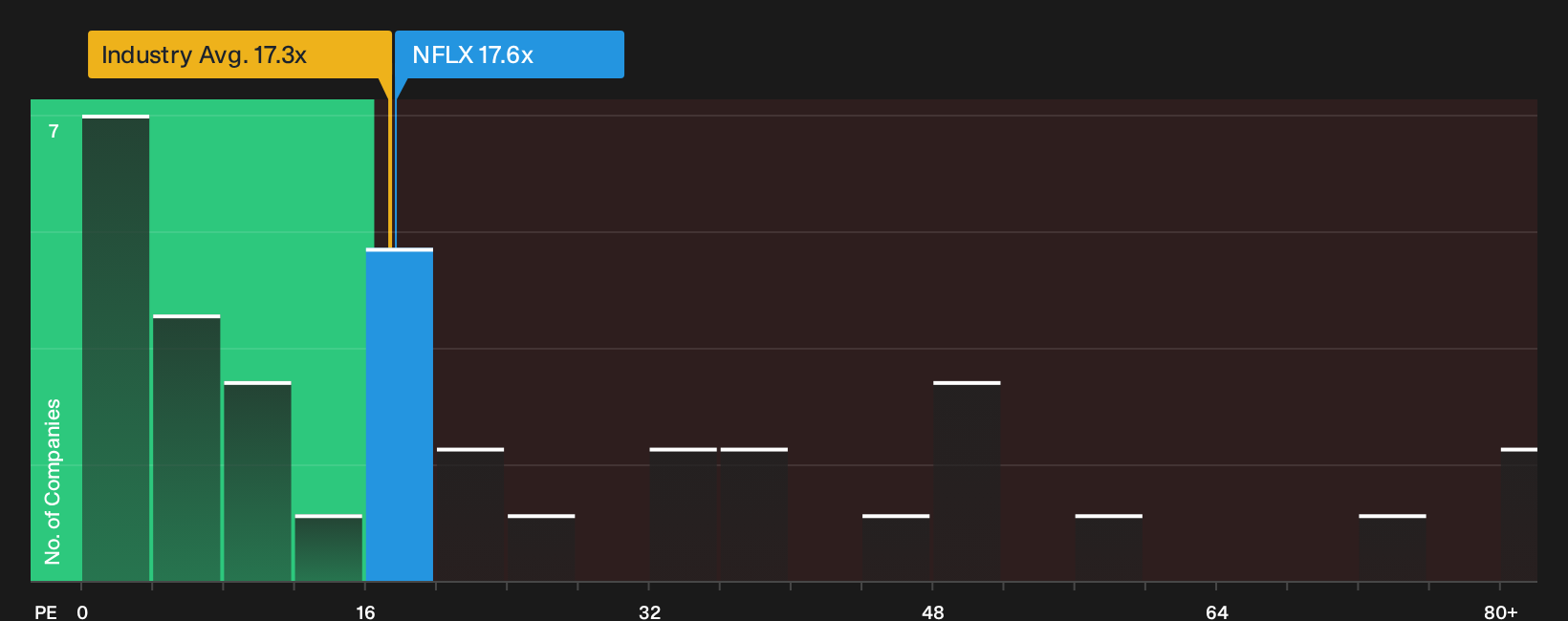
There is a different read when you look at Netflix through P/E ratios instead of cash flow models. The stock trades at 17.6x earnings, slightly richer than the US Entertainment industry at 17.3x, yet far below a peer average of 45.7x and a fair ratio estimate of 26.8x. That mix of small premium to the sector but big gap to the fair ratio suggests either a cushion if the story cools further or missed upside if earnings hold up.
For investors weighing that trade off, the question is simple. Is this modest P/E premium enough compensation for the risk that Netflix continues to be priced more like the sector than the higher fair ratio implies, or is the discount telling you the market already priced in the best of the streaming story?
See what the numbers say about this price — find out in our valuation breakdown.
Next Steps
Mixed signals on Netflix valuation can feel messy, which is exactly why it helps to inspect the underlying data yourself and move quickly while sentiment is unsettled. To see what optimistic investors are focusing on, review the 3 key rewards.
Looking for more investment ideas beyond Netflix?
If you only stop at Netflix, you risk missing other setups that fit your style, your time horizon, and the kind of risk profile you actually want.
- Spot potential turnaround opportunities early by scanning 9 elite penny stocks with strong financials that combine smaller market caps with stronger underlying financials than the headline price suggests.
- Focus your energy on quality by zeroing in on a 29 resilient stocks with low risk scores that leans on resilient balance sheets and steadier business profiles.
- Hunt for fresh ideas by filtering through a 19 high quality undiscovered gems that highlights lesser known companies with solid fundamentals before they hit every watchlist.
Have feedback on this article? Concerned about the content? Get in touch with us directly. Alternatively, email editorial-team@simplywallst.com