


Introduction
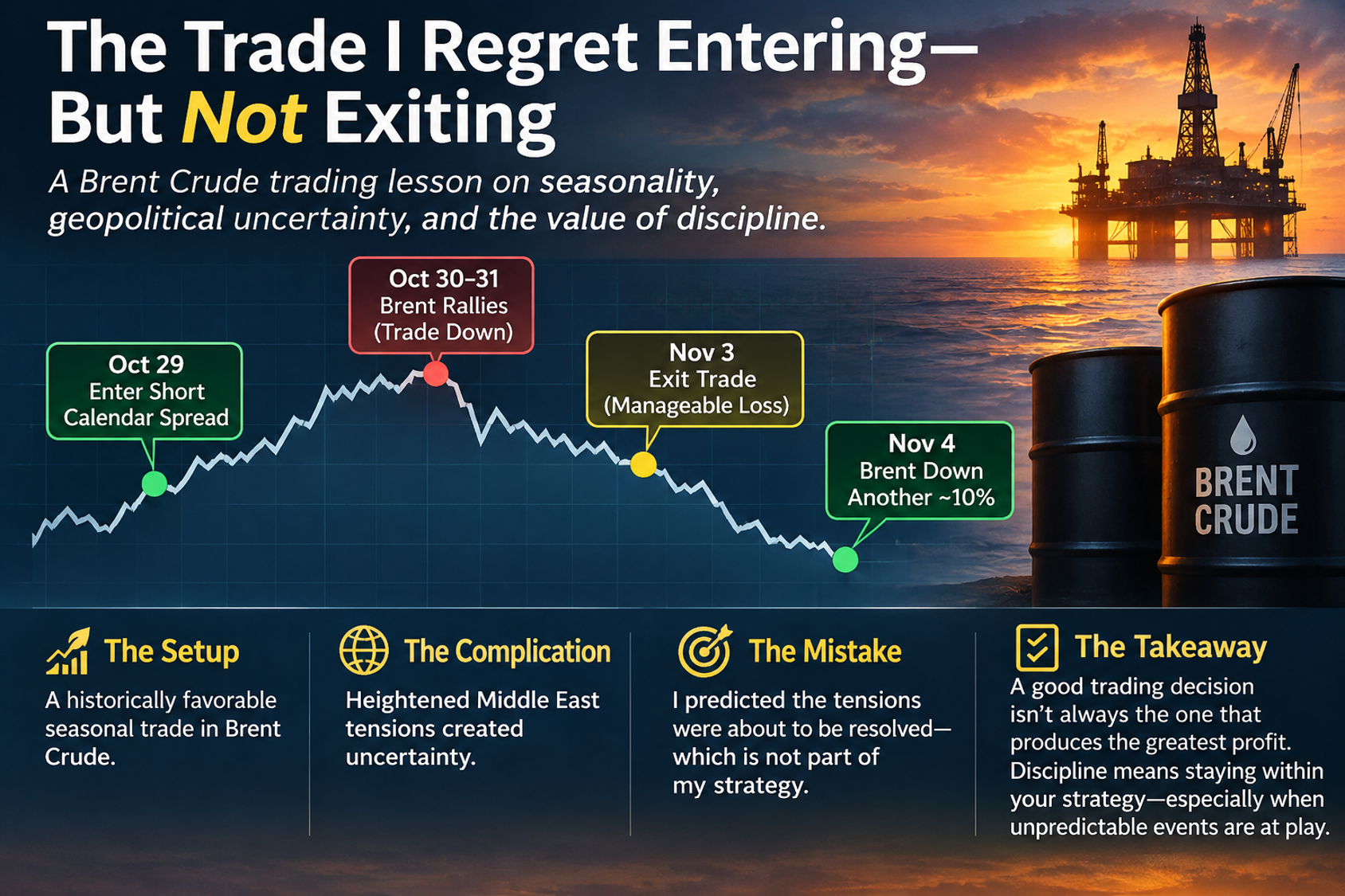
One of the hardest lessons in trading is recognizing that a good decision and a profitable outcome aren't necessarily the same. A recent Brent Crude trade reminded me of that principle. On Thursday, October 29, I entered a short Brent Crude calendar spread. A historically favorable seasonal window supported the trade, but a significant competing influence was geopolitical tensions in the Middle East. I recognized the conflict before entering the position. Nevertheless, I placed the trade. Almost immediately, I regretted it.
When Seasonality Meets Geopolitics
My Smart Spreads strategy is built around historical performance. I analyze seasonal tendencies, contract structures, entry timing, historical drawdowns, and other measurable characteristics to identify opportunities with favorable statistical profiles. The objective is not to predict tomorrow's commodity prices. It is to identify situations where historical behavior suggests a statistical advantage.
The Brent Crude spread appeared to offer such an opportunity. However, geopolitical tensions were creating considerable uncertainty in energy markets. Despite recognizing these risks, I convinced myself that tensions in the Middle East were about to be resolved, which would favor the trade. In doing so, I departed from the foundation of my strategy. Rather than relying exclusively on historical probabilities, I introduced a prediction about geopolitical developments that I had no reliable way to forecast or quantify. The problem wasn't that geopolitical pressures necessarily favored one market direction. They made the historical seasonal advantage less dependable.
Two Difficult Days and a Decision
On Thursday and Friday (October 29-30), Brent Crude rallied sharply, moving against my position. After just two holding days, the spread had accumulated a meaningful loss. The loss was uncomfortable, but my greater concern was recognizing that I had ventured beyond the foundation of my strategy. My expertise lies in identifying opportunities supported by historical statistical patterns, not predicting when geopolitical tensions in the Middle East might be resolved. That type of forecasting is not in my wheelhouse.
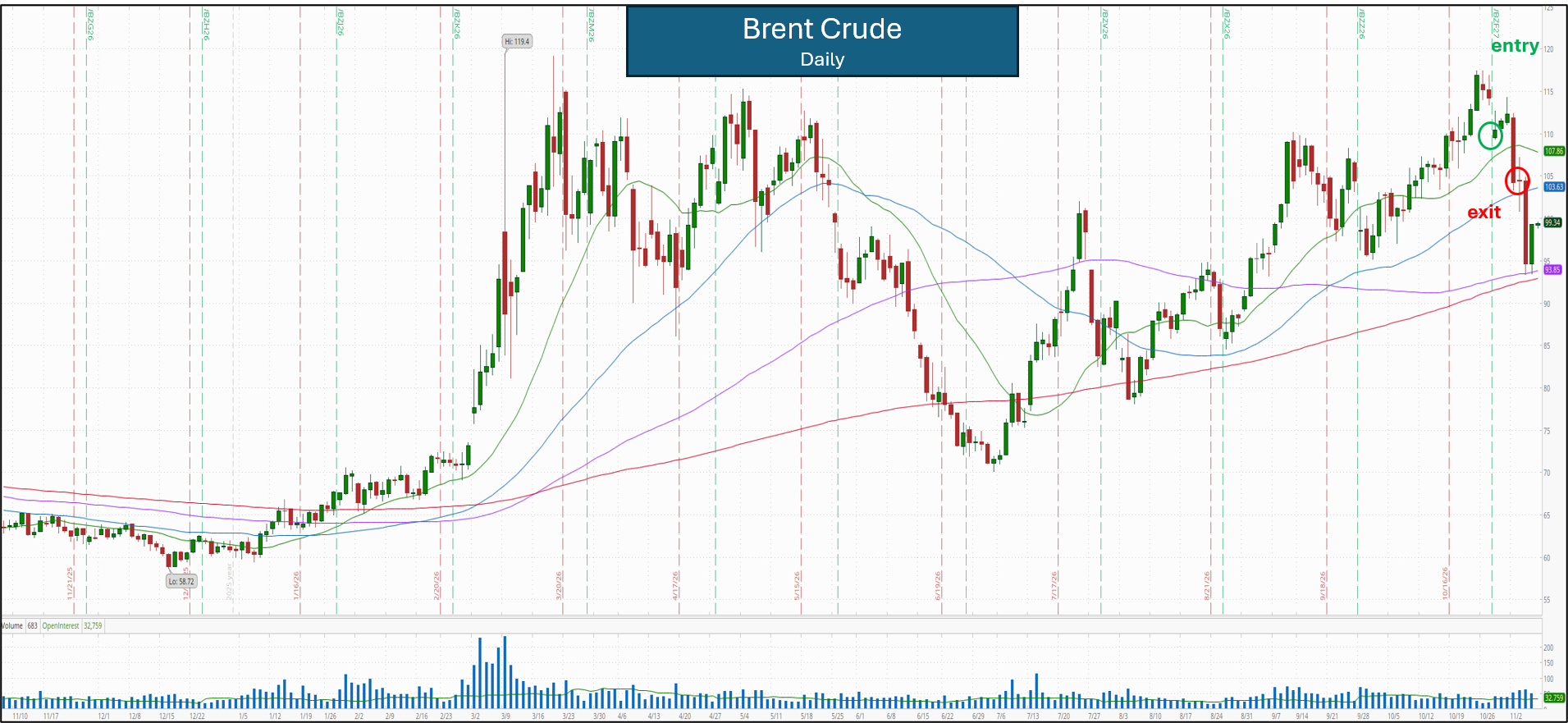
By Monday, I had decided to exit. Rather than closing immediately, I waited for a bounce-back to reduce the loss. Fortunately, Brent Crude declined over 7%, allowing me to close the position with a gain. I was relieved to be out of the trade and believed I had made the correct decision.
Then Came Wednesday
Following the election, Brent Crude declined another approximately 9%. Suddenly, the position I had exited just a day earlier might have produced a considerably better outcome. After enduring the initial drawdown, I had exited just before another substantial move in my favor. But after reflecting on the experience, I reached a conclusion that may seem counterintuitive. I still believe exiting was the right decision.
Historical Probability Versus Unpredictable Events
The distinction comes down to what my strategy is designed to accomplish. Smart Spreads relies on recurring historical patterns to identify opportunities with measurable statistical advantages. Those advantages aren't guarantees, but they provide a framework for consistent trading decisions.
Geopolitical developments are fundamentally different. Military escalation, diplomatic breakthroughs, political announcements, or unexpected election results can dramatically alter market expectations. You can't reliably predict their timing, magnitude, or consequences from historical seasonal patterns.
A Good Trade Versus a Good Outcome
It is tempting to judge trading decisions entirely by their financial results. A profitable trade must have been a good decision, while a losing trade must have been a mistake. But that reasoning overlooks uncertainty. A poorly justified trade can generate an excellent profit. A well-supported trade can produce a loss. Neither outcome establishes the quality of the decision.
The more important question is whether the trade followed a repeatable process. In this case, I believe my mistake occurred at entry. I recognized that geopolitical uncertainty could overwhelm the seasonal advantage but entered anyway. Once I concluded that the trade no longer fit comfortably within my strategy, exiting was appropriate. I would rather accept a manageable loss while following a disciplined process than earn a larger profit by relying on an unpredictable event. That distinction matters over hundreds of trades.
Additional Details
Dual Edge Research publishes 2 weekly newsletters offered at one low price:
- The Bull Strangle Newsletter focuses on stocks and options, combining stock ownership with disciplined option-selling techniques designed to generate consistent income while managing risk.
- The Smart Spreads Newsletter focuses on seasonal commodity spreads, a historically proven approach that seeks opportunities across agricultural, energy, metal, and financial futures markets.
Each strategy is designed to stand on its own, but together they provide a diversified approach that can perform across a wide range of market environments. For traders looking to deepen their education, The Bull Strangle Strategy and Trading Commodity Spreads are both available on Amazon.
Visit BullStrangle.com to subscribe for just $1 for the first month.
For a video overview of the Bull Strangle Newsletter
For a video overview of the Smart Spreads Newsletter
Darren Carlat
Dual Edge Research
(214) 636-3133
DualEdgeResearch@gmail.com
Disclaimer
This information is for informational purposes only and should not be considered investment advice. Past performance is not indicative of future results, and all investments carry inherent risk. Consult with a financial advisor before making any investment decisions.