


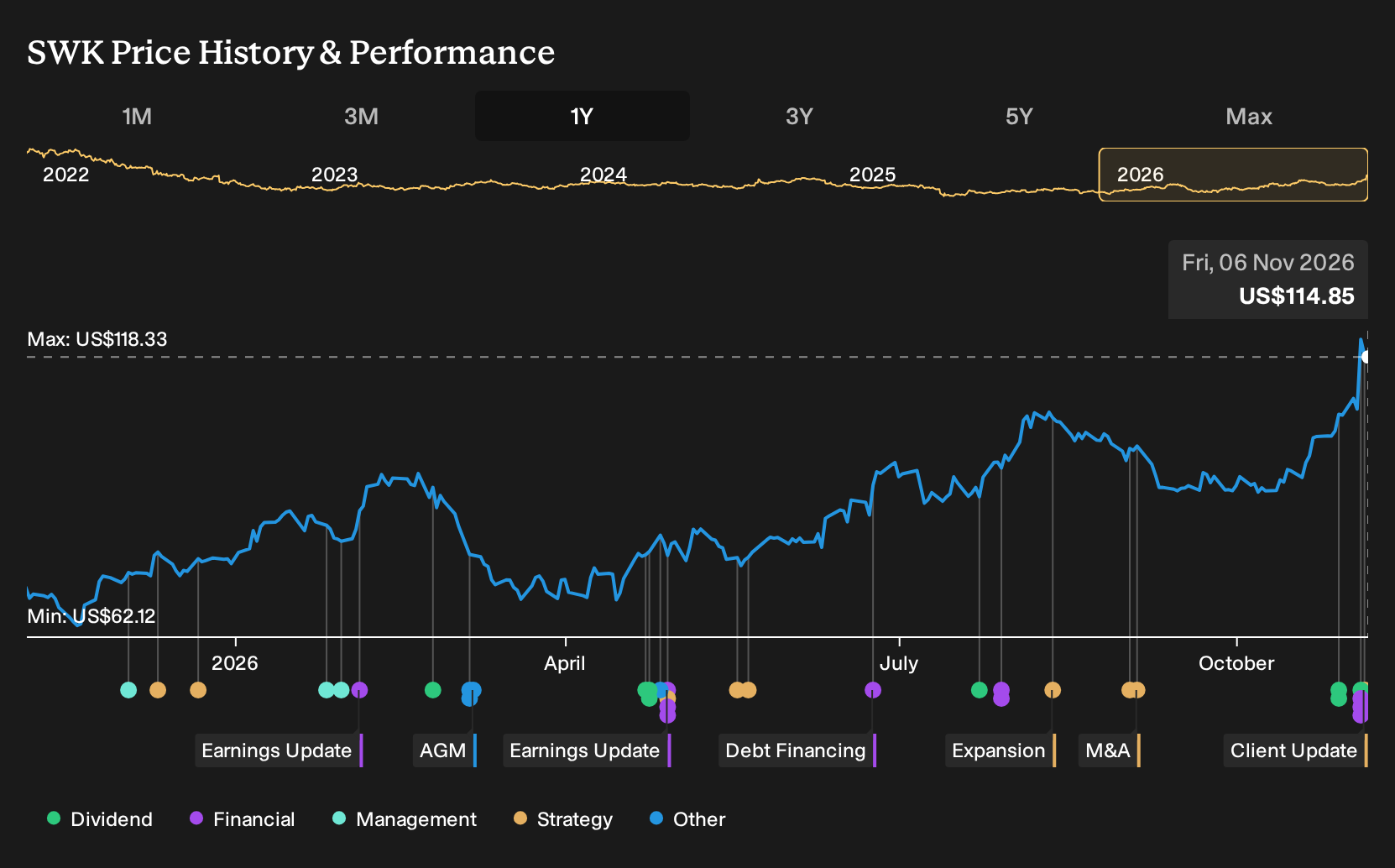
- Stanley Black & Decker reported third quarter 2026 sales of US$3,731.6 million with net income of US$272.1 million and raised its full year 2026 GAAP EPS guidance to US$5.45 to US$5.85, while confirming a new US$1b share repurchase authorization and ongoing dividend payments.
- The business coupled stronger profitability and higher earnings guidance with active capital returns through completed buybacks, a fresh repurchase plan and a maintained US$0.84 quarterly dividend, signaling a continued focus on shareholder distributions alongside operational execution.
- We will now look at how Stanley Black & Decker's raised earnings guidance could reshape the existing investment narrative around margin progress.
See how Stanley Black & Decker’s capital returns and changes in earnings compare with other companies returning cash to shareholders through 8 dividend fortresses.
Stanley Black & Decker Investment Narrative Recap
For an investor to stay with Stanley Black & Decker, the core belief is that the margin program and tools centric portfolio can keep turning recent earnings progress into something more durable, even if top line expansion remains modest. The raised 2026 GAAP EPS range frames that story, but the main near term swing factor is still execution on cost and footprint changes.
The biggest operational risk remains a mix skewed to softer DIY and Outdoor demand, coupled with execution challenges as underperforming facilities are consolidated. The Anchanto powered omnichannel rollout in South Korea looks helpful for international growth and higher value services, but on its own it does not materially change the central margin and demand equation yet.
The most directly relevant move to watch beside earnings guidance is the new US$1b share repurchase authorization, coming after Stanley Black & Decker completed roughly US$500m of buybacks under the April 2026 program. That sits alongside an ongoing US$0.84 quarterly dividend and raised free cash flow guidance. Together, these point to a busy capital allocation agenda.
For you as a shareholder, the question is how this fresh buyback capacity interacts with the need to keep chipping away at a relatively high debt load while funding supply chain and product platform work. Capital returns can support per share metrics when earnings are growing. However, if demand in tools or Outdoor softens again, balance sheet flexibility and the legal overhang from the securities class action become more important catalysts to monitor than the pace of repurchases.
Stanley Black & Decker’s current analyst story points to revenues of US$16.3b and earnings of US$1.1b by 2029, based on assumed yearly revenue growth of 2.2% and an earnings increase of about US$479.5m from US$620.5m today.
Uncover why Stanley Black & Decker's fair value indicates a 13% potential downside to its current price, leaving little room for error.
Exploring Other Perspectives
The biggest contrast comes from how you treat demand risk. Some of the lowest Stanley Black & Decker forecasts assumed revenue of about US$15.6b by 2029 and earnings of roughly US$1.1b, even before this guidance hike and omnichannel push in South Korea. Those analysts paint a more cautious picture. That gap shows how widely opinions can differ, so it can help to explore several viewpoints before deciding what this new information might mean for you.
Explore 3 other Stanley Black & Decker fair value estimates, including one that suggests as much as 22% downside from the current price!
Form Your Own Verdict
Don't just follow the ticker; dig into the data and build a conviction that's truly your own.
- A great starting point for your Stanley Black & Decker research is our analysis highlighting 5 key rewards and 2 important warning signs that could impact your investment decision.
- See our latest analysis for Stanley Black & Decker. The report includes a comprehensive fundamental analysis summarized in a single visual, the Snowflake, making it easy to evaluate Stanley Black & Decker's overall financial health at a glance.
Looking For More Investment Ideas Beyond Stanley Black & Decker?
If you want to cross check Stanley Black & Decker against other opportunities, the Simply Wall St Screener can help you quickly surface stocks that fit different risk and return profiles so you are not relying on a single story.
- For investors who want quality and value to line up, consider using our tool to uncover 39 high quality undervalued stocks that pair solid fundamentals with more modest valuations.
- If capital preservation and steadier profiles matter most to you, filter for 29 resilient stocks with low risk scores that may better match a cautious approach.
- When you are hunting for under the radar ideas with stronger balance sheets and earnings power, cast a wider net with a curated set of 19 high quality undiscovered gems that might not yet be on everyone’s screen.
Have feedback on this article? Concerned about the content? Get in touch with us directly. Alternatively, email editorial-team@simplywallst.com